Value averaging Investment Plans (VIP) – Part II

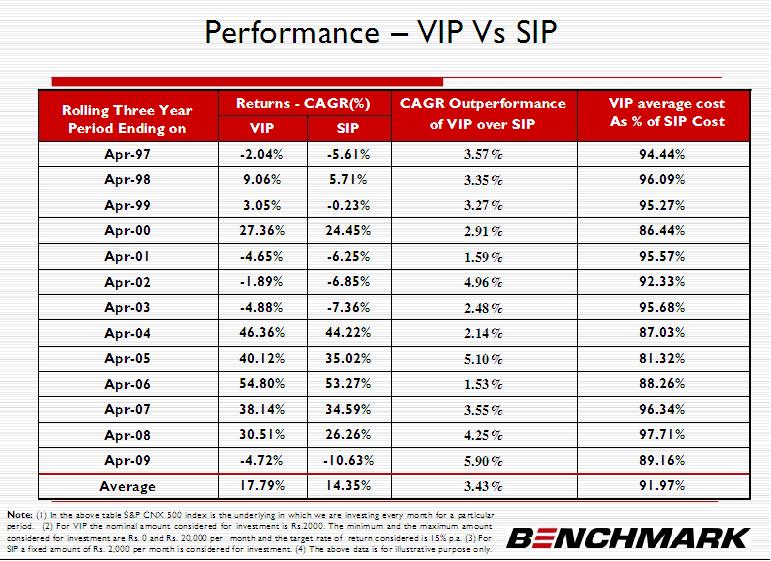
In a paper titled, “A Statistical Comparison of Dollar-Cost Averaging and Purely Random Investing Techniques,” which appeared in the Journal of Financial & Strategic Decision Making (1994), Marshall and Baldwin investigated market data to address a much deep seated premise: Does DCA (or Rupee Cost Averaging, in our context) really yield superior investment performance compared to a purely random investment technique?” They found, with a 99% confidence, that there is no statistical difference in the Internal Rates of Return (IRR) achieved by the former technique. In other words, rupee cost averaging (brought about by setting in a Systematic Investment Plan (SIP) ) is not superior to random investing. Note the word ‘random’ here. I had written in my previous post on the subject about how asset management companies make an extra effort to sell the SIP route of entry into the markets (via Mutual Funds). Wealth managers too espouse the benefits of SIP since they must be receiving a larger commission for locking in a nice stream of cash inflow for their suppliers (the asset management companies). Well, this particular study clearly does not make SIPs to be an automatic choice for the financially astute. Like the promotional material from the Benchmark Mutual Fund house, the other paper from Marshall titled, “A Statistical Comparison of Value Averaging vs. Dollar Cost Averaging and Random Investment Techniques” also throws up data tables and charts which indicate that VIP scores above SIP, consistently and always. The table alongside (click to enlarge) is from Marshall’s paper on the subject and it shows that the average acquisition cost of shares is always lower in the case of value averaging. Three scenarios were considered for analysis – rising, declining and fluctuating market.

VIP is like those arcade video games which are now distributed as freeware where in one instance you’re flying a helicopter through a rather long undulating tunnel with assorted obstacles in the path. If the chopper is rising, ease up on the throttle else it’ll crash into the roof of the tunnel. If it’s falling then press the throttle well lest it crash to the floor of the tunnel. So, while this analogy is weak, it perhaps visually brings out the problem that I see with value averaging. I guess it forces one to operate in a range. In the arcade game, the chances of your chopper travelling the farthest and therefore reaching the end of a particular level is highest if one manoeuvres it successfully through multiple escalating and de-escalating sinusoidal paths. Similarly, the returns from value averaging come in best when you let the scheme run through at least a couple of up and down market cycles. If the market rises for a good long period in an upward channel then this technique will definitely trump the plain jane SIP option. However, if the investment horizon is smaller – say 1 – 2 years and the market keeps continuously rising, I am not sure if a VIP will give the best returns (as compared to a buy and hold).

The other point is the fairly active monitoring that needs to be done. It clearly is not an option for the masses and even for the nerds who fancy taking this on, this may lead to deliverance. The jury may be out regarding my nerd status but my thinking in this is that if I have to benefit from a systematic investing method which guarantees a low cost of acquisition and requires fairly active monitoring – is there something that I can improvise and build from the scratch. Never mind if countless other nerds may have hit upon the method themselves and written and practised it. That is something I want to develop and write about in my concluding post on VIP. My main aversion to the VIP plans as they now stand in India is that I might have to do a fair amount of running around with banks, fund houses, payment instructions etc. Given the prospect of an escalating workload and a need to find a good long term occupation for my funds I need something which might be equally (if not more) high touch to evaluate but low touch to execute. I have an idea forming – should come out soon.
Value averaging Investment Plans (VIP) – Part I

Some days back a colleague alerted me to the existence of VIPs as being a better and smarter alternative to the Systematic Investment Plans (SIPs) offered by mutual funds. Mutual fund houses push the SIPs a lot. The benefits touted are that average investors are not adept at timing the market and therefore a rupee cost averaging approach provides a measured entry into the equity markets. The obvious benefit to the fund houses is that they lock in a steady stream of investments. Almost every interview of a asset management company official nudges investors towards the SIP method of investing. The premise being that average invstors are scared of the riskiness of investing in equity markets. I don’t feel that SIPs greatly reduce the risk in invetsing but yes, they do nudge it down a peg or two.

VIPs are considered to be an improvement to SIPs in that instead of rupee averaging, they average out the “portfolio value” such that the inflows into a VIP scheme get adjusted based on the performance of the portfolio. A target rate of return is fixed at the outset (say 15%) so is the monthly level of investment into the fund. A 15% return is the same as a sequential  increase of 1.25% in the portfolio value. So, what VIP does is that if in a month, the portfolio performance is greater than 1.25%, the 2nd month’s investment installement is reduced to the extent that 2nd month’s goal is already met. In case if the underlying drops in value in the 1st month, and the 1st month’s return is less than 1.25% then this shortfall is added to the 2nd month’s installment to make up for the loss. And so on for the subsequent months.  

So, Monthly Investment Amount = Target portfolio value – Actual portfolio value.

Investors get to specify a maximum limit on each monthly investment. Benchmark mutual fund has one such scheme in the market since mid 2009. Now, the NIFTY has climbed up from 4,000 level to 6,000 during the past 18 months. I wonder how this investment option into this scheme of theirs has fared (Benchmark S & P CNX 500 Fund) during this period. For sure, SIP option would have fared worse since inVIP, the investor can ‘choose’ to annul his monthly investment in case the market is rising like there is no tomorrow but a SIP is a series of post dated cheques signed by you. Marketing material from Benchmark suggests that every 3 year rolling period from April ’97 to April ’09 sees the VIP option beat the SIP one. Click on the picture of the table to magnify.

The VIP concept is fairly easy to understand but I am not sure it works for me, if I look at how the market has behaved in the past 18 months. If the market is to zig zag and oscillate in a bad for the next year whilst maintaing a modest upward bias, then this option will shine, I guess. I am not saying that indexing does not work in India. Many people who shun indexing aver that the Indian markets are ‘inefficient’ and that good fund managers will outperform indices consistently – which I obvisouly do not agree with. But I suspect that a DIY approach can work better for me. One good thing about the scheme run by Benchmark Fund is that does give investors an option to choose their target rate of return. If that facility was there, I am sure many investors would have chosen a target return greater than 15% and ended up straining their cash flows. That’s one dichotomy here – the marketing material from Benchmark stresses on the point that it is simple to understand – that is inserted there to win as many small ‘uns as possible. While, it may be simple to understand, it is definitely high touch for the investors. Cash outflows are not fixed and it does require active management on part of the investors. It is perhaps for this reason (customisation of monthly investment limits) that this option is not available through online share trading websites (I use Icicidirect’s). I don’t have time to run around cutting cheques or giving ECS instructions, etc so that puts me off. Certainly not on my ‘active funds’

I have been thinking of setting up two streams of investments for each of my two kids and might think of this thing there. I do not want to do any active investment management there and the horizon is definitely 10+ years. That brings me to the other important point about the VIP from Benchmark – I feel that the real value of VIP would come out when the investment is held across a couple of market cycles. A couple of bull and bear runs would make VIP stand out. The Benchmark scheme does not charge an exit load for withdrawals after a year and that to me might tempt many to actually redeem after the 12 months are up. Something like the temptation to sell a share that you are holding as soon as 12 months are up since no taxes would then apply. When I say VIP, I may not necessarily go after the Benchmark’s VIP option. I might do a DIY using an Exchange Traded Fund (ETF) using quarterly rolls instead of monthly rests. I need to work out how the schematic will work but it will most certainly be an ETF since these cost less and might post about what I decided. So, a second “installment” of VIP is in order!

Structured Equity Products

First things first – daughter gets through the national round of the spelling bee that was held in Kolkata. International round is next.

Yesterday, someone asked me to analyse a structured equity product which the wealth management group of a well known private bank had pushed for his consideration and possible investment. This was a “structured” equity linked debenture with a pay-out in the form of a knock out barrier option. If I have not lost you yet and if you aren’t KO’d, you may want to take a peep at the term sheet here. In a nutshell, what this instrument is saying is that it’ll pay you regardless of the NIFTY tanking down. If on any of the predefined monthly observation dates, the NIFTY breaches a preset barrier, then a knock out event would have happened and investors will get a fixed return of 27.5% for 24 months.  This is equivalent to investing in a fixed income instrument (bond) that gives an annual return of 11.4%. Note that with QE2, and a new wave of cheap US money expected to flood our markets the chances of the barrier getting knocked out in the short term remains extremely high. so then all that this means is that you are holding a pure fixed income instrument. The hastily scribbled payoff diagram above tries to show what I think this gives us.

“Structured” equity notes seems to be an INR 15,000 crore industry having been introduced only 4 years back in the Indian market. These class of products are quite popular in Asia and with increasing volatility expected due to increasing wads of hot money coming down to Asia, the popularity of such instruments should grow. That is really a problem since it does not seem cool to buy these things. Why? Because these are just plain and simple fixed income instruments at heart masquerading as sexy and exotic equity junkets. The annual yield of 11.4% really does not look quite cool when one considers A) the prospect of interest rates rising locally as the RBI grapples to control inflation and B) the management fee of 2 – 2.5% that such structures entail. Just 9% after taking out the fees. Also, this is not risk free for it entails taking on the credit risk of the issuer. There is no liquidity as well so the managers of such structures do not have much of a duration risk to manage – so what for this 2 – 2.5% fee? That fee, really is to justify the enormous amount of finacial acumen and spreadsheet crunching calculations that goes under anything that swishes using guiles like “structured”, “Knock Out”, “Barrier”, “Participation” etc. Investors who put their money behind such ventures must be feeling really hep and smart about themselves. Imagine having protected your capital (ok, not all of it, 97.5% perhaps 🙂 ) and also participating in the run up of NIFTY. Wouldn’t such males love to brag about it to whoever cares to listen – if some female ears patronise their trumpeting, then all the better! I don’t think I’m stretching the issue – do a random survey, I can bet my widgets that the proportion of investing females that pick up this product would be far lesser than the proportion of investing males that do the same.

SEBI made capital protection on such instruments mandatory some time back, so that lends some saving grace for such macho investors. Thankfully, most ticket sizes (i.e. face value of such debentures/notes) are 1 lakh plus so that means that macho men of modest means will not be able to participate here. Which is good, but then there was this CIO of an asset management house making a case for peddling this for an investment level as low as INR 5000! Wow! That makes it a mass market structured kill! That was from an article that was published in early 2008. In fact the more noise about such products more are the chances that we might be nearing really overbought market levels.  The point behind introducing a sexist angle to this barrier is simply to make a strong point in favour of restricting investing to products and asset classes that one understands. I know most of you would agree that there is nothing hep or cool about buying such notes, but I also do know that if some of you did buy it under whatever compomising situations then a part of you would trumpet. Avoid that. The process of amassing wealth through investing is utterly boring and almost emasculated, if I daresay.

The latent desire that such products seek to serve still needs addressing though. You have a section of the HNI/well heeled type of investors who get edgy whenever the benchmarks seem like peaking up and there is an increase in volatility. The psychological weightage that such investors apply to the act of capital preservation becomes higher. Which is again correct. But I kind of disagree in getting blindsided by the hype around these products and only using such notes to achieve that end. 9% return. Investors would be better off buying a high rated bond (of similar maturity)directly. Picking up a balanced mutual fund might require active monitoring of the fund managers’ actions (since a rising market might invoke some managers’ to increase their allocation to equity in a balanced fund making the risk – reward ratio lean towards the risk side). If you must do something whacky, then take a look at the crude payoff diagram of this structure that I have shown above. What base building blocks can be combined to create something similar to this?

An option strategy called the bull call spread, where one buys an at the money call and simltaneously sells an out of money call at a strike that is around the participation rate of the above structure should achieve a similar payoff. The quantity of options should be scaled up depending on the participation rate of the structure. The net premium paid will be one part of your investment. The balance can be put to work by buying a simple fixed income instrument. And you are home – your manliness intact (if that matters to you!). The hitch here could be finding long dated options – most of you would be using common online trading screens of retail brokerages and the max that you’ll get is a quarter’s look forward. This is something I have not explored myself but what I suggest is that next time your banks’ investment planner or relationship manager calls you, instead of finding an excuse and disconnecting ask that person to give you quotes (i.e. premiums) if you were to purchase/sell long dated options of NIFTY. The premiums would be high, no doubt – but I don’t even know how high. So, it’s a line that at least I am waiting to pick up. Will the bank really negotiate hard for me and try to find me a good deal? Will my notional be high enough for anyone to be really interested in? Does my bank have a prop trading arm where they are be a counterparty to my macho designs? I don’t know the answers to any of these questions – but yes, I am interested in long dated index options, if cost effective.

When to Sell – Part Two

In my post titled Portrait of a Portfolio, I had talked about my conscious shift towards a higher frequency of trading since the start of this calendar year. A lot many informed voices were then pointing out to increasing choppiness and therefore the need to be nimble and hit the right spots in terms of stock selection. The standard ham was “India is a growth and domestic consumpition driven story – long term trajectory remains upwards – but there is a lot of pain in the international markets – higher volatility is expected – cannot predict what the market will do by end of 2010 but stock specific action will abound”. Since I personally agreed to this prognosis and also since a relatively high frequency style of trading/investing suits my personality, I applied this mantra not just to that Portfolio I talked about on 7Oct’10, but to the entire block of personal capital that I ‘play’ with.

A natural consequence of the rapid churing out of my positions is a sharp reduction in the average holding period of my trade positions. These days I have been holding my positions for an average of 45 – 60 days only! This is in stark contrast to the 500+ days positions I normally used to have prior to the crash of the previous year. So, as part of the ongoing effort to gather insights on the best method of selling out, I tried to look at the relation between the returns that I have earned and the time I have spent in nurturing my trades. I took all the 306 odd closed trades that I have on me since May’03 and tried to stack up the (weighted) average returns across the corresponding holding period in calendar days. The chart shown on the right is what came about. The picture in inset shows the same chart with the full range of the y-axis (representing % returns) – I could not resist blowing my trumpet on the 18 bagger investment of mine which I held on for a good 978 calendar days. It was not a black swan – though it is an outlier on the chart – there was logic and conviction backing that trade all the way. I really don’t know if it’s just poor me or even other market players are currently feeling that the age of finding such skyscrapers has passed us by. Anyways, the main body of the chart is squeezed into a narrower vertical range to bring out more detail on the other trades.

Some interesting observations and takeaways come about. I guess, some of these might be applicable to you as well since like it or not us amateurs seem to be cut from the same cloth:

  1. There is clearly no optimum holding period, but in the past 7 years or so the longer term holds win. They have the potential to compound much faster than the market. I spent a few minutes trying to isolate the high yielding tenures and checking if some logical pattern applies to the number of these days. Fibonacci Series? Nope. Prime (numbers) days? No. Numerologically significant days? Absolutely not! What is abundantly clear (at least to me) is that longer the hold, better off you will be provided you keep monitoring and assessing the position every now and then. Personally for me that is a challenge. See, when I started investing, a 3 year time horizon represented 11% of my lifetime! For someone like a WB, a 3 year hold represents 3.75% of his lifetime. The concept of time, patience and maturity is different. However, I cannot wait to grow old to hold for longer time periods and therefore compoung well and high. Who’ll have the inclination to purchase a Ferrowatch at age of 80! And as Adam Smith said, “In the long run we are dead”. Therefore, for me another takeaway from this data representation, though oblique, is that invest when young but think like an octogenarian. A smattering of maturity ahead of one’s chronological age might be the most important thing – apart from luck.
  2. Then there is the importance of stop losses. As I mentioned in some of the previous posts, for an average investor like me, with a full day/late evening job it is impossible to pour over balance sheets, interview managements (ha ha), overlay companies’ prospects in the context of larger economy and all that ‘bull’. I am also not the kind of guy who will read a research report from a brokerage house to invest. Not for me the kind of consensus building investing that some kind of people prefer – call up a hundred contacts from your phone’s address book and bounce an investing idea off them – and if most agree, then invest. My phone’s address book is quite impoverished anyways. So I guess what works for me is a ruthless culling off of losing positions – regardless of the long term, hidden value spiel. As long as the general trend of the local economy is expansive I am cool. This inbuilt bias in equity markets to rise tells me that while such an edgy response to volatility/corrections may not result in the most optimal of returns I think I will make enough to take care of the added burden that transaction costs and taxes place on such behaviour. That’s what I am thinking right now – but remain open to change my view as I “mature”.
  3. One last point regaring the sea of red at longer holding periods. This is my personal example of loss avoidance – of ego triumphing over prudence. Of imprudent youth putting false hopes of a turnaround. An example is the “Stupid Mining Company” trade of mine – when price falls, you just don’t care if it falls another 20% – 30% more, right? How does it matter? A loss is a loss. It was at a particular level once, it will surely climb back and beyond, right? Well, try plotting your own personal chart like the one above – then ask yourself these questions again. The fear of booking a loss is something I think I have hopefully gotten over now. And one should know when to call it a day. While my personal data may not be representative, the reds are concerntrated towards the right of the chart. That’s poor management of capital indeed! I guess what I am implying is that a dud can be spotted in a year or two – it does not require more than that (even if you are the oldest, most “mature” value junkie) to pull out one’s precious capital and put it to work elsewhere.


Portrait of a Portfolio – I

I have been managing an equity portfolio for someone since the past 5 – 6 years. While the returns over the past 6 years or so have been just about acceptable (CAGR of 17%), not much advance planning went into it. Of course, I do spend a lot of time in assessing and worrying about the positions (mostly direct equity longs) but there were no targets or goals till the beginning of the current calendar year. I can be quite cavalier about my money and take risks and yet not lose an iota of sleep even if I end up deeply and irrevocably in red. I once remember dunking 50% of one of my annual bonuses on a stock only to see it dropping 80% in value in the months to come. That was some years back and I still flinch whenever I come across that company’s name again. I had done almost everything wrong in that trade. I now always keep a printout of the chart (see the grotesque graphic above) of that trade at hand to serve as a grim reminder. I’ve not repeated that mistake yet. A set of scathing and self berating doodles are annotated on the chart and a bit more mature post mortem occupies its place of pride in my trading journal.

But it was my money and I had no qualms in losing it. With someone else’s money however, the game is completely different. There is a lot of responsibility and fear when you realise that the person has reposed not just his/her funds, but his/her trust in you. I do not know if professional fund managers think like this. They should, in my opinion. Recently there was talk of allowing the National Pension Scheme (NPS) to invest a small portion of its funds in the equity markets. The logic is impeccable – domestic, sticky money can be routed to the ever hungry infrastructure sector and its reliance on Foreign Domestic Investment (FDI) can thus be reduced. Point to note being that the country has not done too well in terms of attracting FDI this year. The Foreign Institution Investments (FII) that have been propping up the local markets to dizzying heights are not the same as FDI. I think everyone agrees that there is a Schwarzenegger sized opportunity in India’s infrastructure sector. I guess obstinacy and arrogance have stalled that move. Or is it could be that a similar sense of heightened anxiety and responsibility over playing with the public’s money is keeping the boring pension funds away from the capital markets? Bull!

Coming back to this portfolio that I manage: the advent of 2010 saw all the stock market experts proclaim the new year to be range bound and choppy. All surprisingly chorused that stock specific action could not be ruled out however. Given the avalanche of such advise, I decided, for the first time to have a calendar year end target for the portfolio. The return expectations being very sensible (15% per annum), my target therefore is to grow the portfolio by 17.65% between the period 1Jan’10 to 31Dec’10. Given the range bound prognosis of the local experts, I realised that frequent trading by booking short term gains and doing this a multiple times over will be key to reaching the target. Since we pay 15% as short term capital gains tax on equity profits, the 15% target was scaled up to 17.65%. This translates to a tiny 1.364% per month. Easy? That’s what you think! Not my experience really. Brokerage charges were not considered – but these would be offset by the fact that there would be some (non taxable) long term gains and that the effective tax outgo would be less than 15% of the net gain since some interim short term losses would certainly be available to set off against a part of the short term gains.

The chart on the right shows how I have fared in managing that chunk of money.  The solid green line scripts the movement of the portfolio value while the red line is the NIFTY. The light green bars climbing up from the x-axis depict the cash position in the portfolio. As you can see, luckily for me, I went all in just at the start of Sep’10 – just before the current climb began! Mostly in frontline counters. The light blue line is the monthly cumulative target line and as you can see I’ve crossed the target (represented by the faint dashed horizontal line at the top of the chart) already. I crossed it on 5Oct’10 with 87 calendar days to spare! So what should I do? Get out of it all, stay in cash and spend the remainder of the year with a big grin plastered on my mug planning and plotting the CY’11 strategy? Hardly. Interesting days lie ahead and much remains to be done. But I’ll feel awful if I dip below the blue line again. Since this time around there would be no FIIs to pull me out. The big mistake for me this time around happened during the onset of May’10. While the NIFTY fell c 8% – 9% during this time, this particular portfolio fell 12% – 13%. The additional delta was on account of a large long call on the NIFTY. And that hurt, I got numbed and I just let theta take control and it was game over very quickly. The only saving grace was that, unlike the earlier blunder of mine (mentioned above; on my own money), a lot of market participants got suckered and lost a lot of money in May this year. So, I had August company.

I’m worried about what will happen to this portfolio for the remainder of the year. A lot of public issues are going to hit the Indian capital market scene very soon and they are expected to suck out money from the ring. The canary is expected to sing loudly in the coal mines this winter. And then a quick round of profit booking by the FIIs cannot be ruled out. The street also looks divided on whether the Reserve Bank of India (RBI) will affect another round of rate hikes. I guess the market will wait for some times for the results to start hitting the newsreels and then whatever will happen will happen. But yes, I will definitely post about how I fared during the first week of next year!

Buying a House – Tips and Paperwork

Rishab asked a few questions a couple of weeks ago regarding buying property and I will try my best to answer these as well as I can. I guess what I can safely say is to take as much advise as possible from friends, family, bankers, financial planners (if you have access to them) and of course, the internet. It is a great proud feeling to buy your pad (if buying for the first time) and it also involves us emotionally. Like hunting for jobs, this experience should be enjoyed and not feared or seen as a chore. We don’t hunt for jobs or houses every day, do we? Here are a few words of advise that I can suggest from my limited set of experiences so far. Caveat emptor.

1. Pre-Owned or Ready only – I would recommend that you purchase a house that is near complete or second hand only. There is too much economic uncertainty and too much of leverage on the books of real estate companies in India to share project risk with the developers. We have one life and most of us get one chance to pick up a house – we should be as risk averse as possible. With land prices in urban India being bid up higher and higher, property developers have to borrow to buy. If the interest rates rise in the future it will make the going quite though for the real estate companies. That is the reason why the business model of Godrej Properties (GPL) is so cool – they mostly lease property from owners, develop it and share the profits. And that’s one of the reasons why I consider my investment in Godrej Industries Ltd (part owner of GPL) to be a part of my core holdings. Inner core.

2. Documents to look for

The following documents are usually sought for when buying a second hand property:

– Agreement of sale between the builder and the first owners and all the subsequent agreements of sale thereupon.

– Papers that uniquely qualify a clear title to the land. Also known as the Conveyance Deed.

– Registration certificate of the housing society. It usually takes 1 – 2 years after posession is granted by the builder for society formation.

– No objection certificate from the society to transfer the flat in the prospective buyers’ name.

– Copy of share certificate of the society. Once the society formation is complete, it issues share certificates to its members. You should take a look at this.

– A draft agreement of purchase (between you and the seller)

– Copies of municipal tax paid by the society. This may be tough to get but you should try.

– Occupation certificate granted by the municipal corporation to the builder.

– No objection certificate from the society to mortgage the flat in the favour of the bank, along with a letter stating the lien (this is in case you want to avail a housing loan)

– Income tax clearance of the seller (for registration purposes only). Check that.

There are other sets of documents that would be required if A) buying a resale flat if the society is not formed or B) if you are buying a new flat from a builder. Let me know and I shall email these to you. It is prudent to ask for/be aware of these documents. Indeed some housing finance institutions may not ask for all of these (more on that later) and the builder/society might spin tales as to why some of these documents are really not required – if that happens just walk out of that meeting. When I was looking around for my first house, a particular builder just did not want to part with the architectural plans and other documents of a second hand, unlived flat that I had liked. Luckily for me, I did not have a penny on me (only a promise of future income) and therefore I did not have any option but to look to a bank for finance. Since the bank would not advance the loan if the architectural drawings were not made available I had called it quits.

3. Finance – I am really in no position to opine on which housing finance company you should take your loan from. This decision is not as straight forward as taking out term insurance – in that case you should simply head to the insurer that offers you the lowest premium. Most properties are on the ‘pre-approved’ list of many financers – which means that they have already completed most of the paperwork required. Buying property in such buildings from these banks reduces the risk of landing up with an unclear title as well as easing up the paper work. Public sector banks in India generally offer the most competitive rates but dealing with them may not be a smooth affair. They don’t give a rats ass whether you give them your business or not. On the other hand, private sector banks put stiff sales targets on their sales people and you really do not want an over zealous sales turk to finance what turns out to be a sand castle to you! Finally, interest rates may very well rise in the near future. Inflation is too big a monster for the Reserve Bank of India (RBI) not to do anything to the current rates. However, most banks offer only a 3 year fixed when they refer to fixed rates. I daresay that if someone is to buy a house next year, he/she should pick a floating rate – but it really depends on your view of the interest rates. 

4. CIBIL Credit Report – You should apply and procure your credit report from Credit Information Bureau India Limited (CIBIL). This is available for a nominal processing charge and is one of the things that banks look for when deciding on the grant of the loan. There are known instances where people have found errors in their CIBIL credit reports and while the RBI prescribes a time limit of 45 days for compliants to get resolved, you do not want to be running around clearing the errors in your credit report. Purchase opportunities do not last forever. In fact you should procure and check your credit report regardless of whether you intend to take a loan or not. Beware, if you are blacklisted or your credit score is very low, the chances are extremely high that your loan application will get bluntly rejected without a proper explanation. The onus will be on you to investigate and clear your name. Even if this is your first mortgage application, the fact that you might have had credit cards to your name – some of them you don’t even know if you own – will reflect in this report. Just get that report – home loan or not. My gut is that the public sector banks will be quite partisan to the credit report. At least the private banks might be inclined to help you work your way towards clearing your record (if tainted) since there are sales targets to meet.

4. Other considerations – Some other points that you might want to keep in mind (readers, please add on to this list if you can. I will keep adding as and when I get new insights):

– While the useful life of buildings is usually considered to be 70 – 80 years, do not buy a property that has had more than 2 past owners or is more than 15 years old. Maintenance expenses spike up around this point in the life of a building.

– Do not pay more than 1% as processing fees.

– Best to get a term insurance cover from the same institution to cover the quantum and tenure of the loan. Use this option to squeeze a better rate from the bank. Reveal this card only during the latter stage of rate negotiation.

– One trick that many want to play is to play one bank against another when trying to drive a bargain for the best rate. I don’t feel it’s worth it – India is a growing economy. The mortgage to GDP ratio for rapidly urbanising India is a paltry 7% which is way, way behind the developed economies (60% – 70%). So, banks are not under too much pressure to run after you.

– If the seller of the house also has a mortgage, it’s advisable for you to take your loan from the same institution.  The process gets simplified. Unless of course some other instituion is offering you a much lower rate.

– Bargain with the seller like your life depended on it. In some ways, it does. At least your financial life does. Rehearse your speech and plan your tactics, even if it means you appear like a penny pinching moron.

– If you are married, buy property in joint name. Makes things easy later on.

– Try to see the locality during the peak of the monsoon season. You’ll get an idea of water logging, seepage etc.

– refer to my other post on Buying Property for some more ideas.

Buying Property

Some time back Sushanta had asked me to write something about buying property. As luck would have it I was contemplating buying a house in Mumbai at around that same time, but dropped the idea. Not because the price was outside my comfort zone but mainly due to the fact that it clashed with my firm belief to buy houses only after they are nearly complete. I haven’t purchased any house which is “under construction” or “proposed construction” till date. I personally know of friends and colleagues who have been stuck with housing loans where they have started paying the interest component on the loan but the building is far from getting completed. This is the worst possible situation one can be in since the principal stands as it is and you only service the interest component. Many young families give in to the lure of booking property the moment it is conceived on the drawing boards of the architects since these are usually offered at a discount to the current market prices prevailing in the locality. The rate in one of Mumbai’s suburbs where I stay is c 10,000 /per sq feet ( ~1 lakh /sq.m ~USD 2,500/sq.m) and in this particular case I was being offered a flat @ 8,000 psf which would get ready in end 2012. The builder would have to be paid in installments (as and when the plinth, slabs, etc.) get ready. The builder is well known, location of the property is sexy and the future piece was being offered at a discount of 20% to current prices. I would effectively be giving a loan to the developer. Assumming that prices in that area escalate by 10% per annum (they have actually compounded up ~15%  in the past couple of years), it would mean a completion price of c 12,000 psf. I pay 8,000 today and get back 12,000 in 2 years time! I would effectively be lending money to the builder at > 22%! (It’s actually greater than 22% since I would paying for the flat in installments). Makes you wonder what kind of loony builder is this? Well, not quite for I think that Pareto’s rule applies in the housing construction acitivity as well. Close to 80% of the actual costs of a building are incurred during the last 20% of the construction acitivity. Fittings, lifts, floor work, workers wages, permits etc. are what consume up a lot of cash but are needed much later – therefore the builder enjoys the float till that time.

Anyways, given my personal situation I figured out that I’d have to take out a loan for 50% of the amount ( = 4,000/-). and shell out an interest @ Rs. 40 psf. Moreover there is always a chance that the builder over leverages himself and is unable to complete a project (or cuts corners). Idea dropped – I would be happy to deploy that capital in the capital markets and expect a modest 15% annualised return instead. At least I’d have near instant liquidity and can always withdraw in case the need for a house becomes a painful obsession later.

Here’s my two cents worth regarding home buying: 

  1. Decide if you want to rent or buy. pre-tax rental yields are in the range of 2% – 4% in the suburbs of urban India (my hunch). Which means its a pretty stupid business to let out flats which logically means that it must be quite smart to rent. But young families need to build assets and there’s tremendous social pressure to own a house, and therefore we feel the need to move down the list.
  2. There are three main things that one should consider when buying property. These are A) Location, B) Location and C) Location.
  3. Stay within your means. Do not extrapolate salaries into the future and do not overextend in the present. Who knows the tide might just turn and all outsourced jobs might get sucked back into the countries of their origin.
  4. Do not buy property which you cannot touch and see. Period. The risk of promises being broken is high.
  5. If you are a young family and are renting it – then buy a house subject to above 4 constraints.
  6. If you are a young family and are staying with your parents and have no house of your own – then buy (again subject to points 2 – 4 above)
  7. If you are any kind of family and already own houses (my category) buy your next one at outright cash as far as possible and only for portfolio diversification. Which means you’d already have mountains of wealth in other asset classes (not my category!). Unless of course, you can afford the additional leverage.

Taking point 7 forward, I’ve never been too much of a fan of the adage, “make money on Wall Street and bury it on main street”. Many of the visitors to my site would never have made enough money on Dalal Street anyways.

In case you get stuck at point 1 above and keep staying in rented places (many people I know do this), then please ensure that the notional excess of cash at hand is deployed wisely. Hard nut to crack for most. Especially for young Indians whose parents come from the boring mileau of the license raj and Hindu rates of growth. The earning generation’s distinguishing identity seems to be today’s conspicous consumption habits. If you have the fortitude to resist the temptation of “keeping up with the Junejas” and deploy the money in (>> inflation) longer term, boring occupations, then please – do drop off the list at point 1 itself.

An extension of point 2 above is a heads up: just because you have to buy a house, do not pick one up in too remote location/city however attractive the price would be. The risk of buying houses/land in remote cities and localities is that prices remain stuck for ages and the trigger may not come in the current generation (i.e. yours). Can you say with certainty where your kids will be once they are old enough to understand website posts like this? And that they will not curse you for buying assets which they have no interest in at all.

Another problem many non-native families to Mumbai (or any other city for that matter) face is their aversion to taking up residence at the periphery of the city center or further away from their workplaces. It may be difficult forgoing easy accessibility of all the interesting sights and sounds and tastes but the outwardly radial move is well worth it – you save money. Beyond a certain point the convenience factor of being in the center of the city is taken for granted and the irritation of staying in an outpost starts to wane. Logic would dictate that a cannily chosen outpost would appreciate faster than a much discovered nerve center. Something like mid-caps vs. large caps.

Does that mean that I do not personally prefer being long on property (other than the one where I reside)? I do – that’s the reason why I’ve sunk in some amount of money in Godrej Industries Ltd. (though not directly into Godrej Properties)

Economic Hit Men and Various Bonds

Rishab asked me to write something about infrastructure bonds which I do later in this post but before that something about the fascinating world of economic hit men (cool phrase, right?).

_______________________________________________________________________________________

Just finished reading the book “Confessions of an Economic Hit Man” by John Perkins. Fuck. What a book. I’m not referring to the writing style (which is good) but the content – a detailed narrative of the ‘corporatocracy’ of the US and the role that “Economic Hit Men (EHM)” played in it. This represents the latest form of imperialism that has played about and for almost all of us, nearly the only one during our lifetimes.

The Boston Herald newspaper likened it to something like a conceptual love child of James Bond and Milton Friedman (Nobel Prize economics laureate and advisor to Ronald Reagan). And that is exactly how I felt as I turned the pages – I kept playing and re-playing the storylines of the latest Bond films in my mind. I don’t watch much movies so Bond films are the only flicks that I can relate to in this context. Please read the book (you must) and if you can suggest some other movies (other than “The Panama Deception“) that resonate with the theme please do let me know.

John Perkins now writes about a lot of stuff on his website but I think that this book will always remain his magnum opus. In a nutshell, this is what is the core theme that Perkins talks about, of the post Jimmy Carter US:

– As the US became more and more powerful, its apetite for natural resources grew larger and larger. It’s hinterland, being as rich as it is, was never going to be enough for this world leader which has 765 (!) vehicles per 1000 people. In comparision, China is at 128 and India is just about at (ha ha ha) a dozen (though it is touted to become the larest car market by 2030)!

– So the US has always wanted to look outside its borders (just like every previous empire building state has done in the past) to secure it’s supply lines.

– But new methods were needed in the post WWII, Bretton Woods era.

– So US interests would identify countries rich with natural resources and with possibly non-democratically elected governments. The phrase ‘US interests’ is used deliberately here since it would later allow for a possible detraction and an escape route to denial and a possible high moral ground.

– Pocket the leaders of such nationalities and send in a team of consultants to the country (these would NEVER be on the payroll of the US Government)

– Cook up statistics and IRR and all assorted crap about a development plan and come up with an investment plan.

– Get the Bretton Woods sisters (the IMF and the World Bank) to provide loans. ‘Engineer’ things such that work contracts (construction activity mostly) were always awarded to US companies. Ensure that such countries remain indebted.

It talks about the assasinations of President Aguilera of Ecuador and President Torridos of Panama. Then about the US invasion of Panama (Dec 1989) to extradite President Noreiga done despite severe international opposition and violation of internal law. Air strikes on a country as threating as Panama? The book notes that the then President George H. W. Bush was under pressure to shed the wimpy image that the US media was heaping upon him. It also questions if killing thousands (though US media reported far far less) to remove one man accussed of drug trafficking, racketeering and money laundering is anti wimpy. The book says that Noreiga was negotiating with the Japanese to build a second canal in the Panama. What was interesting for me to read is that another anti-EHM, Saddam Hussein was castigated by the US for violating international law when he decided to strike Kuwait less than a year of the Panama invasion! I guess we have different laws for different states. But this time I guess Bush was able to shed his wimpy image and see his popularity ratings soar to 90% amongst the Americans and get more international support since Saddam himself was quite a dark guy. I was preparing for my board exams and seemed to miss much of this – who cares anyways when you are the most important point of your academic life. But when the twin towers were felled, I was very much hooked on to the news feeds. I talked about causality in my previous post – and now I wonder if we can see some causal relationship between today’s threat of terrorism on US soil and the policies of post Carter US. Just thinking. Hope no causality exists.

The lure of lucre and the power of world domination is understandable. The English practised their own form of ‘corporatocracy’ using the East India Company as their front. The Portguese did it though the Spanish conquistadors were more infamous and direct in their methods. I am sure even the Gupta empire in early India did it when it touched places like the Malay peninsula, Singapore, Ceylon, etc.

Whatever be the motivation and regardless of the official stand of the Government the book is a must read. It took immense resolve on the part of the author to write the book. Read it.

_______________________________________________________________________________________

From cross border economic shenanigans that look like a lift out from Bond movies to real bonds closer home:

If you remember, the recent Union budget had the Finance Minister announcing the re-introduction of tax saving infrastructure bonds. I remember having picked up some tax saving infrastructure bonds issued by ICICI and IDBI during the period 2001-2003. To save tax. My salary was lower then than what it is now and therefore a penny of tax saved had greater marginal utility, though the opportunity cost was HUGE since the equity markets were shooting up like crazy, picking themselves up from the dot com destruction. Today the situation is different since according to me the opportunity cost has reduced (not too many bargains to be found in the secondary capital market). But regardless of that, saving taxes is a virtue which increases one’s take home pay.

IFCI has been the one first off the block in issuing these infrastructure bonds. Here is the term sheet of the issue. A lot of material can be found on the internet so I will not ham. Check out this post on finwinonline – it covers the topic well. I have the following observations:

  1. All should invest. Period. Currently there is no substitute to IFCI bonds today and this gives you an INR 20,000 additional deduction from your taxable income (Section 80 CCF). Invest till 20,000 unless you are unweight and/or love investing in fixed income instruments. You can invest more, but A) you’ll not get the tax benefit and B) the yield will not be mouthwatering.
  2. While the deadline is 31Aug’10 and you need to have a demat account to apply, no need to fret in case you still have not opened a demat account. Other similar issues will indeed follow but the question is will they be at par or under or higher? (in terms of interest offered on the bonds).
  3. Since India does not (yet) have a deep corporate bond market, the Finance Ministry has done good to institute a buy back option for the bond holders after the mandatory 5 year holding period. Presence of this exit option has definitely made these 10 year bonds quite attractive to investors.
  4. The other good bit is that since these bonds would be sold through the Bombay Stock Exchange (BSE), capital gains tax will apply on redemption (instead of the gains being taxed at the individual’s tax rate) and there will be no Tax Deducted at Source (TDS).
  5. The other important aspect about the issue is the generous waiver granted by the Finance Ministry of the necessity to procure and publish credit ratings of the issue/issuer as part of the issue. This is cool, right (sarcasm)? Is that why IFCI rushed in first off the block? So, according to me, you might not lose much in case you are a bit strapped for funds at the moment and are not apply to the IFCI issue. Also, I am not aware of the % of allocation in case the total retail appications are more than the bonds available. The reason for that is that A) you have a quota of INR 20,000 to fill; B) it is quite likely that local interest rates will rise in the near future; so C) even if you have other slightly stronger issuers (LIC, IFCI, IDBI, other NBFCs?) throwing out their paper, the dip in coupon induced by their stronger credit worthiness may be offset by the rising interest rates.
  6. Appopros my earlier post re IFCI (License to Bank, dt 5Jul2010), I guess I am in two minds now given this development. It may be possible that the banking license eludes IFCI. Some people are talking about the company selling out to a strategic investor. The Government of India has people on the board of IFCI and since extant shareholding issues are yet to be sorted out, I think the banking license trigger may not apply. While the position is 9.43% in the black for me, this is yet another instance where I’ve broken one of my resolves – to never put money on investment theories which have a digital event at the core of their persuasion.

Finally, the last word on the infrastructure bonds is the sense of equality it provides us common folk while our political leaders clamour for two successive salary hikes in two weeks – and get it as well. I think there is an outstanding demand by our leaders to make their salary tax free as well. If that happens, I know that I will puke on my pizza.

Stop Losses

Many investors err when they end up throwing good money after bad. The temptation to average the costs down has weighed down on most of us. The problem with this tactic is that it works only when you have studied the underlying asset very very thoroughly. Most of us do not do this. Most of us are not equipped to do this. Most of us do not have the time nor the patience to do this. The other mistake that many investors make is that they get into a position without having pre-decided their stop losses. Or ignoring the stop losses when confronted with a losing proposition.

Almost all of us would have had someone in our extended family or friend circle who might have been badly mauled by the markets and would have consequently vowed never to return. It’s not their trades or the risky nature of the markets that did them in. It’s their lack of discipline. So many times we hear the refrain that markets are too risky. Actually, the market is not risky at all – it is the behaviour of the investor that is risky. The market never induces you to buy. This weekend when I was in Bombay, my mother told me about the losses that my father had totted up during his investing misadventures. Luckily for us (my brother & I) he did not sell off his losses, he just ignored them. And these shares (most of them cyclicals) passed on to us after his demise. And wow! The cycle turned in 2002/03 and how! Imagine riding Steel Authority of India Limited from 6 to42 in a period of 18 months. That hooked me for life. Till the losses tested me.

It does not matter when you buy, it’s when you sell that’s most important. This post is one amongst the various efforts on my part to understand the full meaning of this sentence as per my 5Aug resolution. One can get out of a position making a profit or else leave the table with a loss. Stop losses are signposts that help you decide when to sell if your trade does not work out the way you intended it to be. There’s no emotion involved, just hard nosed, dispassionate, stoic discipline. Statistically, mostly men/boys invest – so much so that investing might seem like a male thing to do. But successful investing is really quite machinistic and dull. Stick to one trading system, do not flip in and out. Stick to your stop losses. Write down/visualise your goals for each position. Maintain a trading journal recording your behaviour and why you did what you did kind of thing. Boring. Please read this cool article which talks about the 5 uncommon rules of the really wealthy traders to get some sense of how boring trading can get! Putting money in a bank fixed deposit or better still a ULIP can be so exciting! You’d get all the time in the world to party.

Sometime back I saw the movie Kites. Kabir Bedi, a powerful casino owner plays the father of Nick Brown who tells this to his revenge driven son when the woman whom he was to marry elopes with Hrithik Roshan:

“The true gambler is the one who knows when to get up from the table”

The other anecdote that comes to mind is from a job interview that I had conducted for a senior position in my company some time back. The candidate was trading on the prop account of some agency and among other questions I had asked him about his trading style and attitude towards stop losses. The guy said that he had never ever violated his stops. The two people who reported in to him had busted their stops one time each. I don’t care if this was just for the effect but inspiration strikes from the most unlikely of places. I have read quite a few books on trading, psychology of trading but when I met this “pretending to be in control” guy I thought that if this chap can do it, why can’t I. I’ve respected my stops ever since – hopefully it will become a habit.

This is important since stop losses can protect you even if you suddenly get whiplashed by a sharp correction. In fact its quite cool since you will quickly be in cash and hopefully will be able to redeploy and make more than what the stops cost you. Which brings me to important question: What should the ideal stop loss be?

The quantum of stop loss depends on what you expect from your investments and who you are. If you trade in and out intra-day (the post is not meant to be read by such people anyways) then your stop loss levels will obviously be extremely tight. Maybe 1% – 2%? There’s a lot of material on discussion forums and websites which points out to 2% being a good rule of thumb. But I feel that if one trades for longer periods, across multiple settlement periods a level of 5% is good enough. The volatility in Indian stocks is high enough to justify a 5% stop loss level. This point is important since if you are an infrequent trader then there is a danger of getting whipsawed if you put too tight a stop. Putting too tight a stop is like writing an annuity cheque to your broker. Your choice of stop loss ideally should be predicated by:

  • your risk appetite
  • risk in each individual position
  • volatility of the position
  • the amount of capital locked into the position
  • market conditions – if you want to go long in a bearish market, it’s absolutely essential to impose tighter stops.
  • time frame for the trade (discussed above)
  • Bravado (best if this reason be read and forgotten)

 Mental stops do not work. Period. I have done some conditional formatting and alerts on my trading spreadsheet and the annoying things keep popping up reminding me to cut my losses and run. You could have your own custom system, more sophisticated than mine, but do not do it only in the mind. It’s easy to overrule one’s mind.

This piece is obvisouly written for people like me. Casual traders. Folks that have a day job and who can afford to look at stock prices only a couple of times a week when the market is on and perhaps 3 – 4 times a week at night while the market sleeps. Folks who want to flog their investible surplus for some alpha instead of letting it rot in bank deposits. The Anirudh Sethi Report, which incidentally became the first site to link to my website has a cool example of how stop losses can be used to make money a la big game shooting. The lesson is almost like a Zen Koan. In fact, Zen masters would make awesome traders.

Reliance Industries Limited

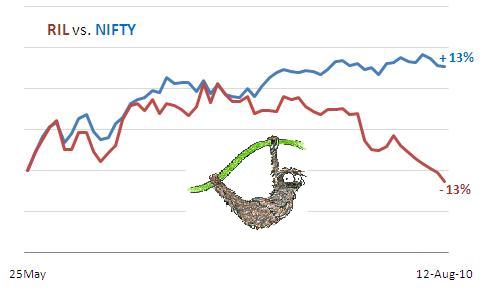
The biggest sloth in recent times has been the Reliance Industries (RIL) stock. As the market (i.e. the NIFTY) traipsed on from 4,800 to 5,500 in a matter of 3 months (~15%), I have been licking my chops (no, I do not work in the chop shop) and have been generally sporting a nice spring in my step. But now I do not know how long my sunny demeanour will last for I have just about picked up a biggish position in RIL and am squarely on the path of Mukesh Ambani. It’s a trading call, unlike the Godrej Industries investment of mine. I feel quite sanguine about the Godrej depoyment, but not so about the RIL punt. The former has careened up 22% (weighted average returns) in 2 months for me and I will surely add to the position should the stock correct in the future. There was news and informed criticism of the US Fed’s solving of its debt related problems by adding on more debt. It definitely means that they’ll have loads of cash sloshing around in their backyard which they will want to deploy in high alpha economies. So some of it will come to India and that may take our local market higher on from here. But since this is hot money and the investment managers need to keep booking profits, sure enough and soon enough the market should correct. Will give some more cash to Mr. Adi Godrej to manage when that happens.

But coming back to flirt with RIL, I have gone long the stock (cash) and have also bitten a bite of the 30Sep 1040 call. There is next to no liquidity (as of now) on the Sep call and maybe the informed, knowledgeable pundits will shake their heads – but I feel that I have a story. I almost never get my options right – the brokerage charges are also too high for my liking and moreover you need to A) be understanding of the math behind how option pricing works in reality and B) be nimble enough to strike (both in and out) at the right moment.

Earlier, I had briefly written about the drowsiness in the RIL counter here and have been keenly watching this oily worm every other night. As you can see from the chart, it has slithered down to 970. The Bollinger Bands and the RSI seem to be giving a buy signal unless the stock is stuck in a downward channel. Then it would be akin to catching a falling knife. These technical indicators work best when the underlying is smugly oscillating in an escalating envelope. Anyway, I have my grip on my stop losses. If one fears or loathes getting wet, then one should not venture into the sea. But remember, only deep sea fishing gives the largest catch. I also scoured the internet to see some reason behing this very sleepy state of this behemoth – at least on the bourses. there are a few things happening (as listed below) but I do not know if they matter much. You may be aware of the old chestnut about the market being a voting machine in the short term.

  1. They’ve started pimping their pumps. They are selling at same rates as that of the PSU oil retailers. I remember some of my trips around Bombay – the Reliance pumps were always closed. The price decontrol announcement by the Government seems to have opened up the nozzles at private oil vendors like RIL and Essar Oil (have a position there as well). BTW, one comes across a very interesting string of letters when we read about fuel retailing trade lingo – DODO COCO CODO (Dealer Owned Dealer Operated – Company Owned Company Operated and Company Owned Dealer Operated). Notice the absence of DOCO.
  2. Maybe the stock has been moribund due to the announcement of RIL’s acquisition of shale reserves in the US? Perhaps the markets did not like it?
  3. The company is going to raise some money by selling off some of its treasury stock. Is that why the stock has been tied down while the rest of the market was inching up?
  4. I think the real reason has been the orchestrated downgrading of RIL by some domestic and international brokerage houses towards the end of July based on the realisation that the KG Basin may not be able to pump out as much oil and gas as what was expected/communicated by RIL. So it’s like the force of gravity acting on a balloon. Things seem to have reached a state where the forces of buoyancy (market rising) and the forces of gravity (broker downgrades) have been counterbalacing each other. Any trade is now a bet on what gives.

My personal take is that RIL is too complicated a business to understand. I do not know how many brokerage houses themselves understand it’s business thoroughly. But the brokerage community lives by its own code – one of them being a shared recognition in the importance of belonging. There’s tremendous security if the whole bunch believes in, talks about and does the same thing. While you are not better off, but most importantly you are not worst off either. In fact there has been a book called Zachs method of investing whose central tenet is to make investing decisions based on a statistical analysis of brokerage ayes and nayes.

STOP LOSS. DONT THROW GOOD MONEY AFTER BADNot that I can claim to “undestand” the companies that I invest in. You really have to be a senior member of the insider team to know it all. But since the trajectory of the Indian market has been upwards during this past decade, it would take a terribly unlucky bloke to lose money on the markets – on a longer term basis. For me one thing is clear – most of the experts who I lend my eyes to are saying (in print) that there seem to be no signs of the market having topped out in the intermediate term. The logic therefore is that if the market needs to move up and reach it’s intermediate top (before the hot money decides to leave our shores), RIL needs to perform. Hope I get lucky on these punts. Stop losses are my pillows.

Design a site like this with WordPress.com
Get started