Newport, Rhode Island
28-May-11 1 Comment
Here today…



01-May-11 Leave a comment
 Typed words in the electronic media spread so fast these days. Only that they seem to typed on anything but typewriters! Godrej and Boyce made an announcement last week that it was phasing out the manufacture of its typewriters due to falling demand. The story was tweeted, re-tweeted and picked up fast and suddenly a whole bunch of newspapers and blogs were running around searching for their lost keys. This particular website actually provided real-time updates on its spirited search to find a fully functioning typewriter manufacturing unit and it seems that their efforts seem to have paid off! Surprisingly, while Godrej and Boyce seems to have deserted the cause of what was once a truly empowering and revolutionary technology at the turn of the previous century, the lone (?) torch bearer seems from the place where I am typing this piece from!! But its good, according to me – a sign of the changing times. An indicator of how and why perhaps electronic products are muscling out manufactured ones from our share of mind – much like what I’ve tried to depict by the much larger firefox logo “jumping” over the lazy looking Hush Puppies one.
Of course, there is nostalgia for old technologies as they fade away, with the sense of loss increasing with the age of the mourner, but a teenager of today would care no less. Of course, the teenager is likely to have picked up the story as it got tweeted but would have forgotten about it the next instant. I do remember the boring typewriting classes that I had once joined. People around me (read elders) had advised me that learning typing is essential to using the computer keyboard. Well, I quickly got bored and lost count of the number of times I had made my quick brown fox jump over the typing instructor’s lazy fox. Many times, my fox would just refuse to trot the keys and I had to back (some) space and re do the whole show again!
 That was good riddance then and my keyboard skills are definitely not worse off at all. I just played a part of Steve Jobs’ Stanford Commencement Speech (2005) video and typed the whole thing as I heard it out. It took me 29.75 minutes (length of the clip = 7:14 minutes) to type out the whole thing implying a typing speed of 42 words per minute, punctuations included. Not bad for someone who gave up on the machine invented by C.L. Scholes. I made 2 errors and had to pause and rewind the clip more than 20 times!! I did add the seconds that were thus lost to my total time to arrive at my typing speed. It was a good video clip to choose I guess since it talks about how Steve Jobs built in all the typefaces and various fonts into the first Macintosh computer. Old technology and work methods giving way to newer ones. Now we learn that even the CAPS key is being done away with by the latest paradigm changer on the block: Google!! Interesting times are at our fingertips.
19-Apr-11 1 Comment
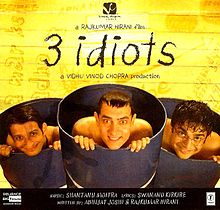 The movie 3 Idiots was so well made. It was peppered with intelligent observations about the current state of our education system and the problems therein. Perhaps elitist since it focused on the most advanced type of colleges in the country and guided as it was by Chetan Bhagat’s book, it had to focus on those seats of privileged higher learning. That fact itself makes the plot quite scary since it alludes to the huge gap and much worse state of affairs in the lower ranked schools and colleges across the length and breadth of the country. While the film did not touch much on the topic of corruption prevalent in our education system but I do remember two anecdotes from the storyline. First was the admission of Rancho (the main protagonist) into the college – that was a very corrupt act indeed since he’d popped in masquerading as someone else. Secondly, one of the songs in the movie made this very poignant point:
Kandhon ko kitaabon ke bhoj ne jhukaya,
Rishwat dena to khud papa ne sikhaya.
99% marks laoge to ghadi, warna chadi
(Shoulders drooping by the weight of the books, my father himself taught me how to bribe. If you get 99% marks then I’ll get you a watch, else the cane)
The idea of corruption and paying bribes is truly as deep-set in the Indian culture as this song brings out. All of us must have faced this situation – either as kids or as parents. Does NCERT or the Education Ministry think it opportune enough to introduce lessons on morality, uprightness and corruption in school textbooks? As a culture we all line up to “bribe” our huge pantheon of Gods and Goddesses with hair, coconuts, donations etc. A recent innovation right under the noses of the Education Ministry is the cool practice of writing down one’s mobile number on exam answer sheets. It is a cue for the examiner, his family already reeling under the shock of price inflation, to call that number – discreetly and always via a syndicate and exchange marks for notes. The reason why this trick was unknown to me as a student is because mobile phones weren’t around then. 😉
 It is truly endemic to who we are as a people, but Anna Hazare, the Gandhian is trying to change all that! And how! By staging a seemingly successful but obdurate fast until his demands are met. I personally feel that Hazare and therefore the Lokpal Bill tackles the symptoms and not the disease. The real disease is the societal acceptance and in some cases even a congratulatory commendation of the use of “power-ups” and shortcuts in the game of life. Until that psyche is changed much little will be achieved from the point of view of eradication (or even a reduction) in corruption levels in the country. Hazare’s methods are undemocratic to me but his fasting does ensure that his Wikipedia page remains well fed! Comparisons are made with the real McCoy i.e. Mahatma Gandhi – at least with the philosophy and his outlook to life. Mahatma Gandhi was good with fasts as some of his observations regarding the act of fasting show:
But he (and also the whole nation it seems) is asking for rules to be put in place to apprehend people who practice the common art of corruption. Its like a woman laying down the law and deciding the punishment if her man were to look at anything but the white spaces if crammed into a truckload of distressed damsels having no chance of escape. Corruption is everywhere around us, how can laws and rules force us to look only at the un-corrupt white spaces. Consider this heart warming story about a corrupt couple:
A husband and wife IAS couple were caught in Madhya Pradesh (MP) last year. They had made 360 crores over a period of 30 years of service. Their methodology was simple. The mid-day meal scheme provides for 1 million kids in MP. 75 paise per meal is allocated to sweets. They stole only those 75 paise from each kid. Sweet, no? Do the math: 75p X 1,000,000 = INR 7.5 lakhs per day. 2.25 crores a month. 27 crores or USD 5.4 million a year. And why did they get caught? Because even in the twilight of their illustrious careers, they refused to share their loot with their cohort of 20 subordinates! Maybe they were tight-fisted because they wanted to ensure an endless supply of sweets for their generations to come.
So how will all this fasting and forcing the hand of the legislators curb all this?
As Rand said, ‘Rules are always meant to be broken”. Here’s the excerpt – if it fits into this theme:
Did you really think we want those laws observed?” said Dr. Ferris. “We want them to be broken. You’d better get it straight that it’s not a bunch of boy scouts you’re up against… We’re after power and we mean it… There’s no way to rule innocent men. The only power any government has is the power to crack down on criminals. Well, when there aren’t enough criminals one makes them. One declares so many things to be a crime that it becomes impossible for men to live without breaking laws. Who wants a nation of law-abiding citizens? What’s there in that for anyone? But just pass the kind of laws that can neither be observed nor enforced or objectively interpreted – and you create a nation of law-breakers – and then you cash in on guilt. Now that’s the system, Mr. Reardon, that’s the game, and once you understand it, you’ll be
much easier to deal with.
23-Mar-11 2 Comments
 Warren Buffett’s recent trip to India has ensured that charity as a virtue has been attracting quite a few newsreels. Some, including the Government of India, are pegging it as a duty! There is a proposal to make Corporate Social Responsibility a mandatory obligation in India. Well, would it really be charity, if things were to get to that?
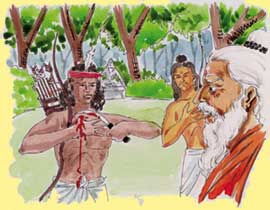
The art (if you will) and the act of giving is not something that needs to be taught to us here in India. It is, I believe, a much greater (and silent) part of our ethos than it is in the western world. There are countless examples of local charities, helping hands being lent – in the lattice network that is India – which never reach and never are meant to reach mainstream media. The way charity is sought to be practised in India, is best brought out by the story of Eklavya. It addresses the core question of how one should feel and behave after giving (a point which I try to address at the end of this post as well).
Most of us would know about how this master archer cut off his thumb at the behest of Dronacharya. There is a lesser known sequel to his thumb sacrfice where he is asked if he ever regretted his sacrifice. This was asked to him when he was dying and he replied that he had indeed once regretted his sacrifice. That was the time when the Pandavas were coming in to kill Dronacharya who had given up his arms on receiving fabricated news of his son, Ashwathama’s death. Eklavya regretted giving up his thumb for he believed that had the thumb been there, no one would have dared hurt his Guru. I guess this is why he attained death at the hands of Krishna (who was also his blood cousin) – which is believed to be a mark of exceptional divine favour.
Buffett’s India trip may have many motives but it is certainly being projected as a mission to rasie money for the needy. There were doubts regarding his trip but I guess he proved himself “retarded” enough to finally make the trip. Japan was to be his first stop which did not happen due to their current problems of nuclear proportions. Joined by the likes of Bill Gates, Jeff Immelt and Paul Bulcke (Nestle’s CEO), who are also visiting India around the same time, I am sure he must have wanted some RoI on the various assorted flu shots and other precuations that visitors to India (chiefly from the US) routinely invest in before taking the plunge. As usual and as expected, a visit to China (Sep ’10) predated his visit to India. In China also, he had done the rounds with his charity collection box but to limited success. The wealth in China (and also India) is new found – I think its owners may like to enjoy it’s effects for some time before embracing charity.
There is nothing spectacular or bold about his visit here, since he would anyways be under pressure to look for growth spots outside of the din of the US currency printing presses. I am not sure od the exact number, but I think I read somewhere that c80% of his investment company’s assets are in the U.S. I like to hear him when he says that India is a large maket and no longer an emerging market. When he points out that a hike in the current 26% limit in insurance Foreign Domestic Investment (FDI) would help the industry, I like it. But when when he and his best pal, Bill Gates, start talking about charity, I switch off. Never mind the fact that the Oracle of Omaha has pledged (or perhaps already given?) 99% of his wealth to charity.
Reason being, I keep wondering is there a return expectation in the minds of these ultra rich people and corporate houses when they give?
The Bhagvad Gita says, “A gift is pure when it is given from the heart to the right person at the right time and at the right place, and when we expect nothing in return.” The Bible elevates charity and the act of giving to an act of love. It teaches, “When you give to the needy, do not let your left hand know what your right hand is doing.”
There is a bit of a personal paradox here for me. I know I have read (and sometimes experieced it as well) that when we give spontaneously, without attachement, whatever you give comes back to you manifold. Now, the problem lies in the fact that the next time you give, you have precognition of this “bounce back effect” having taken place. So, then are your subsequent acts of charity really just outward? I don’t know the answer – perhaps the answer lies in mind control via Yoga or some such device. I’m bad at this.
14-Mar-11 1 Comment
 Writing after a long gap. Apologies for staying away. What better date to start again than the Ides of March? The pen is warm again, the ink that had frozen (quite literally, for I use a fountain pen) is back to its task. And so are my frozen fingers.
I had suffered two shocks – one from the markets and the other from the US East Coast weather – both of which left me cold and too numb to write. With a bit of a medical condition that had developed as well.
I am now back in warm and sunny Hyderabad and feel quite giddy at the constant battering of the sun at 100 degrees F. F for real Fun. In New York /New Jersey, the only television channel that used to play in my room was The Weather Channel (TWC). It was as if my unblinking act of viewing TWC would somehow make things better. It was on one such extended viewership sessions that I came across a light hearted comical filler program on TWC. It was a correspondent of TWC asking people really tough posers like the spelling of the word Arctic, the shape of snowflakes, the expansion of the acronym TWC, etc. One such poser had set me thinking and occupied me for a few moments as I braved an extremely irritating 120+ kmph wind that somehow always figured out the way to blow right into my face even though my walking route to the train station hardly changed and it was generally straight.
The weatherman had asked: “If someone told you that tomorrow will be twice as cold as today, and today is Zero degrees then what would be the temperature tomorrow?”
I thought about this for some time during my return flight to Hyderabad and also posed this to some of my work colleagues and friends. I got a lot of interesting answers, but Adithya’s almost nearly and quite surrealy corresponded to how I thought about it as well.
For a layman it would be simply zero degrees multiplied by 2 which is Zero degrees
However temperature has various scales one of which is Fahrenheit
0 degrees – 32 F and half of 32 would be 16 F which in turn converts to -8.8 degrees
But it isn’t that simple in my view – Cold is nothing but absence of heat and measuring heat is a whole lot harder when compared to temperature which is straightforward.
For example let us take 2 scenarios
Scenario 1 : 20 degrees today 10 degrees tomorrow
Scenario 2 : 10 degrees today and 5 degrees tomorrow
In both the scenarios how can you say that it is twice as cold just by reducing the temperature to half.
Going back to school days we used to measure heat in what we call as Kelvin scale
0 degrees Celsius would be 273.16 degrees Kelvin. Twice as cold => 273.16/2 in Kelvin scale which is 136.58 degrees Kelvin.
When we convert this back to Celsius we would get – 136.58 degrees Celsius which I feel has never been recorded on earth I guess.
So I feel the weather channel guy must have not attended his science classes otherwise he would never make such a statement 😀
or this one from Kishore (which he said he checked off some internet resources):
The answer depends on which temperature units you are referring to when you say “0 degrees.” Since we most commonly use Fahrenheit temperatures here, we’ll assume that for now. If the temperature is 0 F today, then being twice as cold tomorrow presumably means it will be “half as warm.” If so, that means tomorrow’s temperature will be halfway between 0 F and absolute zero, the temperature at which there is no molecular motion and therefore no heat at all.
Because absolute zero falls at -459.67 degrees on the Fahrenheit scale, “twice as cold” as 0 F should be about -229.84 degrees!
If you were referring to 0 Celsius (the freezing mark) instead, then absolute zero on that scale is -273.15 C, and “twice as cold” would be -136.58 degrees C
Ok. “Cool”. Even if you were fortunate enough to feel the East Coast of the US chill this season, you may have a different take on this. Which is fine, as long as you shiver too.
 The best part of this year is that assorted groundhogs came and went; companies and event organisers announced and celebrated the onset of Spring (in their thick winter coats!) . What spring? There’s no let down of the blizzards, sleet, rain, snow, flash floods and yes, even some forest fires!!!
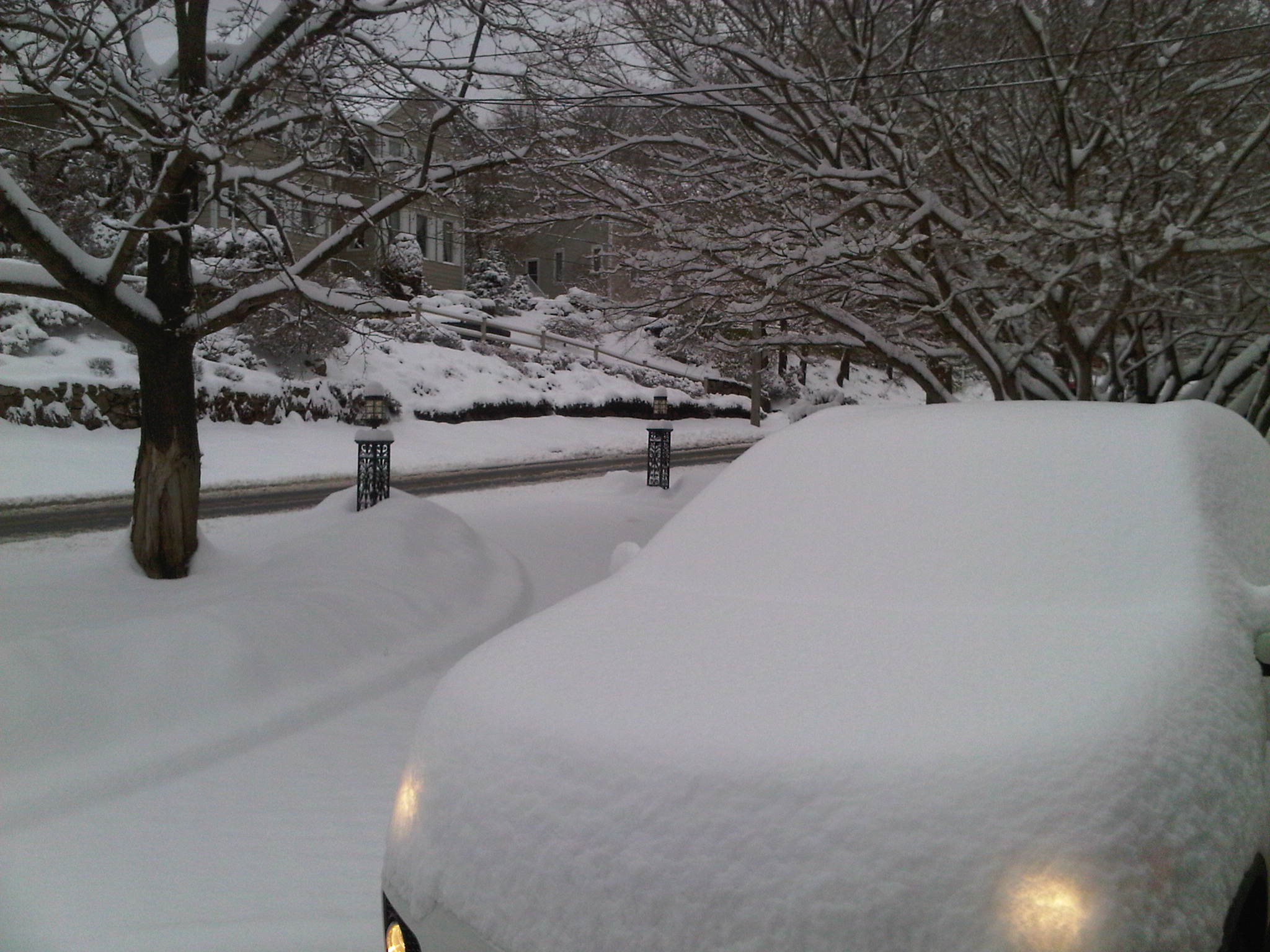
Living there and arriving to work at 8 A.M. EST is tough. Glad for my base to be in a tropical, sweaty, paradise. Check out this photo which Anthony sent me. Most cars look white in the winter there!
But not the car that Eddy drives. It’s a black Lincoln and he is such a welcome sight especially on the day he is at my door to drop me off to the airport! I’d called him at 6:30 EST (for a 11 PM flight!!) and was sheepishly listening in to his lament about some of his other customers who call their cabs even earlier! At 5:30 PM! So eager are we to get stuck in the (usually) Fri evening NY traffic to JFK that we end up reaching JFK at nearly the same time if we’d left much later! But his calling on my igloo earlier last week did break some ice and I managed to escape to the welcoming warmth of a NY traffic jam and already begin my path to a much needed thaw. While in the cab, we did talk about his theory of global warming being responsible for the harshest winter in a decade as also the rapidly rising cost of gasolene in the US. We also tried to unsuccesfully convert gallons into litres (unit sale measure of fuel in India) but gave up after a few traffic signals. However, we did wonder as to what would happen to the privacy of people staying in igloos if global warming continues to persist?
03-Nov-10 Leave a comment
 I stopped by at a local grocery store on my way back home to pick up something for breakfast. The idea was to wedge an oregano infused, golden brown double omlette inside slices of whole wheat bread layered in garlic and chilly-garlic mayonnaise. The ensuing breakfast was bearable, but the previous evening commerce gave me something to write about: the escalating prices of food in India. The egg at INR 3 per egg is a lot of egg in the face and the whole wheat bread leavened me with its INR 22 tag. I would recommend heading to the nearest kirana store, especially if you haven’t personally shopped for a while. I am sure the prices will shock you. Any crescendo that escalates at c15% per annum would.
I am sure Humpty Dumpty would have an even mightier fall today than during the early 19th century when he/it was conceived as being perched on that wall. The reason is simple – eggs are dearer since poultry feed prices (corn, et al) are increasing fast both in local as well as international markets. And that may not bode well for companies like Godrej (Real Good chicken, sob sob) and Venky’s India Limited.
There was a lot of attention to the Reserve Bank of India’s (RBI) winging up of its repo rates in a bid to contain inflation. Whether this move has its desired effect or not remains to be seen (in media). Actually, such causality might be difficult nee impossible to establish. Since a section of the intelligentia remains convinced that monetary tricks do not influence food prices and therefore the hesitant intervention by the RBI may not really amount to anything. While you may have certainly caught the story of the repo rate hike, this sagacious comment by Montek Singh Ahluwalia may have escaped your notice:
Rural areas have benefitted from the economic prosperity seen in the country. Demand for foodgrain, milk, vegetable and protein have gone up. It is a good development
Of course it is! But our preparedness to tackle the implication of that (i.e. a higher price level) may not be. The Deputy Chairman’s (of the Planning Commission) comment reminds me of a similar observation by the President of the United States (was it Clinton?) that countries like India should eat less! Here are some facts: per capita income in India has increased from 24,095 in 2004/05 to 43,749 in 2009/10 – that’s a CAGR of 13%. Agricultural productivity has lagged this rapid growth in incomes – growing at only 2% per annum. The large transfer of purchasing power via the Rural Employment Guarantee scheme has indeed ushered in a new found prosperity in rural India. In my native village, I never used to see the local folk eat vegetables and fruits. It was always variations of millets and pulses. They now have started to add variety to their cuisine, and as Mr. Ahluwalia says, what’s wrong with that?
There is an expectation of rice prices coming down this year due to the copious amount of rainfall that we received this monsoon but that might be washed out too. For since 2005, there has been a continuous rise in prices regardless of the monsoon. So what gives? It has to be basic demand and supply. If demand goes up and supply remains constant then the prices have to increase, right? How I wish our planners get this right – the re-rating possibilities for the fertilizer industry (if it can get it’s gas supply worries sorted!), micro finance organizations, irrigation sector (Jain Irrigation, Yo!) would be significant.
Our production is focused largely on basic food grains which are certainly not income elastic – i.e. one does not start consuming more rice or chapattis if one’s income rises. However, things like eggs, butter, fruits, vegetables, milk, meat etc are most certainly in greater demand if income rises. This will be difficult for someone from the industrialized world to understand, but in India, these food articles are aspirational to many. There are 370 million people currently in India living below the poverty. Forget an apple a day, even if they have consumed an apple in a lifetime till today, they’d be lucky. But all that will change and is changing…slowly. We need good old Keynesian artifacts in Indian agriculture, not RBI’s intervention. The focus should be on the Agricultural Ministry and not the Ministry of Finance.
And while Shri Sharad Pawar remains overworked and occupied by the political flux in Maharashtra, I do not think he is the only one to blame. The reason for the rotting mountains of grain in the Food Corporation of India’s (FCI) godown is less a consequence of callous administration as much as it being a fallout of India’s federal structure of government. It’s a states of the Union vs. the Union issue. The center just cannot get the states to lift off the stocks – I do not know why but I can guess that it must be due to pricing issues. FCI’s hoards cannot be culled by a mere addition of storage capacity. That’s a long term process – the short term measure is getting trucks to line up at FCI’s godowns are carting the stuff away. At least Sonia Gandhi did admit that the responsibility of bringing down food prices is as much the responsibility of the center as it is of the states.
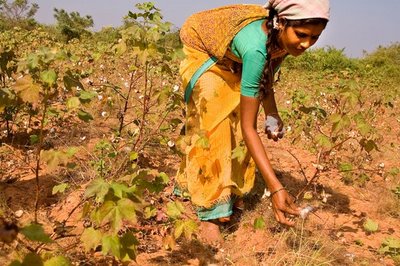 The other important aspect is the cost of farming. In my village, a daily wage woman labourer was paid INR 50 a day to plant onion seeds. This year she is getting paid Rs.100. Male labourers are demanding INR 150. Just like the BPO industry, cheap labour that gave Indian agriculture its competitive edge is blunting rapidly. Cotton is another crop that is sown by my cousins in their farms. They are paying farmhands Rs4.50 for picking cotton this year, again double from last year. They tell me that the total labour cost for cotton has touched INR 15 per kilo this year. I can only imagine the plight of the farmland owners in rich Punjab and Haryana! This again comes back to the point – if a business has to start paying more per unit of labour then it needs to extract greater productivity per unit of labour. The fracas over the modest brinjal shows how arduous the path to this goal will be. Our farms need more mechanization, drip irrigation (Jain Irrigation, yo!), better seeds, non-urea fertilizers and understanding politicians.



 The Third I
Recent Reactions