Gitanjali Gems Limited

The light is shattered into gold on every cloud, my darling, and it scatters gems in profusion.

Mirth spreads from leaf to leaf, my darling, and gladness without measure.

The heaven’s river has drowned its banks and the flood of joy is abroad

 – from Rabindranath Tagore’s anthology of poems called Gitanjali 
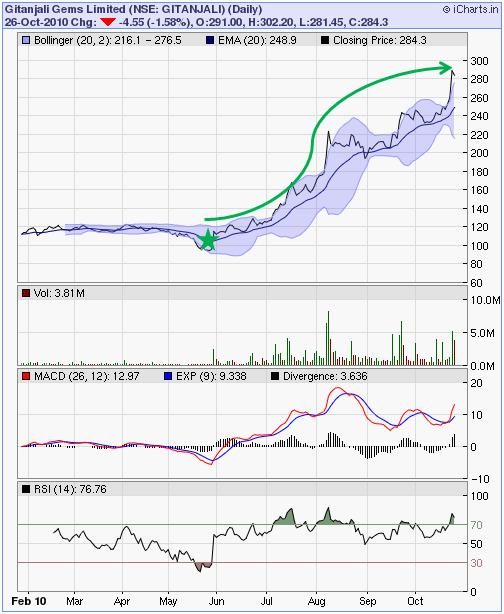
I had picked up Gitanjali Gems on 29Apr’10 and have been holding it since then. The point of my purchase is shown as the green star on the chart alongside. The timing looks awesome but I don’t really care – I’ve gone through the motions quite a few number of times by now. What I am really focused on and trying to discover is a personal method that helps me to know the right time to sell. If I can reach that stage of ‘enlightenment’ by my next birthday, I would have really matured as an investor – in my opinion. Coming back to Gitanjali Gems, it has been an awesome climb, right? In all of 6 months! So is it time to say bye to bling bling? I don’t think so. Why? I like it! Reason enough? It better be!

Take a look at its website and you’d be forgiven to think that u’d landed at some Bollywood portal given that Neha Dhupia, Salman Khan, Katrina Kaif and Kareena Kapoor glitter through in huge 4” by 8.5″ sized banner frames!  At least in my browser window. As if personifying Nakshatra, D’damas, Gili and Asmi. And that’s the point – the company has been so successful in transforming these product names into integrated brands with massive recall. There’s Sangini and Vivaaha as well. Shahrukh Khan is also hidden somewhere in the inner pages of the website – try that ‘treasure hunt’ search if you have nothing else to do and are fully invested in this company.

The CMP of 285 currently discounts it’s trailing 12 month earnings 12 times. It was 5 times when I had purchased it. The company is selling for INR 2,400 crores which is about 530 million USD. Given that it has ambitions of becoming a global brand, that number does not look out of whack, especially when you consider that the mcap/sales ratio of it’s sterling competitor, Titan Industries is 3.3 as compared to 0.71 for Gitanjali. Moreover, Titan Industries’ Tanishq is more into gold as opposed to diamonds. And how does that matter? The shine of diamonds is more than the glow of gold – i.e. margins in diamond retail is more than gold jewelley. Gold has appreciated 17% (in INR terms) in the past one year while diamonds have become dearer by 25%. But since Gitanjali has stake in Tanzania’s bloody mines the raw material price spike will not hurt as much. I think going forward more and more people will start comparing Titan to Gitaljali (if they are not doing so already) and perhaps that will make some difference. The labour required to cut is more than the effort needed to goldsmith. Not high at all, I’d guess. Speaking of global ambitions, the company has recently acquired an Italian jewellery and design firm,

It spent INR 25 crores servicing its debt in 1Q11 which is approximately 2.5% of what it sold. In that sense, the big question mark is the retail foray. Why get into making malls and infrastructure when diamonds are forever? Will they add more leverage to their balance sheet? My hunch is that the Italian Job and/or the SEZ fling will increase the interest costs for the company – let’s see.

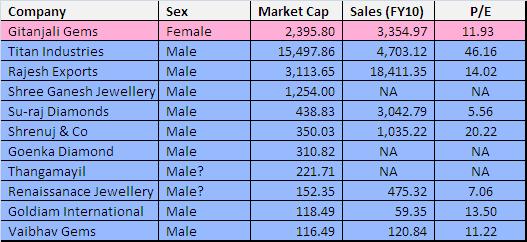
I think I will hold on given that this position of mine has perked up 144% in double quick time, so even if it corrects I’ll be cool. The technicals are shooting up full steam ahead and the share has seen a near parabolic climb recently. So some steam will definitely get let out. My investment logic was never based on such crappy observations that Indians are getting urbanized and therefore they’ll shun traditional gold ornaments and stud themselves with diamonds. The market leader in branded diamond jewellery was available at a market cap of INR 980 crores only. So while it was not some Grahamian deep discount discovery but there indeed was lot of money on the table to pick up. Now, however, it looks like a traditional and boring growth story. But even a slow and steady rise of 15% per annum will make it a 3 bagger for me in 18 months or so! The anticipated deluge of US hot money notwithstanding. If that target is reached much sooner, then I’ll jump out. But wait. Is this not a retail stock? And don’t retail companies, especially ones with a glittering track record and market leaders in their segment get high multiples? If we assume an EPS of 30 for close of next financial year, it’s forward P/E comes to 9.5 only. Plebian, male names sell at such high forward P/Es. When will India and Indians give equal opportunity to females, I wonder. Look at the table below to see what I mean. Gitanjali means an offering/anthology of songs. Would it have made any difference to its valuation if Mehul Choksi would have called his company Upanishad Jewels? ( = anthology of teachings from Vedic Hinduism) Or maybe his choosing the name Gitanjali might have been quite a prescient flash then? I don’t know what these boring boys are doing with jewels and diamonds – let’s leave them for pretty girls like Gitanjali and focus on making money instead.
And please do not ask me why I did not buy this stock when it was INR 34 (Mar 2009) if I am really as smart as I pretend to be.

Trade Ideas – Oct’10

Some trading ideas are occupying my mind at the moment. Much was said about the QE2 in the previous post but free capital must be employed and given my nervous, edgy nature these days, I prefer flitting in and out of positions hoping to compound to a modest proportion. While I am contemplating these opportunities that caught my eye yesterday, let me set the background score with these opening lines from Charles Dickens’ masterpiece about duality:

It was the best of times, it was the worst of times, it was the age of wisdom, it was the age of foolishness, it was the epoch of belief, it was the epoch of incredulity, it was the season of Light, it was the season of Darkness, it was the spring of hope, it was the winter of despair, we had everything before us, we had nothing before us, we were all going direct to Heaven, we were all going direct the other way.

In fact some lines from the book are so very apt in the current global financial markets:

The Fed to all of us: “Keep where you are because, if I should make a mistake, it could never be set right in your lifetime”. Also, “For I’m the devil at quick mistakes, and when I make one it takes the form of Lead”

The global economy to its planners: “Crush humanity (read economy) out of shape once more, under similar  hammers (read printing presses), and it will twist itself into the same tortured forms”.

Inflation rate in US to whoever cares to listen: “It is a far, far better thing I do, than I have ever done; it is a far, far better rest that I go to than I have ever known”.

And so on. These are issues far beyond my full comprehension, so I’ll do what I am forced to do – seek some new punts and see what happens. I just can’t remain still for long. And rotting my money in the bank is criminal.

1. Jain Irrigation Systems: I know that this seems to be a fairly valued stock with it’s 1 yr forward P/E running at 30 and that it’s market cap is in the region of INR 8,700 crores (= USD 1.9 billion) on an expected FY11 sales figure of INR 4,200 crores (= USD 933 million). The stock has recently seen a 1 yr forward P/E band of 33-34 as well, so on that logic there could be some steam there. The company has compounded it’s revenues at a crazy 40% CAGR over the past 5 years using a mix of organic (!) and inorganic methods. So, the market obviously feels that this kind of growth will continue into the future (say 3 – 5 more years) and that’s why a P/E of <40 appears justified. But I am not sure if net earnings growth will also grow at the same clip. Currently, around 6% of the money that the company earns goes into servicing its debt. But I picked up a (moderate sized) position today as I feel that there is a short term 10% – 15% opportunity here. Another important point for me is that this company is from my home district, Jalgaon so I do feel my agrarian roots rising up as I sow this small packet of capital here. But really, the company is cool, having delivered world class drip irrigation methods to a country so sapped of water. It is now pioneering the concept of using drip techniques for paddy – the killer crop when it comes to water requirements. If that clicks, then it will be awesome for the country. From the chart above, I guess 1050-1075 seems to be a support level and given the Lower Bollinger Band touch, a negative plunge of the MACD and a code red, buy signal from the RSI, I will venture out here. A mental stop loss of 1000 is in place. 1000 also appears to be the next support? Lets see.

2. Balmer Lawrie: We have been hearing and reading so much about logistics and transportation being a huge opportunity that many of us may not even bother to check if the story still has some room for possible fresh investments. I have invested in and out of Balmer Lawrie in the past and like the logic for Jain Irrigation above, I guess this could turn out to a small, skim the top kind of opportunity. But in this case, I would be content to hold on to this stock for longer given that A) it is cheaper than Jain Irrigation and B) I am familiar with the company. I once worked in an office buidling next to a Balmer Lawrie Grease Division plant and I like to believe that the proximity and therefore some induction effect helped me make money on this counter in the past! I have not yet taken a position here but the chart on the right looks tempting to me.

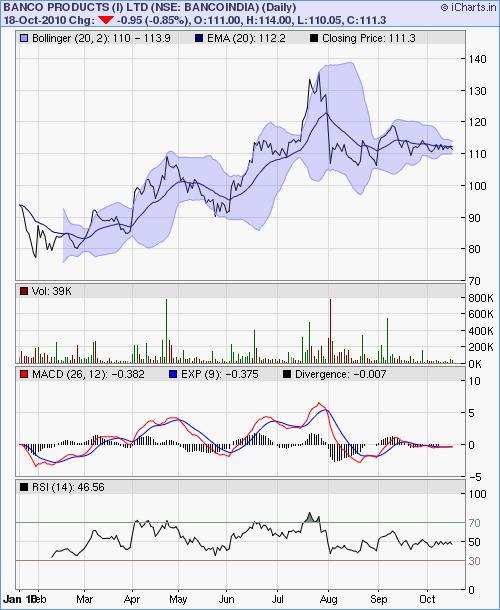
 3. Banco Products: What I am really doing is flipping coins between Balmer Lawrie and Banco Products. This one is a Gujarat based company which has been around for 50 years but appears to be selling cheaply as well. It has made auto-equipment all these years and is now getting into cement business as well. Duh. It supplies it’s gaskets and radiators to companies like Tata Motors, TVS Suzuki, M&M, Maruti Udyog etc. It’s operating margins (@ 26%) are highest amongst peer group companies like Bosch, Bharat Seats and UCAL fuel systems. With an expectation of a FY’11 EPS of 12, the CMP gets discounted 9.25 times – that’s not bad. This really has been a turnaround story over the past couple of years with the share price jumping up from the 20s to the current 110 levels. Given the market cap of INR 800 crores (= USD 178 million) over an expected sales of INR 550 – 575 crores for FY’11, the stock still looks a tad cheap. Recently they acquired a company in Europe and are setting up a cement plant in Tanzania. Seems like these guys are confident of what they are doing. On the charts, I see a Bollinger Squeeze which to me means that it can shoot up or down from here. But the RSI and MACD are not there yet for me. I am biased towards Banco, so I think I’ll throw in some coins tomorrow. Let’s see.

4. Talwalkars Fitness; KSB Pumps; MIC Electronics were other punts that came to mind. And a long term possibility on TV Today (but that requires more thought, and I don’t have time at the moment. Maybe later this week).

(I had taken a position on 31Aug’10 in MIC Electronics and written about it in my Earths, Lights and Money post but got out with a 14%. It has corrected only around 8% since then. I’m not fully sure but I do want to hitch a ride on it again and again since the story appeals to me a lot)

Oh! Calcutta

I was in Calcutta over the weekend. I like the city. I guess it was after some 15 years or so that I visited this eastern Metropolis where it starts getting dark at 5:30PM (during this part of the year) itself. Bits and pieces of this neglected city have changed – many parts remain the same. Cars are smaller and therefore quite numerous on the many narrow lanes. There is still a lot of seemingly hostile but good natured haggling over daily transactions, which I admire in this part of the country. A successful haggle results in an exchange of not just currency notes and coins – sweat and grime change hands too. The climate is quite humid and the Ganges is quite muddy furiously blushing at the confession of sins that it brings in all along it’s flow. I managed to fight my way using a few broken, mispronounced words in the local dialect and restrict a particular cab fare to 100 rupees instead of the 120 that was being asked for. When in Rome, do as the Romans do. Speaking of coins, I guess this is perhaps the only major city where 25 paise coins are still in currency.  I felt nostalgic since the scene reminds me of my childhood spent in Eastern India – red soil, open spaces (on the outskirts of Calcutta now) and the relatively slow pace of life. And the fact that a 10 rupee note goes a long way here. While I did not board a bus, but was craning my neck to to catch a glimpse of the “cash fans” – the bus conductors here, fold up currency notes longitudinally into slim rectangles and use each gap between their fingers in the palm of their hand as placeholders – the gap between the index and the middle for fivers; the middle and the ring holding up the tens while the ring and the pinky holding on to the fifty rupee notes! I am not sure of this distribution – but I did not get a chance to verify. It looks (or used to) like an expensive fan. I saw this 15 years back and became a fan of wristy conductors. Maybe by now, with a change of government in West Bengal, the conductors have got shoulder sling bags made of leather like their counterparts in Bombay. Maybe not – only citizens of Calcutta that travel in busses can elaborate. The yellow toad-like taxis are everywhere – these run on (2 x reading + 2) meters while the white ones represent the privately negotiated OTC market. These are the dinosaurs on Indian roads – the Ambassadors. The dexterity of the drivers though would rival any accomplished drag racer anyday. Or Pokemon. Or Garfield.

Apropos my earlier post on the pani puri, I did manage to plop some puchkas down my maw. Awesome! Especially when the server kept plunging his dirty stubby fingers in the heavenly soup of pungent tamarind water. Meanwhile IFCI has cantered up. I wrote about it 3 months back on 05Jul’10 and while there does not seem to be any clarity around the digital event regarding its banking foray, the long term resistance has been broken and people are talking about it reaching the 90s pretty soon. I guess I’ll wait and watch for some time.

Reliance Industries Limited

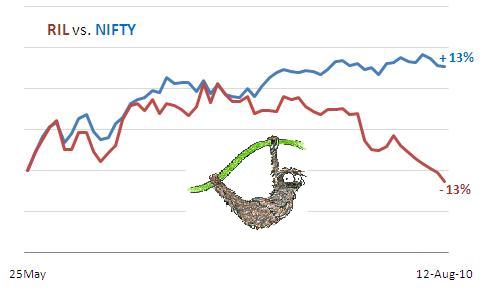
The biggest sloth in recent times has been the Reliance Industries (RIL) stock. As the market (i.e. the NIFTY) traipsed on from 4,800 to 5,500 in a matter of 3 months (~15%), I have been licking my chops (no, I do not work in the chop shop) and have been generally sporting a nice spring in my step. But now I do not know how long my sunny demeanour will last for I have just about picked up a biggish position in RIL and am squarely on the path of Mukesh Ambani. It’s a trading call, unlike the Godrej Industries investment of mine. I feel quite sanguine about the Godrej depoyment, but not so about the RIL punt. The former has careened up 22% (weighted average returns) in 2 months for me and I will surely add to the position should the stock correct in the future. There was news and informed criticism of the US Fed’s solving of its debt related problems by adding on more debt. It definitely means that they’ll have loads of cash sloshing around in their backyard which they will want to deploy in high alpha economies. So some of it will come to India and that may take our local market higher on from here. But since this is hot money and the investment managers need to keep booking profits, sure enough and soon enough the market should correct. Will give some more cash to Mr. Adi Godrej to manage when that happens.

But coming back to flirt with RIL, I have gone long the stock (cash) and have also bitten a bite of the 30Sep 1040 call. There is next to no liquidity (as of now) on the Sep call and maybe the informed, knowledgeable pundits will shake their heads – but I feel that I have a story. I almost never get my options right – the brokerage charges are also too high for my liking and moreover you need to A) be understanding of the math behind how option pricing works in reality and B) be nimble enough to strike (both in and out) at the right moment.

Earlier, I had briefly written about the drowsiness in the RIL counter here and have been keenly watching this oily worm every other night. As you can see from the chart, it has slithered down to 970. The Bollinger Bands and the RSI seem to be giving a buy signal unless the stock is stuck in a downward channel. Then it would be akin to catching a falling knife. These technical indicators work best when the underlying is smugly oscillating in an escalating envelope. Anyway, I have my grip on my stop losses. If one fears or loathes getting wet, then one should not venture into the sea. But remember, only deep sea fishing gives the largest catch. I also scoured the internet to see some reason behing this very sleepy state of this behemoth – at least on the bourses. there are a few things happening (as listed below) but I do not know if they matter much. You may be aware of the old chestnut about the market being a voting machine in the short term.

  1. They’ve started pimping their pumps. They are selling at same rates as that of the PSU oil retailers. I remember some of my trips around Bombay – the Reliance pumps were always closed. The price decontrol announcement by the Government seems to have opened up the nozzles at private oil vendors like RIL and Essar Oil (have a position there as well). BTW, one comes across a very interesting string of letters when we read about fuel retailing trade lingo – DODO COCO CODO (Dealer Owned Dealer Operated – Company Owned Company Operated and Company Owned Dealer Operated). Notice the absence of DOCO.
  2. Maybe the stock has been moribund due to the announcement of RIL’s acquisition of shale reserves in the US? Perhaps the markets did not like it?
  3. The company is going to raise some money by selling off some of its treasury stock. Is that why the stock has been tied down while the rest of the market was inching up?
  4. I think the real reason has been the orchestrated downgrading of RIL by some domestic and international brokerage houses towards the end of July based on the realisation that the KG Basin may not be able to pump out as much oil and gas as what was expected/communicated by RIL. So it’s like the force of gravity acting on a balloon. Things seem to have reached a state where the forces of buoyancy (market rising) and the forces of gravity (broker downgrades) have been counterbalacing each other. Any trade is now a bet on what gives.

My personal take is that RIL is too complicated a business to understand. I do not know how many brokerage houses themselves understand it’s business thoroughly. But the brokerage community lives by its own code – one of them being a shared recognition in the importance of belonging. There’s tremendous security if the whole bunch believes in, talks about and does the same thing. While you are not better off, but most importantly you are not worst off either. In fact there has been a book called Zachs method of investing whose central tenet is to make investing decisions based on a statistical analysis of brokerage ayes and nayes.

STOP LOSS. DONT THROW GOOD MONEY AFTER BADNot that I can claim to “undestand” the companies that I invest in. You really have to be a senior member of the insider team to know it all. But since the trajectory of the Indian market has been upwards during this past decade, it would take a terribly unlucky bloke to lose money on the markets – on a longer term basis. For me one thing is clear – most of the experts who I lend my eyes to are saying (in print) that there seem to be no signs of the market having topped out in the intermediate term. The logic therefore is that if the market needs to move up and reach it’s intermediate top (before the hot money decides to leave our shores), RIL needs to perform. Hope I get lucky on these punts. Stop losses are my pillows.

Shakti Met Dor

Here is another dilemma that I face now. I had invested in Shakti Met-dor about a month back. The company looked undervalued, some people were beginning to notice and write about it but the charts were not indicating anything stellar to me – at least then. I was more happy to cream off 7 – 8% in about a month’s time and get out. I am sitting on an upside of 26% now. Of course, my digging around on the net had made me aware of a much larger upside that was possible on this stock. So I was waiting for the market to discover the hidden value in it – perhaps around the time of it’s quarterly results declaration? I also thought it a good omen to have dumped some money on the stock of a company which is domiciled in the same city where I am working currently.

The company fabricates doors and windows. That’s it. My money is hinging on these humble pieces of building fitout equipment. Doors and windows are not cool enough, I guess. Maybe that’s why the company has never really been able to command a good enough valuation despite doing pretty well for itself. Some time back it recently upped its manfucturing capacity and no one seemed to have noticed back then. The additional capacity seems to have come on board and the additional widgets are now contributing to the bottom line. The coffers seem to be filling up and now people are starting to see it on their screens due to the falling P/E ratio.

What’s my dillemma? When to sell. Again. The same problem.

And what’s the catch? The management – or so it seems. They must have realised that since the market cares two hoots about them, it was time they got out of the party where they were not invited. They now want to delist. The promoters own around 55% and it may seem that they have a long way to go (SEBI requires 90% ownership for promoters before they can slink away). But there’s more to it – we need to open our doors of perception wider. The problem is that, in true Pareto style, just about 100 shareholders seem to own around 90% of the stock under issue. I am afraid that if the management is able to corner these 100, then I’m done for. Who knows what relation exists between these 100 and the management? I hope they do not locate me – but that seems difficult as I work just 7 kms from their head office. The website of the company is nothing great. I am sure some creative webmaster can create quite a few interesting themes with doors and windows opening and closing on their website. They do not have an investor relations page or section but that’s all undestandable since the management has said that the reason for seeking an exit from the listed secondary market is the heavy burden of listing and exchange fees that the company has to bear. If that is such a heavy expense then why would they ever want to pay a few thousands to a web designer to spruce up their website? But despite the frugal website, they have managed to slip in an extract about their company culture (Career With Us >> Our Culture) which should help us investors:

“Openness: We like to be ethical, fair and forthright in all our endeavors; openness not just in the sharing of knowledge across the organization, but also in terms of respecting the feedback given by our people.”

I hope they feel the same about their investors? Or are some investors more investors per share of holding than others?

Despite such nobility, there is some speculation that the promoters have been quietly ferreting away bite sized chunks of shares away from the market ever since 1998 and do not appear to have been open and honest about it. That sounds like fraud to me. Stock analyst Mudar Pathreya said all this and also a bit more in his interview to CNBC-TV18 on 27Jul’10. He says that the company should be worth more than Rs. 500/share and advises shareholders to hold on.

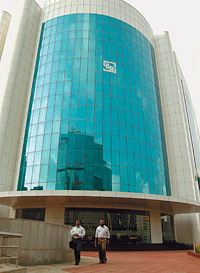
Where is SEBI when it is needed the most? I need you, SEBI for I need to make money. I remember Prof. A, who during my first year of management studies had remonstrated very vigorously and animatedly:

“SEBI should be plucked out and thrown into the Arabian Sea”.

 Serious, risk averse dyed-in-the-wool kind of value investors will stay away and look the other way. But I am greedy. Greed is good. Greed is good.

Sugar me baby

Sugar me baby, NOT.

The problem with too much of a fixation on charts is that we sometimes tend to ignore their non causality. Past patterns may not repeat. Just because a stock is at its 52 week low/high does not automatically mean that it will start rising/falling. In fact, quite the opposite. Momentum surfers say that, if accompanied by strong volumes a rising tide is likely to rise further and a sinking ship is bound to plunge deeper. Trouble is that we amateurs tend to sell too early (“too much of greed is not good”) or hold on to falling lines sliding further. That is what I had in mind when I said (here and here) that its not important when you buy – when you sell is what determines your worth. Another category of misadventures has to do with those with blood on their hands as they attempt to catch falling knives. Many look at a 6m or 1yr chart, and buy into a stock if they see that its fallen quite sharply. These are  people hopping onto a slide midway in the hope that the slide will magically metamorphise into a roller coaster and take them up. While they lose lesser than the ones who have been around at the top before the slide, it hits the ego more. Guys who have been losing money on a losing investment for some time seem have turned accepting to the fact that they have hit a rough patch and bravely ignore  further losses. Guys who get in fresh in the middle of a drop have to brace themselves for the stock market equivalent of a tight slap.

If there’s some sudden, extraneous shock (the PIIGs dominoing themselves to bankruptcy, terrorist strikes, political events, my turning up to work in pink  corduroys, et al) then it can help to get in during sudden drops. Else, it’s not so simple. Better bet would be good stocks that have done nothing and might be on the verge of a breakout. See the chart of Reliance Industries Limited (RIL), for instance – there has been a reconcilation between the brothers, global energy stocks are firming up, entry into communications and power…but the RIL stock has been sleeping.

On the other hand, one sector that has definitely turned quite bitter of late is sugar. Take a look at the chart alongside – while the NIFTY has done a handsome 23%, the sugar stocks have fallen from 12% – 32% during the past 12 months. EID Parry has trumped the NIFTY though to return a nice 46%, but then only 65% of EID Parry is sugar. Now, I do remember a colleague of mine buying into one such sugar producer and losing quite a bit in the bargain. Not a sweet deal at all. Same has been the case with Airtel. A couple of people I know bought into the leading telco, drawn by its image and brand name hoping for a quick rebound. But the rebound has not come about and they are still ringing up losing numbers.

Food is not good here in India. The stomach turns to see so many people going hungry only to realise that mountains of rice are allowed to rot in the Food Corporation of India’s (FCI) godowns.  The Indus Valley civilization taught us to build granaries but somewhere down the line we forgot how to manage them. Its pointless to blame Mr. Sharad Pawar since he is, by his own admission, quite overworked. I am not quite sure what role the food ministry mandarins have played in the local sugar mandis, but the the picture looks bleak for these cane crushers.

Sugarcane is quite a popular crop back there in my village. Its yield per acre is high since these grasses can be planted quite close to each other. Its almost impossible to venture deeper into the growth since the stems are quite stubborn and the rough leaves do scratch and irritate the skin. Wild boars gorge themselves on the canes and I remember my cousins/uncle/labourers taking turns watching over the farm under the starry skies.  Later in the morning it was always a pleasure to watch a village belle walking around, with unkempt hair digging her incisors and tearing into the outer skin of a sugarcane stump with a beautiful ferocity that can now be matched with the savage manner in which some investors have been mauled into losses over these stocks.

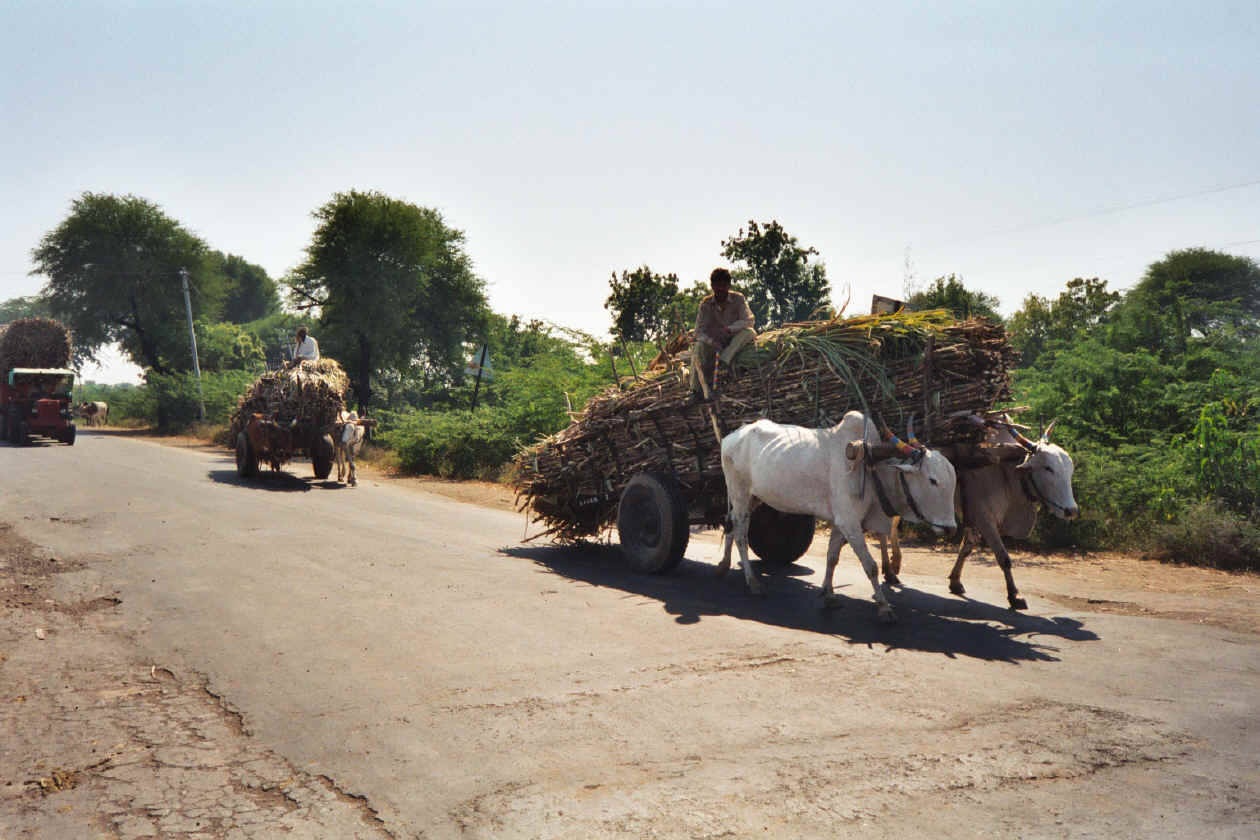
Sometime back there was a shortage of cane since there were many takers. There was talk of ethanol doping of fuel, the liquor companies where in attendance too, the gur producers and of course the sugar refiners. As a kid, I remember seeing serpentine queues of bullock carts laden with sugarcane waiting to offload their ware at the local sugarcane factory. I am not sure if you know but sugarcane needs to be processed immediately upon harvesting, else the sugar content declines rapidly. But a year or so back, we heard of millers coming directly down to the farms to collect the produce. This is a cyclical stock and once you see such un-natural behaviour (home pickup), it is almost sure that the good times are about to turn.

The heady demand drove up cane prices and the sugar producers had to stock up on inventory procured at very high costs. They are still holding on to these stocks. Since sugar prices are coming down now, the sugar companies have no option but to eat this cost. Further, since the Indian monsoon seems to be ok ok this year, there will be fresh produce coming into the sugar mandis later this year. Which will cause prices to fall even more. Also, there is a wide acceptance of the fact that the RBI might increase domestic interest rates. I do not know offhand, how much debt is carried by the sugar producers, but if they indeed do – then its one more nail into the coffin. Domestic brokerages have thumbed the sector down – many are predicting a 30% – 50% drop in quarterly profits.

Only deregulation of the sector can spike up the sector. But one wonders why talk of deregulation always surfaces when the sector underperforms. It is again a digital event, not in one’s control – and with Mr. Sharad Pawar overwhelmed with work, this is one coin flip which we’d rather ignore. These are cyclical stocks – roller coasters, ferris wheels, etc. Lets have them increase their P/Es first and then look at investing in them. Depressed earnings of cyclicals reduce the denominator of the P/E ratios and therefore they become attractive when their P/Es are high.

Godrej Industries Limited

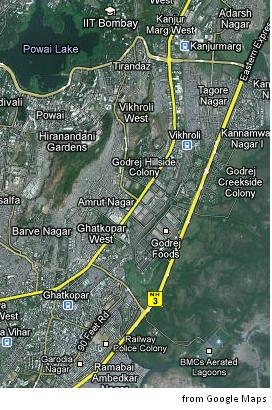
Once while coming to work in an auto-rickshaw, I had the great fortune of being driven by an extremely chatty driver. The good man had loads of original theories on how to solve India’s population problem. Uttar Pradesh (UP) in particular. I’m sure you must be aware of the standard chestnut where applicants to consulting or other weird jobs are called to estimate the number of some random widgets in a given geographical area. Well, this rickshaw driver sure can make it through any of these interviews. If only he was a bit more suave and lettered. In a span of a few kilometers, with wheels turning at not more than 30kmph, he picked out the population of present day UP, logically assumed the number of “useless” people above 50 years and under 10 years of age, and logically devised a plan to eliminate them etc etc. While we turned an oft turned turn, he got pretty excited on seeing the Godrej premises in Vikhroli (a suburb in Mumbai) and started telling me that the Godrejs are actually from UP. I was hooked though I really was not too interested in the ansectoral origins of the Godrejs. Rick man confidently asserted that the real name of Godrej (which of the Godrejs’, I dared not ask 🙂 ) was actually some XXX Thakur. I forget the first name that he mentioned but it sounded pretty lyrical. According to him, this XXX Thakur came to Mumbai penniless and worked very hard in the city of opportunities. To muck in well and to sound important, he took on the title of Godrej. “What does the name mean?”, I had asked him keeping a wary eye on the meter for my office was near. He did not know. We’d turned off the main road and gotten inside the office premises and this guy got further excited upon noticing a railway line that passes behind the building. According to him, the Godrejs wanted to build a railway station bang between Vikhroli and Ghatkopar (neighbouring suburb to Vikhroli) but could not since they would not bribe – or something to that effect. It was a very interesting trip (some 7 – 8 months ago) – before this there was also some talk about a lady doctor who used to hire his vehicle daily and a young woman who used to work in the doctor’s clinic, but that story is out of context and a bit crass to mention. But please do pick the brains of auto rickshaw drivers of Mumbai (or any Indian city for that matter) – they are quite a chatty lot and they work quite hard.

So that was it – but I think that there are two points here about the Godrej Group that seem true. First is regarding corporate governance and citizenship. It’s one of the most respected business groups in the land and for good reason. I really don’t know (nor care) if the story regarding the railway station between Ghatkopar and Vikhroli is true or not. The second point is that Godrej & Boyce has given a massive, Massive, MASSIVE chunk of land in Vikhroli on a 99 year lease to Godrej Industries Limited who have further given the developmental rights to Godrej Properties Ltd. (IPOed in Jan ’10). Now, in 1985 there was a company called Sea Breeze Construction owned by Mohan Khubchand Thakur and Desiree Mohan Thakur which came into the Godrej fold in 1989. So that’s how this yarn must’ve been spun!

Anyway, maybe the rickshaw drivers of India deserve a seperate post for themselves but the real purpose of this entry is to record one of the things that has been occupying my mind for fair measure: Godrej Industries Limited as an investment opportunity. I had some excess cash recently and wanted some parking place for it. Fixed income is not really me – bonds/debentures and National Savings Certificates, Company fixed deposits et al.  I bought some amount of gold (in the form of units of an Exchange Traded Gold Fund) but I still wanted some occupation for my idle funds. Finally, I picked up Godrej Industries as one of my core holdings. Equity is where I usually am and equity is where I usually will be for the next decade or so.

While there are short term predictions by various “experts” that the share price will reach 184 – 190, this is one purchase of mine where I haven’t stared at the charts too much. For the following reasons:

  • Its a holding company. Usually, in India – holding companies always trade at a significant discount to their net asset values. If someone does a sum of parts of all the asset values of a holding company, compares the sum with the current market cap and therefore presents a “deep value” kind of spiel, please do not give in. Caveat Emptor. Discounts of 40% – 50% are also not unknown.
  • Market is almost always right. On the very rare occasions where it is not, the effect can be seen quite tellingly on the charts. Moreover, well known, highly capitalised and liquid counters are covered very well by the stock analyst community. Information tends to me less assymmetric (though in India, you never know!) – which means that the chances of hitting a home run based on some insider info is rare. Moreover, we all must feel some security and trust in a name that has been synonymous with locks in India.
  • But I read somewhere that the market does not or does not want to see too far out. It’s view is limited to 6 – 9 months. For good measure. The market participants which ring in the most volumes – who are not you or I – need to keep an eye on churning their capital. Most of it borrowed.

So why look at charts excessively, if its sticky money that you want to deploy? And as I said in a previous post – it’s not when you buy that matters. It’s your selling point that makes all the difference.

Not that I looked at anything else, for that matter. 😐

It gives us a diversified play – property, consumer goods, agrovet, chemicals, etc. The “etc.” is not an after thought – there are indeed other small diversified business units. For example, going back to my autorickshaw trips – earlier I used to wonder as to why Geometric Software’s office is in Godrej’s property (same locality as the venue of the opening narrative) – but there was no motivation to find out – recently (as a result of reading up on Godrej Industries) realised it’s Godrej connection. Godrej Industries owns 100% of Godrej Chemicals, 75.2% in Godrej Agrovet, 69.4% in Godrej Properties, 23.4% in Godrej Consumer Products, 43.4% in GHL. Price discovery seems full (maybe even a tad high – who really knows what discount to its NAV is ideal?) – but to me it looks to be a steady compounder over 4 – 5 years. Godrej Properties came out with an interesting concept – of real estate developers not necessarily having to own the land parcels on which they build. The company also announced plans of increasing their focus on low income housing. But the jewel in the crown seems to be the Vikhroli land. All this is known since ages and factored into the price – but the market is sometimes myopic. So maybe the game is on.

At first glance, the PE also looks high – but companies that are turning around and turning black – usually have high PEs which fall back in line as the earnings catch up.

My notes on this are quite long and there’s really no point in going further. Maybe I will restrict writing about Godrej Industries once a quarter. Two last points

  1. I really like shopping at Godrej’s Nature’s Basket. Mostly in Mumbai, a couple in Delhi and Bangalore. One Mumbai outlet is bang below my home. Till date, if I have ever cooked anything – the ingredients have been purchased at my local Nature’s Basket outlet. Will post pics of my cooking disasters later.
  2. 4.5 acres of land in Mulund (another suburb in Mumbai) recently changed hands at ~200 crores.

License to Bank

The Finance Minister during his Budget speech for the year 2010-’11 had promised new issuances of banking licenses to private sector players and Non Banking Financial Companies (NBFCs). Which really seems to have lighted up hopes and share tickers in anticipation of the grant. It could very well be a grand party, but the RBI promptly stepped in on the back of this announcement (post the Budget ’11 speech and the subsequent soundbytes) declaring that all the norms of due diligence would be strictly adhered to and that a few more screws would be tightened. We all now await the screws. I have a feeling that the apex bank may not be too keen to dole out banking licenses to corporate houses and might toy with upping the net worth criteria (currently Rs. 300 crores). The policy announcement regarding these eligibility norms are now awaited – expected shortly.

I think such prudence is called for, whatever be its reason. The Indian banking sector has come out relatively unscatched from the global banking turmoil partly because of the fact that it’s still small in size in comparision and closed (to the outside world of free capital flows). Seeking a widening of base by inducting new players into the fold seems to be the right thing to do at this point, but will more of the same spread the roots? One of the most important functions that banks serve is to lower the cost of capital available for economic activity. They can do this since they have access to low cost funds – the interest that banks need to pay on current accounts and savings accounts (CASA) is lower that what an institution would have to bear if it were to raise the money from other sources. This therefore lowers the hurdle rate that the economic deployment of such funds should earn.  That explains, in part, what has got the NBFCs and the private financial institutions all excited. But apart from that there are other parameters which also might get considered by the RBI – those of geographical coverage and reach into the poorer sections of the society. I later pick on two institutions (towards the end of the post) which I feel are good candidates, each covering one of these two objectives with one of them also being a prime trading call from my perspective today.

But some history first: RBI seems not to be too inclined towards this policy and looks like it has had to toe the line cast by the Finance Ministry. The last time that this was done was in the early ’90s. In fact, no new Indian bank  has been set up since the advent of liberalisation in 1993. Some of the NBFCs that were allowed to get converted into banks were Yes Bank, Kotak Mahindra Finance Limited and 20th Century Finance. While Kotak diversified into full service banking services, 20th Century Finance became Centurion Bank and was eventually taken over by a bunch of private equity investors only to finally land in the lap of HDFC Bank. HDFC Bank itself started life in the early ’90s and along with Axis Bank (formerly UTI Bank) has become a very successful private Indian bank. Then there was the case of UBS that had to wait for nearly 3 years before getting its banking license from the RBI. The matter had to do with disclosure norms and UBS being a Swiss Bank (perceived to be stolidly protecting of its customers’ interests and assets) may not have been too comfortable disclosing certain information about its customers, including Hasan Ali Khan, the Pune based stud farm owner. Standard Chartered Bank was not allowed to sell off its Mutual Funds business to the UBS Securities. SEBI had barred UBS Securities from issuing offshore derivative instruments for one year.  Was this a tactic to delay, we know not, but for sure what comes out is that the Indian banking scene is tempting enough for global players, burnt from the sub-prime arson, to ignore. Recently, the Credit Suisse group received the green signal to start core banking activities. In December of last year, the RBI finally accorded its assent to convert the Orissa State Cooperative Bank into a full fledged bank. It had to wait for 43 years till it became eligible to sit on the high table. Interestly, of the 31 state co-operative banks, only 15 have managed to secure banking lincenses. The deadline for them expires in 2012.

Given that backdrop, lets look at the names published in the media regarding the current hopefuls: Reliance Capital, Bajaj Auto Finance, Mahindra & Mahindra Finance, L&T Finance, IFCI, Indiabulls, Religare, Aditya Birla Financial Services, SKS Microfinance et al. The CEO and MD of IDFC has ruled out his company from applying. The news certainly seems to have set the shares of some of these companies on fire – with a promise of more to come.

There are two companies that I want to mention. First being SKS Microfinance, which has submitted its (draft?) Red Herring Prospectus (RHP) for its IPO that is soon due. I guess it should also be keen to apply for banking license. While I don’t know what happens in such cases – i.e. when the objects of business change drastically enough to warrant a re-look at the financials, prospects etc, then does the RHP have to be pulled back and re-submitted? While there may be an ethical debate regarding SKS Microfinance and the threat of defaults on micro-lending activity might be higher, the logic that such companies can reach the poorer sections of the society and introduce banking to them is impeccable. The fact that N.R. Narayana Murthy’s Venture Capital (VC) fund Catamaran Investment Pvt. Ltd. may also dip its toe will definitely make people eye the IPO.  Is the Bangladesh based Grameen Bank a full fledged commercial bank? Need to check, but to borrow a line from my previous “Hot Pani Puri” post: Micro sized sales units sold at low prices but in large numbers is the essence of India. But I do not apply for IPOs so no show there for me.

The second company being IFCI. It has been playing quite a tango with the Government so far and seems to be a prime candidate for receiving a banking license this time around – solely for that reason alone. The Government had wanted to divest its stake in IFCI and had made an announcement in early 2007 but the front running joint bid from Sterlite Industries & Morgan Stanley got stopped in its tracks since the Government would not come clean on what it proposed to do regarding the conversion of institutional debt (that IFCI held on its books). If this was to be converted to equity, then it would obvisouly be less attractive to the winning party. So the party was called off. The Finance Minister (Chidambaram) must have smarted privately and had promised to make amends in the future. Given that the banking licenses are now to be handed out, interest in IFCI has peaked and the stock has moved up well. IFCI had earlier made an attempt to make itself into a bank, but that earlier attempt had failed. All others (ICICI, UTI, IDBI, HDFC) went ahead while IFCI was left out. But It looks likely to pass muster this time. What will happen if it becomes a bank? Its cost of capital will come down improving its profitability and new avenues of business will open up. It would be fair to compare it with the valuation ratios of other banks and expect the market to crank up its valuation of IFCI to match these levels.

For the year that ended Mar, 2010, the equity base is Rs. 738 crores and its net worth is Rs. 3,152 crores. Given the face value of Rs 10 per share this gives a book value of (3,152/73.8) = Rs. 42.7 per share. The Current Market Price (CMP) is Rs. 56.75 (before opening bell on 5th July, 2010) giving us a P/BV ratio of 1.32. The PAT for the previous financial year was around Rs 671 crores giving us an earning of 671/73.8 = Rs. 8.55 per share. This implies a trailing 12 month price to earnings multiple of (56.75/8.55) = 6.64. Lets compare that to the number that other banks are reporting:

Incidentally, the reason I’ve highlighted Karur Vysya Bank in red is because that was a trading call I’d entered into at Rs. 475 on 27May’10. Translates to a 25% return in 39 calendar days. The reason I’m digressing is because I am now faced with a decision on whether to hold or sell. Which will be the subject of one of my future posts. When to buy is not the important thing, when to sell is the most critical piece. What do you think? Should I take the money and run?

Now, coming back to IFCI, its logical to expect the share to jump up to a 10x earnings multiple if it becomes a bank and increase its P/BV ratio by 50% to bring it somewhere in the middle of the table. Therefore, lets watch it up to Rs 70 per share giving a return of 23% or so (hopefully). I’m getting in given the above logic, however will be ready with an appropriate stop loss should something spook the banking license party.

Design a site like this with WordPress.com
Get started