The Bond Bubble

The bubbling stories going around this week in the financial blogosphere have mostly centered on the heady climb of US treasuries. In fact the topic has been quite hot the past month but the din is getting louder now. Comparisions with the dot com bubble and the housing bubble have started doing the rounds. The yield on the 10 year US paper is currently around 1% now. Which means that if you freeze the frame today, it will take a hundred years for the interest component to add up and match the price you pay for such bonds today. The P/Es (inverse of yield) of the no-brick and no-mortar tech companies were also in the heady hundreds during 1999-00. I don’t have too much of a view since it’s all happening outside of our shores. The Small Investor writes about it here as also the links I’ve listed below: it’s important enough for us to pay attention since we have NOT decoupled ourselves from the west. It’s actually the FII money that’s driving up our local markets here. Hot money.

  • FT Alphaville on the conundrum that equity prices and bond price are now moving in step. i.e. UP!

Logically, I’d guess that the bond market is bigger, more liquid and less amenable to manipulation. So, if the bonds and the stocks are sending out conflicting messages, should one not trust the former?

However, are bond markets better predictors of the economy? I think not: since nominal GDP growth and interest rates are both driven by inflation. Correlation is NOT causality. It’s a mistake many make – if two lines A & B move in tandem, that does not necessarily mean that A and B have a causal relationship. There could be a third factor C which is driving both A & B. So, bond prices are ↑; equity markets are ↑; economic data (US) is ↔. Thats the confusion. 

  • A website called bond-bubble (what else!) has come up and the graph on it’s homepage is quite telling.

It shows the super steep rise of US public debt – almost a parabolic rise. To me this looks similar to the rise of the Chinese stock market. That looked parabolic as well ( y = 4 * A * x↑2) and it could not defy gravity. But can US debt come crashing down? Maybe – if the currency crashes.

  • That seems to be awesome news for the gold bugs! It makes the case that the bursting of the bond bubble will pave the way for a massive upsurge in gold prices. The article notes that the yellow metal shines brightest in three situations – “heightened economical/financial risk; outright inflation and/or deflation”. And therein makes the case for a coming Gold bubble! Marc Faber,  (who keeps telling people to buy gold) has been bearish on treasuries right through the start of April but no one seems to be listening.

 TULIP SOUTH SEA RAILROAD ROARING TWENTIES → POSEIDON → JAPAN → DOT COM → HOUSING → BOND → IS IT GOLD NOW? 

This is making people like me (the “half informed”) even more nervous now. Ignorance is bliss – part knowledge is most painful. Anyways, the local markets are frothing on all the money that’s coming in from the US. The Fed there is busy buying up treasuries and sloshing money in their system (to buy the bonds, the Fed has to release money by paying whoever is holding bonds). They’re doing it by working their printing presses overtime spooking inflation. But I guess the game with inflation is that if you whack it too much too fast, the thing just snaps and the party careens towards deflation. I wish I had paid more attention during my economics classes. But to me it sounds logical that what comes in, goes out. So, this money will go back from where it came (at least in the interim). And all will fall down.

Though there is some more ground for the NIFTY to cover. That’s what the “experts” here are saying. The market isn’t fully stoned yet. It’s just started rolling the weed, maybe a few drags….let’s stop hallucinating. In 2008 so many of our local “experts” were shouting out that India is decoupled and that the housing bubble will not effect us. Even politicians had joined the chorous. De-coupled my moon. We are as joined to the US hip as our big bro in the vicinity.

Maybe I’ll be able to call the top.
Reliance Industries Limited

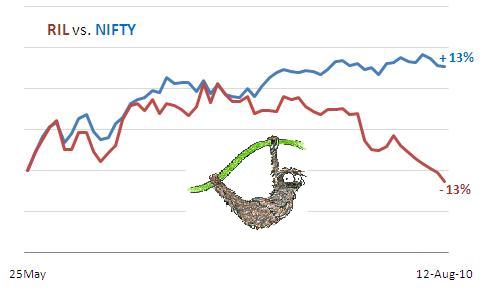
The biggest sloth in recent times has been the Reliance Industries (RIL) stock. As the market (i.e. the NIFTY) traipsed on from 4,800 to 5,500 in a matter of 3 months (~15%), I have been licking my chops (no, I do not work in the chop shop) and have been generally sporting a nice spring in my step. But now I do not know how long my sunny demeanour will last for I have just about picked up a biggish position in RIL and am squarely on the path of Mukesh Ambani. It’s a trading call, unlike the Godrej Industries investment of mine. I feel quite sanguine about the Godrej depoyment, but not so about the RIL punt. The former has careened up 22% (weighted average returns) in 2 months for me and I will surely add to the position should the stock correct in the future. There was news and informed criticism of the US Fed’s solving of its debt related problems by adding on more debt. It definitely means that they’ll have loads of cash sloshing around in their backyard which they will want to deploy in high alpha economies. So some of it will come to India and that may take our local market higher on from here. But since this is hot money and the investment managers need to keep booking profits, sure enough and soon enough the market should correct. Will give some more cash to Mr. Adi Godrej to manage when that happens.

But coming back to flirt with RIL, I have gone long the stock (cash) and have also bitten a bite of the 30Sep 1040 call. There is next to no liquidity (as of now) on the Sep call and maybe the informed, knowledgeable pundits will shake their heads – but I feel that I have a story. I almost never get my options right – the brokerage charges are also too high for my liking and moreover you need to A) be understanding of the math behind how option pricing works in reality and B) be nimble enough to strike (both in and out) at the right moment.

Earlier, I had briefly written about the drowsiness in the RIL counter here and have been keenly watching this oily worm every other night. As you can see from the chart, it has slithered down to 970. The Bollinger Bands and the RSI seem to be giving a buy signal unless the stock is stuck in a downward channel. Then it would be akin to catching a falling knife. These technical indicators work best when the underlying is smugly oscillating in an escalating envelope. Anyway, I have my grip on my stop losses. If one fears or loathes getting wet, then one should not venture into the sea. But remember, only deep sea fishing gives the largest catch. I also scoured the internet to see some reason behing this very sleepy state of this behemoth – at least on the bourses. there are a few things happening (as listed below) but I do not know if they matter much. You may be aware of the old chestnut about the market being a voting machine in the short term.

  1. They’ve started pimping their pumps. They are selling at same rates as that of the PSU oil retailers. I remember some of my trips around Bombay – the Reliance pumps were always closed. The price decontrol announcement by the Government seems to have opened up the nozzles at private oil vendors like RIL and Essar Oil (have a position there as well). BTW, one comes across a very interesting string of letters when we read about fuel retailing trade lingo – DODO COCO CODO (Dealer Owned Dealer Operated – Company Owned Company Operated and Company Owned Dealer Operated). Notice the absence of DOCO.
  2. Maybe the stock has been moribund due to the announcement of RIL’s acquisition of shale reserves in the US? Perhaps the markets did not like it?
  3. The company is going to raise some money by selling off some of its treasury stock. Is that why the stock has been tied down while the rest of the market was inching up?
  4. I think the real reason has been the orchestrated downgrading of RIL by some domestic and international brokerage houses towards the end of July based on the realisation that the KG Basin may not be able to pump out as much oil and gas as what was expected/communicated by RIL. So it’s like the force of gravity acting on a balloon. Things seem to have reached a state where the forces of buoyancy (market rising) and the forces of gravity (broker downgrades) have been counterbalacing each other. Any trade is now a bet on what gives.

My personal take is that RIL is too complicated a business to understand. I do not know how many brokerage houses themselves understand it’s business thoroughly. But the brokerage community lives by its own code – one of them being a shared recognition in the importance of belonging. There’s tremendous security if the whole bunch believes in, talks about and does the same thing. While you are not better off, but most importantly you are not worst off either. In fact there has been a book called Zachs method of investing whose central tenet is to make investing decisions based on a statistical analysis of brokerage ayes and nayes.

STOP LOSS. DONT THROW GOOD MONEY AFTER BADNot that I can claim to “undestand” the companies that I invest in. You really have to be a senior member of the insider team to know it all. But since the trajectory of the Indian market has been upwards during this past decade, it would take a terribly unlucky bloke to lose money on the markets – on a longer term basis. For me one thing is clear – most of the experts who I lend my eyes to are saying (in print) that there seem to be no signs of the market having topped out in the intermediate term. The logic therefore is that if the market needs to move up and reach it’s intermediate top (before the hot money decides to leave our shores), RIL needs to perform. Hope I get lucky on these punts. Stop losses are my pillows.

Sugar me baby

Sugar me baby, NOT.

The problem with too much of a fixation on charts is that we sometimes tend to ignore their non causality. Past patterns may not repeat. Just because a stock is at its 52 week low/high does not automatically mean that it will start rising/falling. In fact, quite the opposite. Momentum surfers say that, if accompanied by strong volumes a rising tide is likely to rise further and a sinking ship is bound to plunge deeper. Trouble is that we amateurs tend to sell too early (“too much of greed is not good”) or hold on to falling lines sliding further. That is what I had in mind when I said (here and here) that its not important when you buy – when you sell is what determines your worth. Another category of misadventures has to do with those with blood on their hands as they attempt to catch falling knives. Many look at a 6m or 1yr chart, and buy into a stock if they see that its fallen quite sharply. These are  people hopping onto a slide midway in the hope that the slide will magically metamorphise into a roller coaster and take them up. While they lose lesser than the ones who have been around at the top before the slide, it hits the ego more. Guys who have been losing money on a losing investment for some time seem have turned accepting to the fact that they have hit a rough patch and bravely ignore  further losses. Guys who get in fresh in the middle of a drop have to brace themselves for the stock market equivalent of a tight slap.

If there’s some sudden, extraneous shock (the PIIGs dominoing themselves to bankruptcy, terrorist strikes, political events, my turning up to work in pink  corduroys, et al) then it can help to get in during sudden drops. Else, it’s not so simple. Better bet would be good stocks that have done nothing and might be on the verge of a breakout. See the chart of Reliance Industries Limited (RIL), for instance – there has been a reconcilation between the brothers, global energy stocks are firming up, entry into communications and power…but the RIL stock has been sleeping.

On the other hand, one sector that has definitely turned quite bitter of late is sugar. Take a look at the chart alongside – while the NIFTY has done a handsome 23%, the sugar stocks have fallen from 12% – 32% during the past 12 months. EID Parry has trumped the NIFTY though to return a nice 46%, but then only 65% of EID Parry is sugar. Now, I do remember a colleague of mine buying into one such sugar producer and losing quite a bit in the bargain. Not a sweet deal at all. Same has been the case with Airtel. A couple of people I know bought into the leading telco, drawn by its image and brand name hoping for a quick rebound. But the rebound has not come about and they are still ringing up losing numbers.

Food is not good here in India. The stomach turns to see so many people going hungry only to realise that mountains of rice are allowed to rot in the Food Corporation of India’s (FCI) godowns.  The Indus Valley civilization taught us to build granaries but somewhere down the line we forgot how to manage them. Its pointless to blame Mr. Sharad Pawar since he is, by his own admission, quite overworked. I am not quite sure what role the food ministry mandarins have played in the local sugar mandis, but the the picture looks bleak for these cane crushers.

Sugarcane is quite a popular crop back there in my village. Its yield per acre is high since these grasses can be planted quite close to each other. Its almost impossible to venture deeper into the growth since the stems are quite stubborn and the rough leaves do scratch and irritate the skin. Wild boars gorge themselves on the canes and I remember my cousins/uncle/labourers taking turns watching over the farm under the starry skies.  Later in the morning it was always a pleasure to watch a village belle walking around, with unkempt hair digging her incisors and tearing into the outer skin of a sugarcane stump with a beautiful ferocity that can now be matched with the savage manner in which some investors have been mauled into losses over these stocks.

Sometime back there was a shortage of cane since there were many takers. There was talk of ethanol doping of fuel, the liquor companies where in attendance too, the gur producers and of course the sugar refiners. As a kid, I remember seeing serpentine queues of bullock carts laden with sugarcane waiting to offload their ware at the local sugarcane factory. I am not sure if you know but sugarcane needs to be processed immediately upon harvesting, else the sugar content declines rapidly. But a year or so back, we heard of millers coming directly down to the farms to collect the produce. This is a cyclical stock and once you see such un-natural behaviour (home pickup), it is almost sure that the good times are about to turn.

The heady demand drove up cane prices and the sugar producers had to stock up on inventory procured at very high costs. They are still holding on to these stocks. Since sugar prices are coming down now, the sugar companies have no option but to eat this cost. Further, since the Indian monsoon seems to be ok ok this year, there will be fresh produce coming into the sugar mandis later this year. Which will cause prices to fall even more. Also, there is a wide acceptance of the fact that the RBI might increase domestic interest rates. I do not know offhand, how much debt is carried by the sugar producers, but if they indeed do – then its one more nail into the coffin. Domestic brokerages have thumbed the sector down – many are predicting a 30% – 50% drop in quarterly profits.

Only deregulation of the sector can spike up the sector. But one wonders why talk of deregulation always surfaces when the sector underperforms. It is again a digital event, not in one’s control – and with Mr. Sharad Pawar overwhelmed with work, this is one coin flip which we’d rather ignore. These are cyclical stocks – roller coasters, ferris wheels, etc. Lets have them increase their P/Es first and then look at investing in them. Depressed earnings of cyclicals reduce the denominator of the P/E ratios and therefore they become attractive when their P/Es are high.

Design a site like this with WordPress.com
Get started