NIFTY Total Return Index

Dividends now represent 27% of the total return index of the NIFTY since the start of 2000. What this means is that assumming that the changes in index constituents are pari passu, if the dividends issued by the component companies of NIFTYwere reinvested/reconsidered back into the NIFTYcalculations then the value of the index would roughly be around 6,728 (27% more than the current NIFTY value of 5295, as at 1Apr’12). The Total Return Index (TRI) tracks the capital gains of the NIFTY stocks and assumes that any cash distributions, such as dividends are reinvested back into the index. The German stock market DAX is an example of a TRI while NSE distributes historical values of its TRI here.

I downloaded NIFTY TRI and played around with the data trying to find some patterns and inferences. The first chart is a simple compare of the NIFTY TRI (dark green line) against the NIFTY (dark brown line) with the difference between them shaded in light green. The gap between the two indices is also shown in the second chart. I am unable to make any meaningful conclusion from this chart.
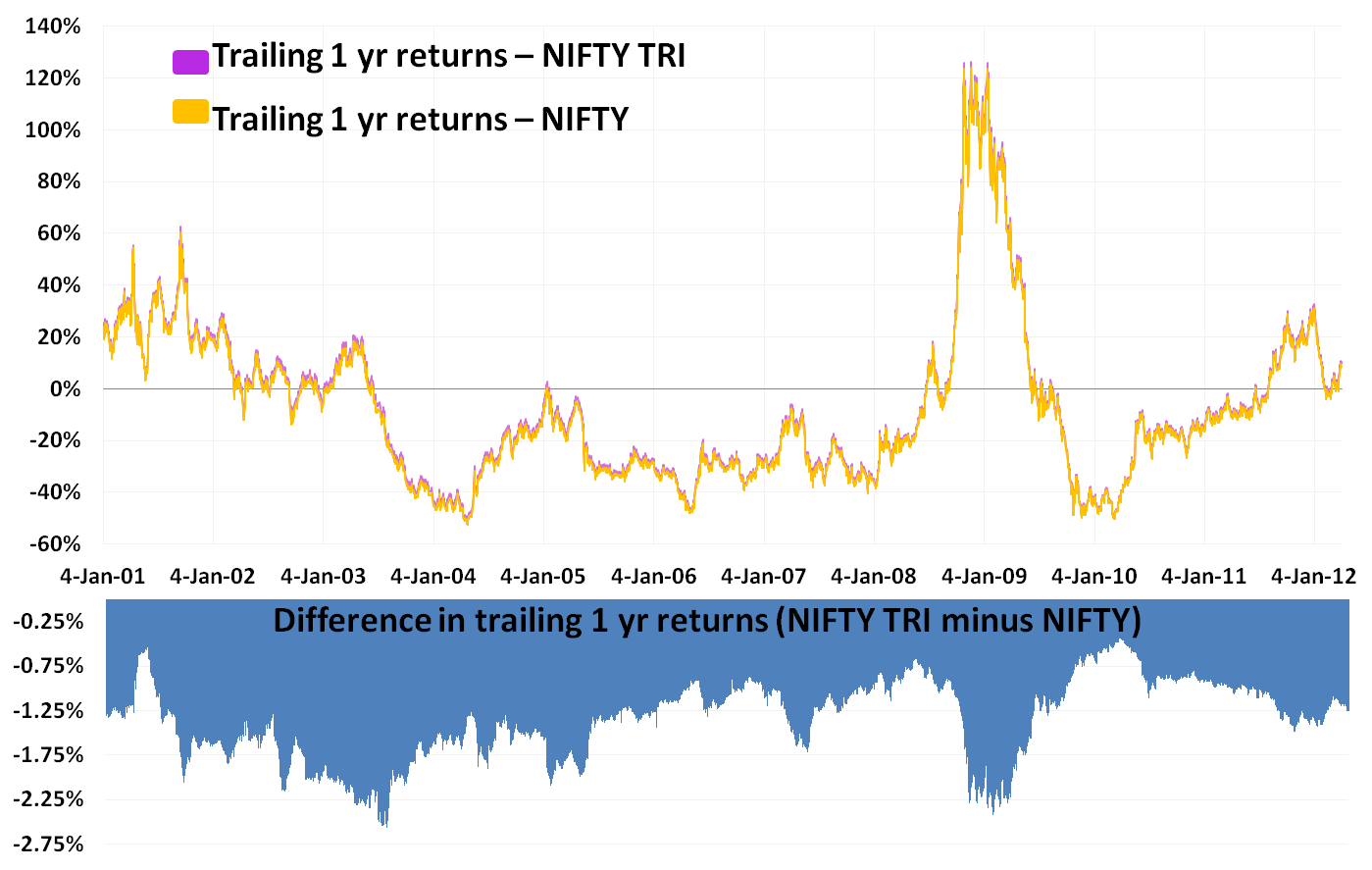
The third chart is interesting. This shows a comparision of the continuously trailing 1 yr returns of the NIFTY TRI compared with the trailing 1 yr returns of the NIFTY since 4Jan2001. Given that the NIFTY continuous 1 yr returns have swung widely over a +120%  to -50% range during this period, the difference between the two lines is not noticeable at all. The small footer chart shows the difference between the two series of 1 yr returns. What came out was that the trailing 1 yr returns of the NIFTY are always greater than the trailing 1 yr returns of the NIFTY TRI. Duh. This did not make any sense to me. I guess the major insight, though unrelated to the topic of the post, is the amazing wild swings in the trailing 365 day returns of the NIFTY. Can anyone spell V  O  L  A  T  I  L  I  T  Y for me? 🙂 

NIFTY Volatility Index (Part 2)

 In my previous post I had talked about the high negative correlation between the VIX and its underlying, the NIFTY. The chart on the right shows the actual movements of the NIFTY compared with the corresponding VIX moves. The period covering Mar’09 to Sep’10 marked a very rapid increase in the market (NIFTY rose from 3000 levels to 5,500). Since the VIX indicates volatility, the period at the start of this phase saw the most rapid increase in the NIFTY (in percentage terms) and that is why the VIX readings were above 40% during this time. The period from Sep’10 till date however have seen the market mostly move in a sideways direction. It started off around 5,500 in Sep’10 and is now at the 5,300 levels. Accordingly, if you look at the VIX, it has also remained mostly flat. Now, the big thought in my mind is this: we hear mostly bullish noises these days. Golden Cross; correction within an overall bullish trajectory etc. So, if the negative correlation were to hold and the NIFTY were to move up from now, it is logical to expect the fear (i.e. VIX) to come down from its current levels (~24%) t0 something like a 15% (?) or so. Since the start of this chart (chosen since that is the date range for which NSE publishes its VIX values) marked the markets coming out of a rather exceptional period in its history (global banking sector meltdown), VIX values > 40% may be really rare to come by again in the near future.  I have nevertheless plotted a dotted red line on the VIX portion of the chart which shows the median level of the VIX range. In the event that the VIX ‘reversion to the mean’ becomes a reality in the months to come then I guess we should brace ourselves for another secular fall in the NIFTY. If you take the economic events near the starting period  of this chart to be exceptional, and ignore the corresponding VIX values as outliers, then the new median will be quite close to where the VIX is today (22% – 24%) in which case there is definitely a case for it to fall down to late teens/earlier twenties. As you can guess I am rooting for a rise in the NIFTY and trying to twist my data interpretation to fit that notion!! 🙂

 The correlation factor in the above chart comes in at a high -0.83. Why such a high number? The reason could be because increased volatility (i.e. high VIX) signifies more risk. To keep their portfolios in line with their risk preferences, market participants must deleverage. Since long positions outweight short positions in the market as a whole, deleveraging entails a lot of selling and less buying (since the longs have to be shortened). The relative increase in selling causes downward pressure on stocks. The volume rise in the NIFTY puts really drives the VIX up. The NIFTY VIX is a weighted sum of puts (strikes < forward) and calls (strikes > forward) on the NIFTY. The weights are proportional to 1 / [(strike)^2]. As the NIFTY goes down, all the out of money puts become more valuable and those start having the highest weights (since the weights are the reciprocals of the strikes).

The unit of measurement of the VIX is in percentage terms. Its value essentially signifies the % expected movement of the NIFTY over the next 30 calendar days. So, for example, since the value of NIFTY VIX was 24.33% (on 29Mar’12), what the market is essentially saying is that it expects the NIFTY to move (either up or down) at a 24.33% annualized rate over the next 30 days. This implies that the market is pricing in a 24.33% /SQRT(12) = 7.02% movement at current levels over the next 30 calendar days. Which btw, is huge! In terms of confidence level, this means that the near term options on the NIFTY are being quoted with the assumption of a 68% likelihood (1 sigma) that the magnitude of NIFTY’s 30 calendar day return will be less than 7.02% (either up or down)

Taleb here points out how even seasoned market participants wrongly derive mean deviation (the 7.02% deviation as at yesterday’s close) from measures of standard deviation. My uninformed take on this is that if all are consistently making this error then that becomes the norm. Consider for instance, that a standard market data provider like Reuters or Bloomberg inadvertently distributes erroneous reference data – since both sides of the trade are using that same value, it becomes the de-facto standard and no one is out of balance.

VIX as a trading indicator: Since the VIX is a measure of dispersion and has a reversal to the mean property, all the standard technical indicators like RSI, Bollinger Bands etc can be used as identifiers for trade entry points. Since we do not have derivatives on the VIX in India yet, these technicals can give entry points into the underlying (i.e. NIFTY) by inverting the logic (buy for VIX would be a sell for NIFTY) due to the high -ive correlation between NIFTY and VIX. There have been studies which point out that the 2 period RSI on the VIX gives a very good trading signal. If the RSI (2) of the VIX >90, then buy the underlying and if RSI (2) < 30, then sell the underlying. Underlying = NIFTY in our case. I do not have any ready charting software at hand, so I will have to painstakingly generate the RSI values in a spreadsheet if I have to test and see how this really could have played out on historical data. Maybe fodder for a future post… 

NIFTY EPS vs Price (update)

This is a continuation of the chart I had prepared and posted on 04May’11 here with newer data points pertaining to the intervening period in between. The trailing NIFTY P/E has indeed fallen from a level of 20.58 (04May’11) to 18.65(23Mar’12). Here’s the updated chart:

The smaller image on the right is the earlier version of this chart. There, I had done a straight line extrapolation of the most recent behaviour of the chart and predicted that the line will fall down and gradually approach an index value of 5,200 and a trailing P/E level of 18. What happened in reality (the bigger chart above) was more severe. The line moved down quite sharply (NIFTY dropped to 4,750 at one point) and rightward as well (expansion in EPS). Not that I profited too much from all of this. I am always long, so loss aversion by staying in cash/gold is my equivalent of profiting from a long/medium term, secular drop in markets. Ergo, I  havent lost much money in the interim and have ridden the dotted red line. Now, I had mentioned something called ‘cycloidal’ in my earlier post when looking at the chart – strangely enough, the line did indeed fall and is now even curling inwards, just like those cycloidal mathematical curves and/or their variants would. I don’t understand the pulse of the markets enough to figure out why this is the case but yes, we can at least look at the chart here and form our own conclusions.

TV Everywhere? Or Nowhere?

Delhi, Mumbai, Chennai and Kolkata will replace all analog telly networks with digital ones come 1Jul’12. That’s causing a nice fight to develop between Multi System Operators (MSOs) and the Direct To Home (DTH) gang. The last mile connectivity providers, i.e. the local cable operators were being squeezed in between. However necessity has forced Dish TV, a DTH company to innovate by tying up with the local cable companies. The local cable companies will serve as the distribution channel partners of Dish TV and also as sales ushers by pushing the Dish TV set-top boxes in cable households to coincide with the first phase of cable digitization which begins on 1Jul’12. All very nice and funny since Dish TV earlier used to tout itself as a business which provided an alternative to the monopoly of the local cable guys (see pic alongside)! Very confusing since now there are news that the cable companies are jamming signals of DTH transmissions in Mumbai and Delhi!

Will have to see how all of this plays out – DTH companies like Dish TV and Tata Sky claim that they have shelled out close to 20k crores towards digitisation. The current debt on Dish TV’s books is Rs. 1,200 crores already with much of it being USD denominated making it very vulnerable to INR’s depreciation. A bigger concern is that the promoters had already pledged a huge “dish” full of shares and now they’ve done more. Perhaps financial stretch will force consolidation in the infantile industry. The six private DTH platforms in India are: Dish TV, Tata Sky, Sun Direct, Reliance Digital TV, Airtel Digital TV and Videocon d2h.

Here’s the trailing 18 months chart of Dish TV. It is selling at its 52 week low but that is nothing to suggest that it may not go on to celebrate its 60/70 week low as well. The chart certainly looks bearish for now, but yes, the 50 DMA may very well begin its rise leading up to the 1Jul’12 deadline. My sense says avoid. At this point in time, I have not read and studied enough about this game to form any opinion at all. But yes, the fact that India has more than 100 million television enabled homes is very significant.

There is something seriously wrong in the Indian television and media broadcasting space. Even if the stocks are tempting on the technicals, the crazy amount of flux in the industry is just reason enough to avoid punting in them. There is a bit of a chorus coming out about Dish TV being under-valued and that it is a value play now that it is at its 52 week lows. It’s being pegged at a target of 80 in 24 months! There are also reports out there which are predicting the Indian television sector to grow at 17% compounded over the next 4 – 5 years! If that be the case then why did Rupert Murdoch’s News Corp sell its stake in Hathway after staying with its investment for more than 10 years? Zee split; Den networks has packed its den with debt; media companies like NDTV, TV Today, TV18 etc are moribund as ever; Sun TV got tainted by corrupting sun spots; ENIL’s mirchi is anything but hot on the bourses; and so on….

Lets Buy Oil, Not Gold

What is the difference between the professions of the Shahrukh Khan version of Don vs. the earlier one essayed by Amitabh Bachchan? The original Don was a gold smuggler while the new one pushes drugs – quite a subtle generational shift this and very much attributable to the lifting of the import duties on gold in 1992. The yellow metal had flowed in freely once the shackles were removed. The differential between the Indian price of gold vs. the UAE one reduced to a level so as to make the risk weighted returns of smuggling very low indeed. Ergo, the villians in Hindi films underwent an apt metamorphosis. Even ertswhile smugglers gave up their shady coves and wharfs and took to politics. But the smuggling never really died down – it continues to this day and the recent budgetary proposal to increase the basic customs duty on gold imported into India will certainly do its bit to not only revive this old cottage industry but also bring the old Bollywood villian out of his holster. Even godmen have dipped their toe in the pool – Swami Nityanand’s name has been doing the rounds it is said.

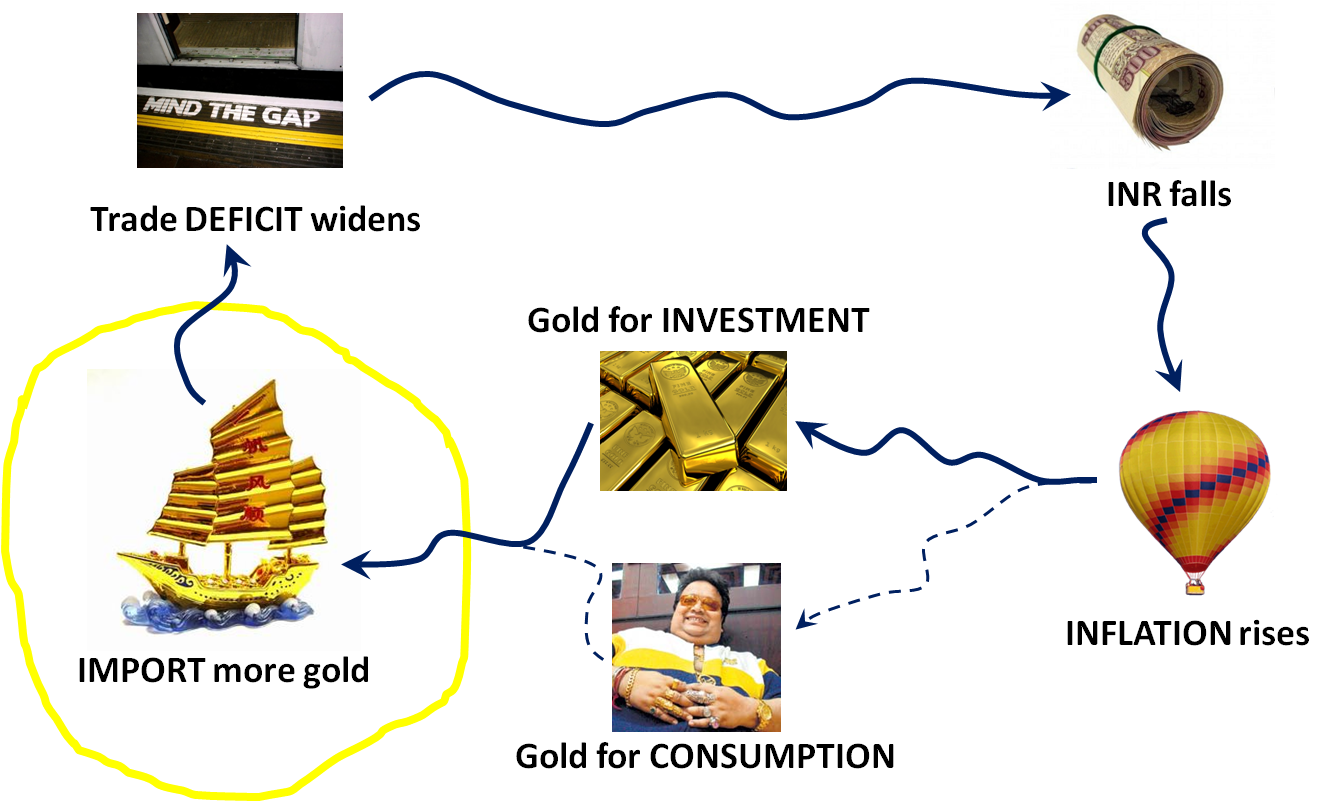
It’s a good thought, according to what I have read and understood provided that the authorities (read customs, BSF, RAW, etc) can lift up their game to apprehend all worth appprehending – it could turn out to be good for the economy in the longer run. They are saying that China looks all set to overtake India as the world’s largest consumer of gold – if the logic of the customs duty hike is bona fide, then this is one race which we’d be better off letting China win. As such China beats India nearly everywhere anyways. The chart alongside (via World Gold Council) hints at this. From the country’s viewpoint, gold holdings, are no different from foreign exchange reserves really – despite the fact that a huge chunk of India’s gold is in private hands and therefore cannot be mobilised easily if required to serve for national duty. Which is why the move to curb gold consumption (and therefore gold imports) by raising customs duty makes sense. We consumed 1,000 tonnes of the yellow metal in 2010 and another 933 tonnes of it during the next year! While it is clear that the current risk aversion trade and low tariffs have been responsible for this influx, the taps have been flowing all through the 70s and 80s – via the surreptitious route. Today, gold is now officially the most smuggled item to India having pipped television sets to the post. Which is why the government came out with a couple of gold mobilization drives to shore up the foreign exchange reserves. If this is the method that the planners of the economy are betting on to control the trade deficit, then I am guessing that sometime in the future we will see another issue of these gold swapped bonds/gold mop-up drives. Lets see. Remember, RBI had bought 200 tonnes of gold from the IMF sometime in late 2009. I guess they won’t be needing to do that anymore. The notion that the national stock of gold can indeed be considered as a proxy reserve of foreign exchange currency reserves is buttressed by the fact that India recently purchased oil from Iran using gold. Did you know that nearly a third of our current trade deficit is due to our purchases of gold.

The government, via two customs duty hikes in quick succession, is hoping to provide an external stimulus that helps the economy to break out of the current gold – inflationary cycle. The customs duty hike works in the import stage which is circled in yellow in the picture alongside.

NIFTY Golden Cross

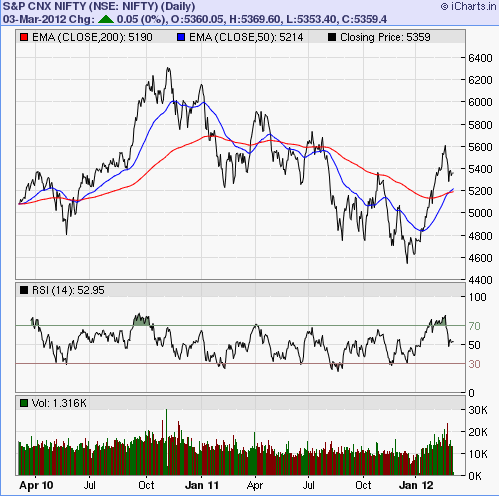
Further to the last post, here’s the trailing 18m NIFTY chart which shows that new golden cross that has just happened. The question really is – how long will the 50 DMA stay above the 200 DMA line?

NIFTY’s Crossovers

A golden cross happens when a smaller daily moving average intersects and moves above a larger daily moving average, commonly the 50 DMA squigglier line cutting above the meandering 200 DMA line. They say that golden crosses mark the transition into the bull market. Well, NIFTY sure seems to be plotting and planning a golden cross and I guess the next few days will make it clear. The budget is around the corner, so it may very well be the case of Mr. Market holding its breath, crossing his fingers and hoping that nothing stupid, unexpected or untoward happens – all the populous evil having already been factored into the price. If the day passes over (RBI is widely expected to sit out of this party having done its bit in terms of the CRR cut) then its likely that the market resumes its upward journey with the 50 DMA pulling away from the crossover point.

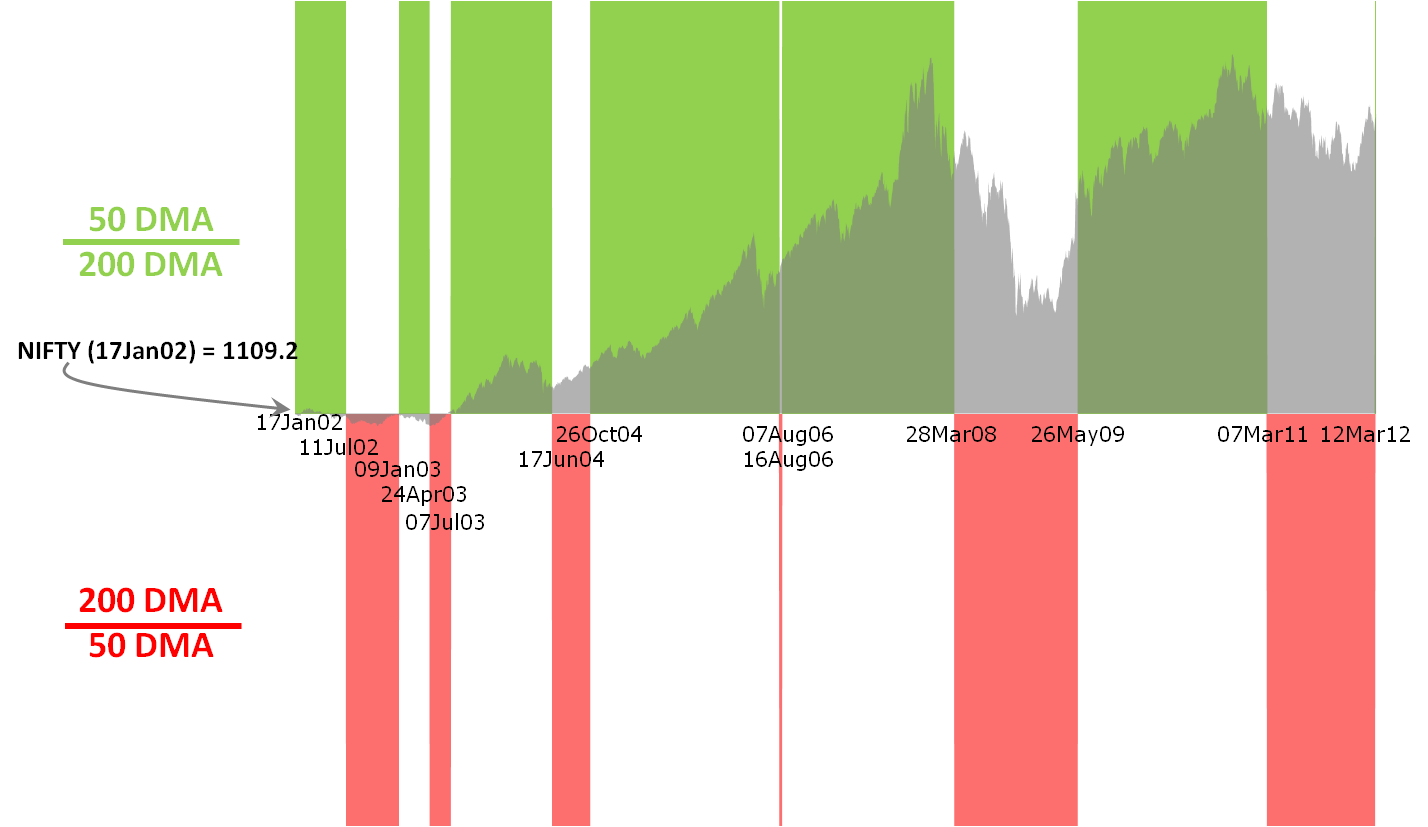
So, I pulled up data on the NIFTY from 2000 and charted the various crossovers between the 50 DMA and the 200 DMA. The green columns indicate days where 50 DMA > 200 DMA while the red ones are for days where 200 DMA > 50 DMA. The gray mountain range is the NIFTY during this entire period (17Jan02 to date) rebased to zero at the starting date of this chart (i.e. 17Jan02). The reason the chart starts from 17Jan02 is because I have NIFTY data from start of 200 and from that date it took upto 17Jan02 for the first golden cross to appear (if the index values before 2000 are ignored). The point is that up till now the proportion of days that the 200 DMA is greater than the 50 DMA (bearish climate) has been quite low – as you can infer visually from the chart.

Confirmation Next Week?

The NIFTY chart is poised at an interesting point as at this weekend. The 50 EMA is about to deliver a right uppercut to the 200EMA…hopefully. If it does, then I guess the bull market will be really, really confirmed. Budget dithering and the slipperiness due to oil may keep the 200EMA above the 50EMA though…

Lupin’s about to break out, Gitanjali and Godrej Industries are doing awesome; so is my relatively recent pick – Jubilant Foodworks. I’m long a NIFTY ETF as well…looks like the smile may just about be coming back…fingers X’d

Emerging Markets: 2012-’18

Foreign Institutional Investors (FIIs) had mostly stayed away from Indian equities during 2011. While around 20,000 crores were brought into the debt markets some 3,000 crore worth of net equity positions were withdrawn from India. I guess it took the softening of  inflation and the subsequent cessation of the interest rate hikes that got this hot money back to India. Its FII money that mostly contributes to the volatility of Indian stocks. So, the more one studies whats happening across the globe – what the top fund houses, hedgies etc are saying, the better prepared you are to take a stance wrt to the Indian scene.

This calendar year, we have seen the return of this fickle capital to India and other emerging market stock exchanges. They are saying that FII flows into Indian stocks have already reached $4 bn in 2012! Mind you, we have seen 56 days in 2012 till now – a good 300+ days are yet to pass us by. Will this deluge of foreign capital continue to build up? Most certainly not. But before the tap runs dry and the vacuum switches on, I think it looks likely for the NIFTY to at least climb right all the way up to 5900? While that’s a good 8.7% points away from current levels of the NIFTY, I think it’s certainly achievable given the very bullish set-up and the decent correction/pause in the rise of the Index given the option expiry/rollovers for the Feb series. So with all that covering up and rolling over completed, I am hopeful of another 7% – 8% rise of the NIFTY. It will then be a good time to unwind the non-core positions.

There is however an interesting view put out by Jeffrey Frankel (Professor of Capital Formation & Growth at Harvard University) who points out to the cyclicality in the occurrences of troughs or crises in emerging markets asset class. He serves on the “Business Cycle Dating Committee” in the United States – whose job it is to declare the official start and end dates of recessions. So, he has a view on past emerging markets’ economic cycles and where the emerging markets are in the current cycle. Frankel draws attention to the earliest references to economic cycles perhaps came from the Old Testament, where the Pharoah orders Joseph (the chief architect) to build stockpiles of food grains as the Nile flowed in plenty for 7 years and then it relatively dried up for the next 7 years. So there were 14 year cycles then. While I am not sure if Egypt of biblical times could be called an emerging market, but closer to our times, Frankel notes that during 1975-81 (7 years) we had a phase which marked plentiful capital flows to emerging markets [recycling of petrodollars in the form of loans to developing countries]. Then the period from 1982 – 89 saw the international debt crisis which spread out from Mexico with these 7 years being referred to as the ‘lost decade’ in Latin America. 1989 saw the issue of the Brady Bonds [where the Latin American countries dunked their currencies and issued bonds denominated in US Dollars] which helped the Latin American nations move over from the capital drought. The period from 1990 -96 was obviously marked by crazy capital flows to emerging market countries. Then came the East Asia crisis of 1997 and another 7 years of capital drought. So that took us to 2003/04. Now, the period from 2003/04 to 2010/11 has seen the third cycle of net capital inflows into emerging markets – will the period from 2011 – 2018 be the next drought period? We can answer these questions only in hindsight. A lone swallow does not a summer make – i.e. the eagerness which the $4bn of today has shown in coming over to the Indian stock market can easily turn into a nervous stampede out of the country. Then this would be a mere blip in the 14 year cycle charts. If you look at the chart at the start of this post, the period of rapid rise of the MSCI Emerging Markets Index during the period 2003 – ’08 was really the time when capital flowed in so freely into emerging party spots. Now, the preceding 7 year period was from 1997 – ’03 during which time the index lost ~50% of its value. Scary? So if this logic holds good then is it appropriate to surmise that A) we are headed down and B) the top of 2008 will not be taken out till 2018 at least.

There are ends of beginnings of ends and then there are beginnings of ends of beginning. It’s difficult for simple people like me to say what is beginning and what is ending, but there is a neat little tidal wave of money coming in on the bourses where my hard-earned money rests and I am going to ride the wave for now. Amen.

Managed Floats

Jeffrey “King of Bonds” Gundlach was the former head of the $12 bn TCW Total Return Bond Fund. His presentations on the state of whats happening around the economic world are eagerly awaited and discussed. You can find his latest message here. I am showing two screens that caught my eye. These are the lines of movement of the Chinese Renminbi (RMB) and the Indian Rupee (INR).

The INR is on a “managed float” path. Successive administrations at the Reserve Bank of India (RBI) have managed to maintain and further this strategy of not pegging the INR to a particular foreign currency at a particular exchange rate. Earlier, the RBI used to intervene in the currency markets (it still tried its hand very recently), but the growth in recent trading volumes on the INR means that RBI’s intervention will lack any meaningful punch going forward. The INR has therefore moved a little bit closer to full float status. 

The RMB, on the other hand is undergoing a lot of makeovers. It was earlier pegged to the USD at a fixed rate and then in 2005 when the peg was lifted, all the pent up pressure got released and an immediate revaluation took place. However, the peg was unofficially brought back due to the onset of the financial crisis. Then, in Jun’10, China’s central bank said that it will increase RMB’s flexibility. Now it is moving to managed float status. HSBC had earlier predicted the RMB to become the 3rd major world reserve currency in 15 years. That’s a lot of time for a few more makeovers.

Design a site like this with WordPress.com
Get started