Jubilant Foodworks

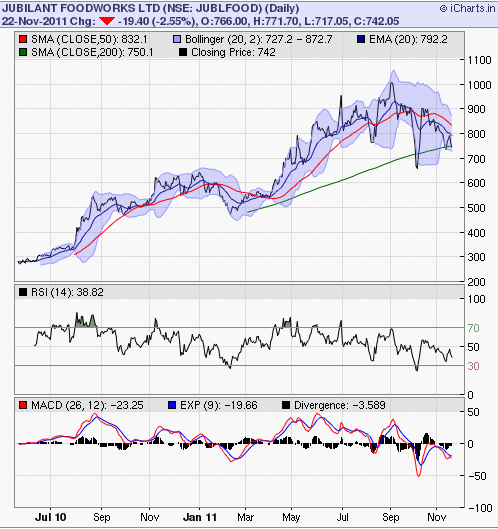
Here’s the battle at the 200DMA line that is going on at the Jubillant Foodworks counter. Ever since I wrote about this stock on the pizza vs. Italy post, I have been looking at it keenly.

Let’s see what happens.

The Great Depression vs. The Great Recession

For most of the day today, I have been reading a bit about the Great Depression (GD) of the Thirties and Forties in the US. It is natural to compare the events and situation of today to those times and  hope that the lessons from the GD can be applied in today’s situation as well. If the GD tableau is to really serve as a money management lesson then it is very important to establish the fact that the two scenarios were actually quite similar.

That is where the fun begins. Many eminent people (Incl Ben Bernanke) have maintained that the current situation (i.e. the Great Recession) is not the same, nor similar to the GD of earlier times. It is stated that during the 12 years of the GD, the unemplyment rate went upto 25%, a third of the US banks went bust, the US GDP fell by a third and the US stock market  fell by 90%. Nothing like that is happening today, so what we are experiencing today is just a recession. It may be a great one, but it is not a depression. Well, what if the unemployment figures of the GD were inflated and the emplyment statistics of today are being supressed for some reason? The reason why so many banks did not fail during this time is because the government (actually, all over the world) stepped in and bailed them out. The book I am reading says, “between 1923 and 1929 banks across the country failed at an astonishing rate of two a day, but the rising prosperity masked those failures”. Which means the banking norms then were not as mature as they are today. So, here’s a question: in today’s age, aren’t events at Lehman, Bear Stearns, Citi, JPMorgan, AIG, BofA, Freddie Mac, Fannie Mae etc equivalent of those banks failing then. Comparing on numbers isn’t correct since consolidation in the banking industry hadn’t happened during those times. Click here for a very lucid article of the comparision between the RD and the GD.

The GD was truly a scary time. People living today (esp outside of the US) would find it difficult to comprehend or associate such times with the US. Of course, financial hardships caused by famine, war, natural disasters is common is many parts of the world (incl. India) but to think that the people who lived in the engine room of the world’s economy had to stand in “bread lines” to get food is both surprising and revealing at the same time. Well, the bread lines formed because there was little or no social security net in the US during that time. If the GD would have never happened and therefore if social security would have never come about, wouldn’t the GR of today become similar to the GD of those times?  Here is an extract from the book I am reading which in turn is an extract of an anonymous letter which a 12 year Chicago boy had written to the “Mr. and Mrs. Roosevelt in Washington D.C.”

I’m a boy of 12 years. I want to tell you about my family. My father hasn’t worked for 5 months. He went plenty times to relief, he filled out application. They won’t give us anything. I don’t know why. Please you do something. We haven’t paid 4 months rent. Everyday the landlord rings the doorbell, we don’t open the door for him. We are afraid that we will be put out, been put out before, and don’t want to happen again. We haven’t paid the gas bill, and the electric bill, haven’t paid grocery bill for 3 months. My father he staying home. All the time he’s crying because he can’t find work. I told him why are you crying daddy, and daddy said why shouldn’t I cry when there is nothing in the house. I feel sorry for him…Please answer right away because we need it or we will starve. Thank you. God bless you.

I am pretty certain that there are 12 year old boys in the US, who would not be so misplaced in today’s times as to not write similar letters. Ultimately, it is best for plebians like us to assume that financial “experts” are often wrong and that astrology and economics don’t mix. Earlier, they’d say India has de-coupled from the world! After that, the grey cells started debating nuances on whether the current “slowdown” is a recession or not. However all are now of one voice when they say that A) India is as coupled to the world economy as copper is to iron in a bimetallic strip and B) we are indeed in a recession. Is the realisation that we are in a depression around the corner as well? If that happens then you may as well desert equity as an asset class to base your future planning on…

The Italian Job

There should be a rule against letting such colourfully inspirational leaders as Berlusconi from stepping down. The people behind this should be shot. Now that Italy’s given the boot to Berlusconi, reading news from that not-so-well-heeled country will not be the same as before. 😦 One fondly remembers the time when Berlo had poured scorn on Finnish food saying that he had had to “endure” it adding that there was absolutely no comparision between ham from Parma and smoked reindeer venison. The issue was regarding Italy’s bid to be chosen as a home base for the European Food Authority (which in turn would have meant a lot of benefit to the local Italian food processing industry). This was in 2005. The last, somewhat consolatory laugh probably belonged to the Finns when Kotipizza Oyj, the largest pizza restaurant chain in the Nordic world, won the America’s Plate International Pizza Contest  (in 2008) over their invention which was very aptly called “Pizza Berlusconi”. It has smoked reindeer in it.

While I am not so much of a gastronome to sample smoked reindeer pizzas, I held Silvio in high esteem for the wise lessons on investing that he once dispensed at the NYSE:

Italy is now a great country to invest in…a reason to invest in Italy is that we have beautiful secretaries…superb girls. 

 Now, I am not sure if the chartists and technical gurus out there, who spend all their time reading between the (trend)lines have ever thought of mapping and charting hemlines. But Berlo obvisouly had spent a good deal of time on that subject and he let the world of high finance know. While he may not have intended it thus, this sermon might have proven to be very profitable indeed for an international investor with A) a very sharp memory; B) a natural ability to make logical connections and C) a Berlo like keen eye for beauty! Berlo’s view of short hems in Italian offices was to really serve as a trading signal to go “short” on Italy itself! I am sure many people made money shorting Italian bonds, stuffing profits in Italian bags and being long Italian credit protection. Also while Finland got their psychological payback via the Pizza Berlusconi, that episode also throws up an investing lesson. Being long on pizzas is not the same as being long on Italy itself.

Towards that end, I came up with this chart which can be a good contender for one of the most profitable set-ups in recent times. Go LONG PIZZA + SHORT ITALY. Using metaphors, this could mean shorting the MSCI iShares Italy Index fund and going long on Jubilant Foodworks (the makers and sellers of Dominos Pizza in India). I have no idea how pizza foodchains are doing in other countries but Jubilant has been rocking. Though their dough is acting tough these days, what with the share price perilously close to the 200 SMA mark and questions being raised on the company’s ability to maintain its sales growth trajectory going forward. Whatever happens to the share going forward, its performance in recent times has been awesome.

 Hungry Kya?

Hardly Halcyon

The Tuamotu Kingfisher (TK) is one the world’s most endangered birds. So is Kingfisher Airlines (KFA). The entire population of the TK has dwindled down to less than 125 (on one lone, tiny island is the South Pacific). The stock price of KFA has dwindled down to less than 20! A lot of myths and stories abound on the mirthsome kingfisher.

I can recount some of them (NB: the distinction between Kingfisher and kingfisher is intentional)

  • How the kingfisher got its bill: Actually, in today’s day and age of “good times”, the whole point is not about the Kingfisher getting any bills, its about refusal to pay bills! Whether it be tax bills; PF bills; ATF bills; Interest on loans bills etc etc. But yes, at approximately the time of creation, there was a council of wise animals who deliberated over the raw deal that the kingfisher had got. These wise animals were the Stately Bird of India (SBI); the Bird of India (BOI); Bird of Birds (BOB); Punjab’s Naive Bird (PNB);  I See that I See Insolvency (ICICI) etc. These wise animals expressed that while the kingfisher was supposed to be a sea bird, it was neither given webbed feet (more FDI!) nor a good bill (in the form of govt protectionism!) making it extermely difficult for him to earn a decent living. So, the council of wise animals, in all their wisdom, decided to be owls and attach an awl at the tip of kingfisher’s beak (generous credit lines!). The council of wise animals was really very wise – they kept increasing Kingfisher’s bill so that it could fish more. For fish were hard to come by during these “good times”. Some of them were in fact becoming more like Kingfishers themselves (by taking on equity) and some of them were lengthening  their beneficiary’s beak further using its good name (lending against a franchisee brand value as collateral!!!)
  • The daughters of UB Holdings: The Alkyonides were the seven nymph daughters of Alkyoneus, king of giants. Just like Kingfisher Airlines, UB Engg, United Spirits, Mangalore Chemicals and McDowell Holdings are some of the daughters of UB Holdings, King of Good Times. When their father was slain by Hercules, the daughters flung themselves into the sea. Amphitrite, sea-goddess and wife of Poseidon, transformed them into ice birds, or kingfishers. The Alkyonides signified prosperity, joy, liberation and tranquility. The daughters of UB Holdings  however seem to represent lack of these today!
  • Hardly Halcyon any more: The “good times” between the mortal king Ceyx and his wife, the  goddess Halcyon were numbered on the (Kingfisher) calendar as they had caught the envy of the higher Gods. The Greek Gods, peeping toms that they were, overheard some private jokes being passed between Halcyon and Ceyx where they were comparing themselves to Hera and Zeus respectively. The Pantheon’s pride wounded, a chain of events followed which ultimately resulted in Halcyon and Ceyx transformed into kingfishers. Such generosity from the Gods had conditions – Halcyon could lay eggs only in winter and by the sea, always coming to grief as the wind and tide kept washing them away. So Halcyon’s father, Aeolus (a lesser God. Of winds) intereved and procured a period of quiet and calm approximately 2 weeks around winter solstice when the winds would die down and the kingfisher could roost. Winter solstice is usually on 22/23 December. The Halcyon days are usually observed from 14/15 Decemeber. Will something happen and save Kingfisher yet again?

This is all myth anyways. Just like some tricks and inconsistencies that the auditors pointed out during their statutory review of Kingfisher’s accounts. The moment when the banks were asked to convert their loan exposure into equity exposure, one should have dived underwater on this stock. Personally to me, it all seems odd and nostalgic since UB Holdings has been my best multibagger investment to date. I had bought this on 29Dec2004 @ 100.25 per share and jumped out at 719.71 a share. Considering a generous lottery of 1:1 bonus granted in Jul’06, this meant a 14 bagger for me. The investment logic was simple – A) world’s second largest retailer of daaru was selling at a few hundred crores and B) every evening when I used to travel back home from work (Fort area in Mumbai to Kandivali) all the liquor shops I’d see on the way were thronging with customers. Buying the share was easy/a stroke of luck – keeping the investment and letting it run its full potential was the hard part. Honestly, I did not do any big analysis before deserting the slender tree branch on which Kingfisher sat. I just felt that a 14 bagger was good enough for me. But yes, in hindsight, one can see warning signs begin to emerge the moment a company departs from its core competence (making and selling liquor to a rapidly urbanising economy growing at 5% – 7%) to more colourful adventures (airlines).

Well, there may yet be some nice fat and juicy worms which the Kingfisher may just grab at using his much discussed beak and whatever people are writing about it may not be its obituary, but as far as I am concerned this stock is too risky to own as of now.

Registration of Investment Advisors

SEBI has uploaded a concept paper on regulation of investment advisors to its website on 26Sep’11 and has been inviting comments from the public till 5:30pm, 31Oct’11. The contents of SEBI’s discussion paper look so very similar to the provisions of the Regulation of Investment Advisors in the US. In the US, investment advisors are regulated by the Investment Advisors Act of 1940. At the state level (or depending on the net worth/size of operation of such advisors) they could alternatively be governed by the Series 66 regulation or the Uniform Securities Act (click to download).

The following caught my eye from SEBI’s discussion paper:

  • This thing has been going on since Mar 2007. A committee and a sub-committee
  • The regulation is proposed to be implemented through a Self Regulating Organisation (SRO). Hopefully that will be without sin.
  • Duality of market participants as sometimes they act as agents of the producers of the financial products they sell and sometimes they act as advisors to the end consumers.
  • The role of the SRO will be to cleave this duality and make advisors (somewhat) accountable
  • The paper trashes enhanced level of disclosures as an effective tool since it cites India’s lack of (financial) literacy and generally high levels of information asymmetry as being two facts that would blunt the effectiveness.
  • Any entity of individual providing investment advise – whether it be a bank, wealth manager, private banker etc will have to announce him/her/themself as an investment advisor. Period.
  • Advocates, chartered accountants, media publishers, etc will be exempt. I guess the exemption naturally extends to blog authors as well – if at all someone felt that the category was subject matter of the discussion paper.
  • Folks wishing to get registered under the aegis of the SRO need to be chartered accountants from ICAI, MBAs in Finance or have a relevant work experience of at least 10 years.  

Obviously, it’s a good practice to copy regulations from advanced markets but it’s also important to recognise that such regulation did not prevent the gross mis-selling of financial products in the US – the latest example being home mortgages. Investment advisors, whether registered or not – packaged homes as ATM machines and sold them to the American public.

I have two comments/suggestions to make:

1. With relation to advertising and general disclosure: It should be made mandatory for registered investment advisors in India (whenever such a breed be whelped) to declare their historical track record of investment advise rendered. Accepted that information flows may be asymmetric in India and that most of the consumers of financial products may be financially illiterate, but I don’t think they are so illiterate as to not appreciate quantitative measures of historical track record of the advisors they are dealing with.

2. Buying a house is definitely THE most important and largest financial transaction that Indian investors commit themselves to. Do the objects of this discussion paper touch the property buying process? Or are young property buyers always to depend on the mortgage provider (i.e. producer) to act as financial advisor? Maybe some scheme or arrangement that notifies some independent advisors as being registered property purchase investment advisors. Maybe property buyers get an incentive for buying property via such advisors….i dont know what may work, but i thought this is an important area that may need independent and unbiased investment advise. A natural extension of this point is the question that asks if “real estate brokers” be considered as investment advisors or not?

The 200 DMA Pivot

During a bull market, breaks below the 200-DMA tend to represent good buying opportunities. During a bear market, breaks above the 200-DMA tend to represent good selling opportunities. The challenge, of course, is to be able to weigh all the evidence and arrive at a high-confidence conclusion as to whether the previous major trend is still in force because every break of the 200-DMA will be a false signal…until the last one.

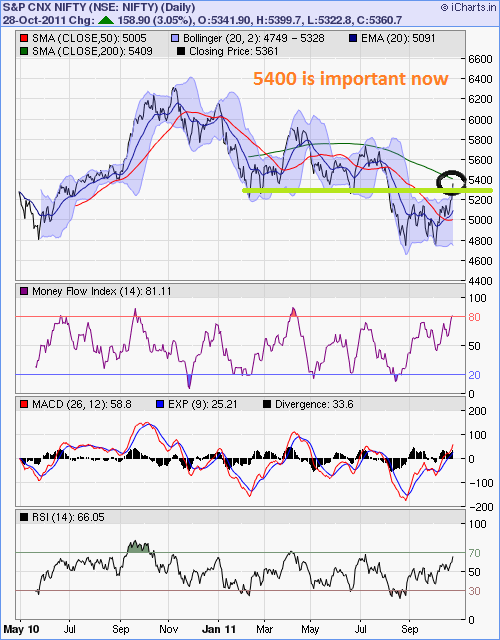
Market makers track the percentage of stocks above/below their respective 200DMA. If this number is greater than 85% or 90% then many traders look for a reversal in the market. On the other side, when this indicator plunges below 20%, people hope for an upswing. Ergo, most traders may end up avoiding stocks that are trading below their 200DMA. Whether the line is the cause of trend reversal or not is not my point – i haven’t read enough to make that point. All I am saying is that if enough people behave in step, it can cause a stampede. Who cares who cast the first stone in the pond and caused the ripple? As long as enough subsequent ripples/waves follow that first in synchronous phases, you can have the makings of a great wave. Then there is the “golden cross” which is the point at which the 50DMA and the 200DMA cross each other. A close (and sustenance) of the 50DMA above the 200DMA is supposed to indicate the commencement of a bull journey (and vice-versa). When used in conjunction with the 50DMA, the 200DMA line provides some trending views: if a stock that has price trading above its 50DMA and if the 50DMA is above its 200DMA then the stock movement is bullish and the trend should continue. A natural logical extension of the above rule is to consider the 200DMA as support and resistance levels. This is what appears to be the case with the NIFTY currently. Will the 5400 level get taken out? If the index closes and stays conclusively above 5400 then maybe this will become the new support line. The index could hover around that level, being range-bound and wait for the 50DMA to catch up and cross-over the 200DMA giving a clear signal of an intermediate up-move. Alternatively, with Trichet (President, European Central Bank) warning all that the Europe’s sovereign debt woes are far from over, it could well be possible that the 200DMA level does not get breached by the NIFTY and the index falls down. I have no hunch and in moments of apparent inflection points such as what i am thinking next week to be, it’s best for retail rats like us to sit the action out and see what happens.

Here’s a trading strategy:

Monitor your portfolio. On stocks that you pick (whatever be the method), get out of them if their price falls below their respective 200DMAs. Stay in cash and re-enter when the price goes above the 200DMA.

I have a feeling that, if this tactic be consistently applied over a long time period, it would yield superior returns to a “random walk” style of investing even after taking transaction costs and taxes into account. This scheme may not work in markets like Europe, US or Japan, but this would be very applicable to economies that are in the middle of their S-curve of economic growth (China, Thailand, India…)

Deepak Shenoy has given some direction here on how to live under the 200DMA line.

And finally, a very important trading lesson picked up from State of the Market:

One should never buy stocks on HOPE when they trade below 200 dma and one should never sell stock on fear when they trade above 200 dma because no HIGH is too High and no Low is too Low.

ITC’s Run: Fork in the Road?

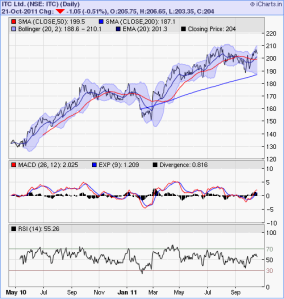
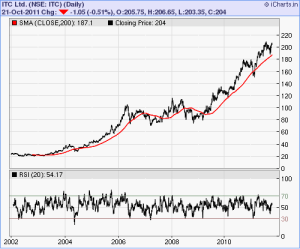
There is always a bull market somewhere. Take a look at how ITC has behaved over the past 18 months (charts via icharts.in). It seems it will take more than a few ‘puffs’ to get it past the 210 line. So may not be the local nadir. But when one looks at the past 10 years chart, this looks a good time indeed. Whats the point in timing over such fantastically run companies anyways!

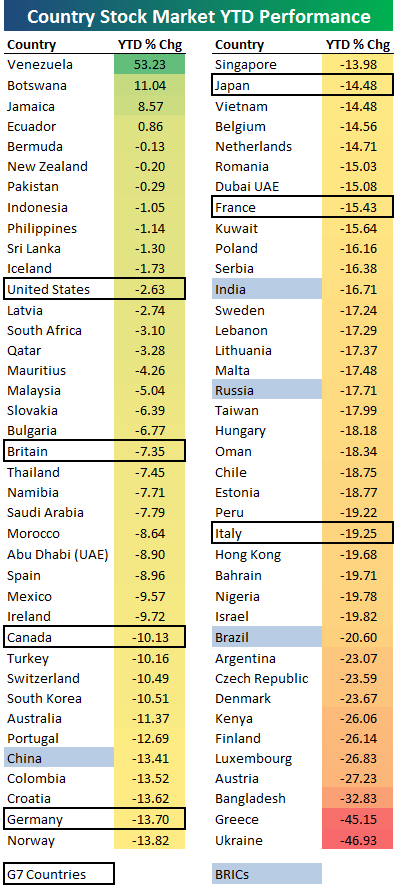
Country Stock Market YTD Rankings

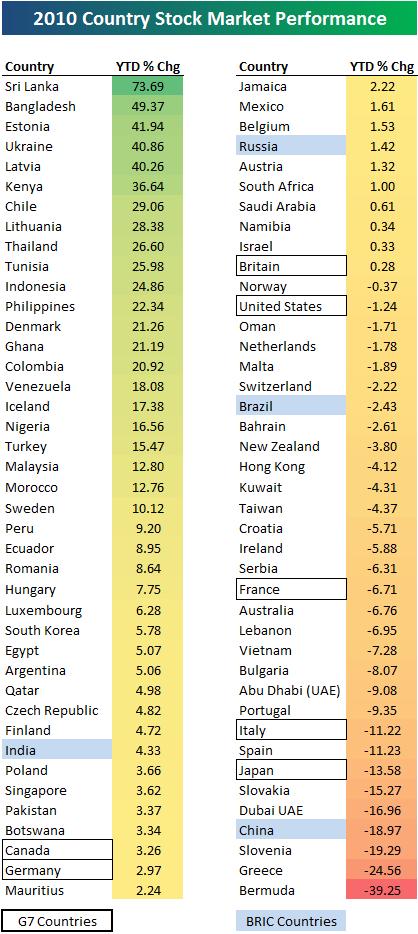
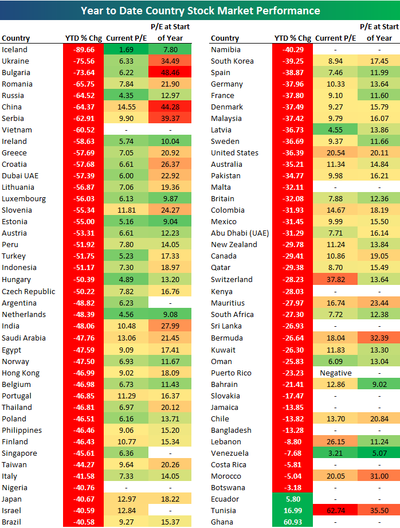
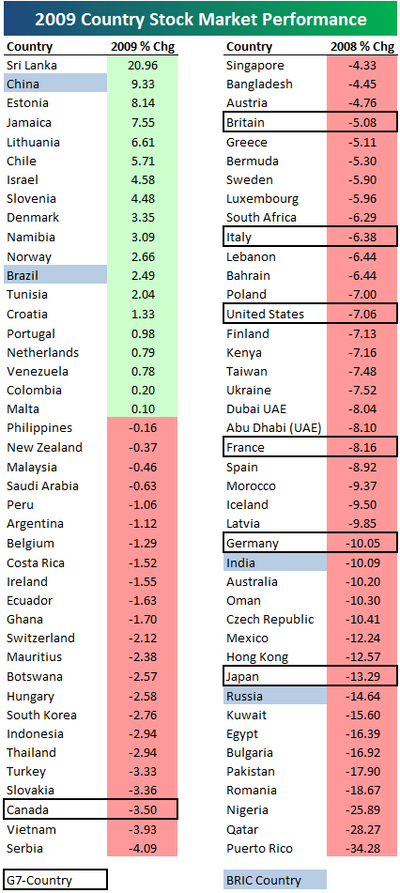
Following chart comes via the Bespoke Investment Group. There’s always a bull market somewhere! News of Venezuelan President’s battle with cancer made many investors scramble to pick up assets there as people hope to pick up great companies at bargain prices hoping that there will be a regime change! Venezuela in 2007 was really a candidate for the worst performing market as Hugo Chavez went about nationalising local companies. Companies like Cantv (20% of weightage in local stock market index!). He is concerned that the US may attack Venezuela after Libya and Syria and has taken massive loans from China and Russia. Some of these will be repaid in oil barrels (I like the Chinese!). Also, if you take out the inflation (running at ~25%, the returns in real terms come down sharply. But even then the returns are handsome. Until you remember the ~50% currency devaluation that was done by Chavez at the start of 2010. So, in $ terms, the returns would be even lower.

Good to see Pakistan at no 7. Not for long though, is my guess.

2008 – 2010 country performance pics below. Lets see if Venezuela and Pakistan feature in these…

Salary Negotiation

Tip to recruiters/HR folks: understand and master this chart.

Tip to job seekers: understand and master the inverse of this chart!


Gold Platinum Ratio

The gold – platinum breached unity recently for the first time in the past 30 months. I have plotted the prices of gold, platinum and the gold/platinum ratio for the past 10 years. It does look like the 70s rally in gold may just get repeated this time as well.  Last time we saw this convergence, the ratio quickly fell down and it was more a case of platinum retracing its sharp fall of 2008 and tearing away from gold. Gold rose as well but platinum rose faster. This time around, what will happen? Many folks are of the opinion that the ratio will shoot up as a result of gold continuing its upward march vis-a-vis platinum.

It seems that platinum is a cyclical asset while gold is more seen as a heat sink, attracting the risk averse wielder of capital. Since industrial demand is down and many catalytic convertors seems to be idling around, platinum appears to have lost its sheen. Platinum has indeed been a 5 bagger during the first 8 years of the past decade, so a reversal to the mean (given its cyclicality) is expected. But the question to goldbugs is – will 1.0 the new near term median level for the gold-platinum ratio? Or will this p/g ratio retrace its recent climb and get down in the region of 0.5 which seems to be its last decade’s resting level. If the latter, then gold surely has ample room to rise.

Design a site like this with WordPress.com
Get started