Seven Habits of Highly Ineffective Investors

Inverting the perspective sometimes yields interesting insights. Here’s my attempt at an inverted mashup of Stephen Covey’s widely popular work. Stephen Covey died on 16July 2012.

Lack of Independence or Self-Mastery

Habit 1

Being ReactiveEquity investing is never risky. The risk does not come from the trade but from the trader. Reactive traders are influenced by the noise around them – hot tips, consensus, crowd behaviour, market gloom etc. All losses that are experienced by investors fall into three categories – direct control, indirect control or no control. Almost all the losses of highly ineffective investors fall in the direct control area. The boring but effective investors usually have control on their losses or experience losses due to events totally out of their control (9/11, Lehman Collapse, etc.)

Habit 2

Begin With No End In MindThe ineffective investors’ Covey urges them to visualise their funeral. What would their obituary read? Here lies an ineffective investor: he was a wayward arrow and never knew where he was headed (until his last journey!). Ineffective investors do not have a personal trading mission statement. Neither do they have personal trading heuristics or models and typically tend to get along with the flow. They don’t write down what their closing position should be before entering the trade.

Habit 3

Don’t Put First Things FirstIneffective investors do not prioritize and plan their tasks based on importance. They have no independent will and are generally incapable of thinking for themselves. If they read a research report or a stock story, they rush into buying or selling without spending enough time on self discovery and understanding ‘why’ they trade.

No Inter-dependence

Habit 4

Don’t Think Win-WinIt is not at all important for an ineffective investor to have a plan B and a pre-determined response to what one needs to do if the investment thesis does not work according to plan. A win-win thinker hedges his bets, uses stop losses and balances his portfolio wisely. Why bother with all this if your aim is to be as ineffective as possible? “What dork expects to win on a heads and win on a tails as well? Is it really possible?”, is something which a highly ineffective investor would like to know.

Habit 5

Seek First to be Understood, then UnderstandBragging rights are reserved for ineffective investors. There is a certain male bravado amongst this set. They unnecessarily keep staring at the screens and fantasise and want to talk about their exploits to anyone who would care to listen. The clinically precise and hermit-like reclusive effective investors tend to focus their energy in listening to what the market is telling them

Habit 6

No SynergyIneffective investors do not tap into the power of the network; they do not read extensively and they do not develop their lattice network of various mental models that are required for one to be effective in analysing investment options. Why waste time in reading books, investment blogs and other data reports when all one wants to be is ineffective at investing?

No Self-Renewal

Habit 7

Forget To Sharpen The SawSelf-rejuvenation and self-renewal are only meant for people who want to be effective. These losers seek a balance in their life, are not obsessed with the markets and are perfectly fine checking their portfolio values once a day (it at all). Ineffective investors are blunt instruments are would be the ones who’d typically lose sleep over their positions and want to keep tabs and follow the market even when they are on a vacation. Ineffective investors do not plan, practice and re-test their models.

India at the Olympics

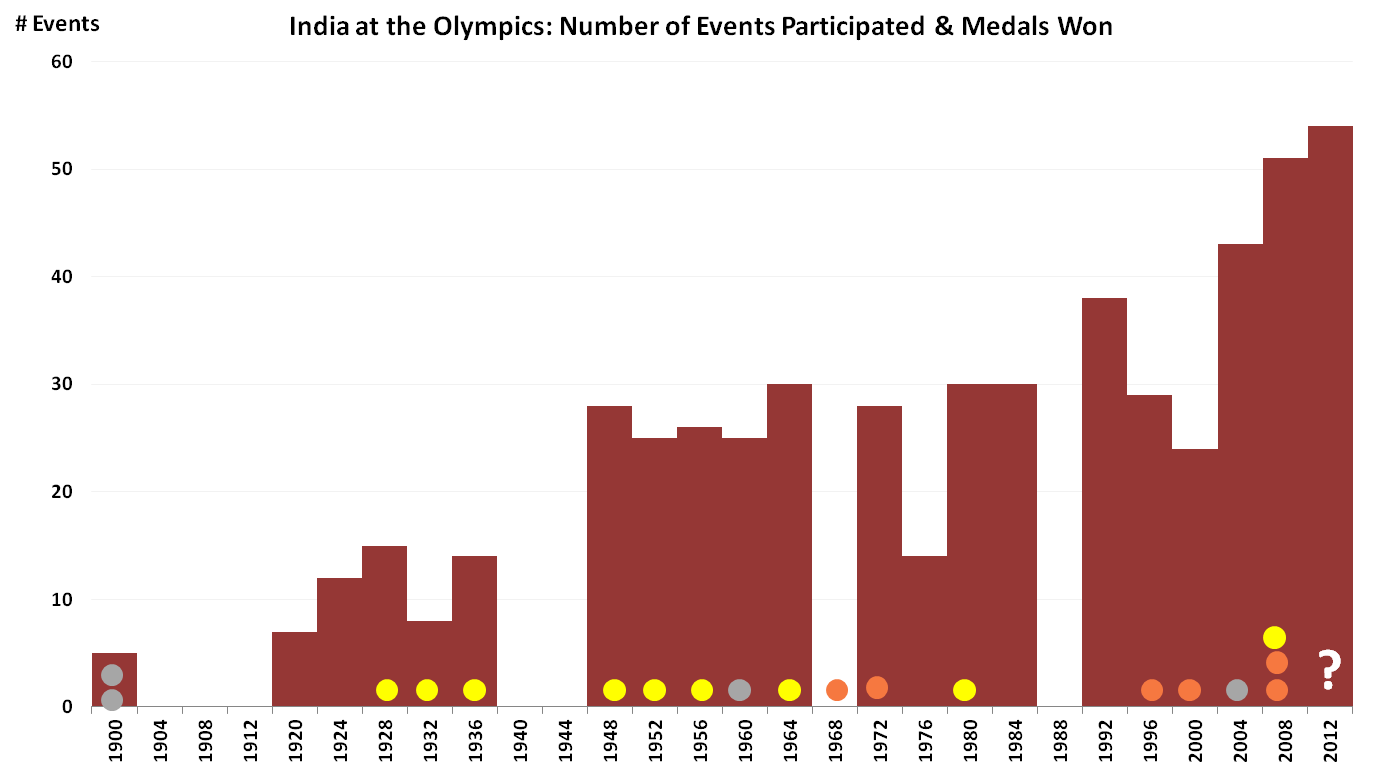
Economists, statisticians and others belonging to a similar have postulated a positive correlation between economic prosperity of a nation and its sporting prowess as measured by the success it achieves in international sporting events like the FIFA soccer world cup or the Olympics. China’s ascendancy to the Olympic podium has been rather sharp over the previous dozen years gone by. That has certainly keept the correlation desks busy! I plotted some data points I rather painstakingly collected from the online records of the LA84 foundation. The formats of the reports filed by each Games organizer have never really been consistent and it was not easy to get all this data. Wikipedia doesn’t have it and therefore there may be some errors in my representation.The chart below still does show the general trend. I was not able to get complete data for the 1968 games so that point is not shown on the chart (though India did win a medal in 1968). The number of events that India is participating in has gone by year on year which denotes the trend of village belles and Indian women picking up bows and arrows, boxing gloves, heavy discuses and weights. When I was picking up the data for this chart I was aware of the growing proportion of women atheletes in the Indian camp but I did not specifically pick this statistic so cannot show it on the chart. If you ignore the start of the 20th century (where India was represented by just one athelete), the year 2008 was very significant in Indian Olympics stats. This was the first year that India managed to secure more than 1 medal! Does this mark the beginning of a trend? I personally think that India’s showing at the Olympics is a far better indicator of things changing for the better than us winning the cricket world cup. Let’s see. Btw, the picture on the top right is that of the 4th place winning Indian Football team in 1956! 4th place. Don’t  ask how many nations participated but still 4th was certainly good. 🙂

Here are some links which try to point at the linkage between being wealthy and succeeding at sports;

Read more of this post

Commodity Casino

Here’s an interesting chart (showing ytd commodity returns) originally published by DB and being tagged around by bloggers. Metals, crude and shipping are down. Shipping is down big time really. Is this chart positive for India? Looks like it if you look at the increasing demand for thermal coal from India in the second chart on the right. The heat wave continues here in the US and I wonder if this may inject the much needed inflation in the US economy?

Gold’s Identity Crisis

A very significant development took place in the US early last month which could perhaps turn out to be very bullish for gold. The OCC (Office of the Comptroller of Currency) and the FDIC (Federal Deposit Insurance Corporation) circulated a public note asking for comment on their proposal to change the risk weightage of gold from the current 50% to 100%! It’s even more pervasive – the BIS’ Basel Committee for Bank Supervision are not only contemplating  increasing the amount of regulatory capital that banks must set aside through the forthcoming Basel III rules but they are indeed contemplating giving gold a Tier I asset status (i.e. a 100% risk weight). In other words, they propose to make gold a zero risk asset. Banks have to risk weight their assets and have to set aside regulatory capital for the more riskier assets that they hold. If gold becomes zero risk weighted then this will release a lot of steam from the banks’ balance sheets. This move (as also the proposal to ask banks to put aside more regulatory capital going forward) if implemented from 1Jan’13 onwards, will effectively put gold on the same pedestal as US treasuries and it logically seems that the yellow metal will see a run to catch up with the handsome gains that US treasuries have witnessed in recent times.

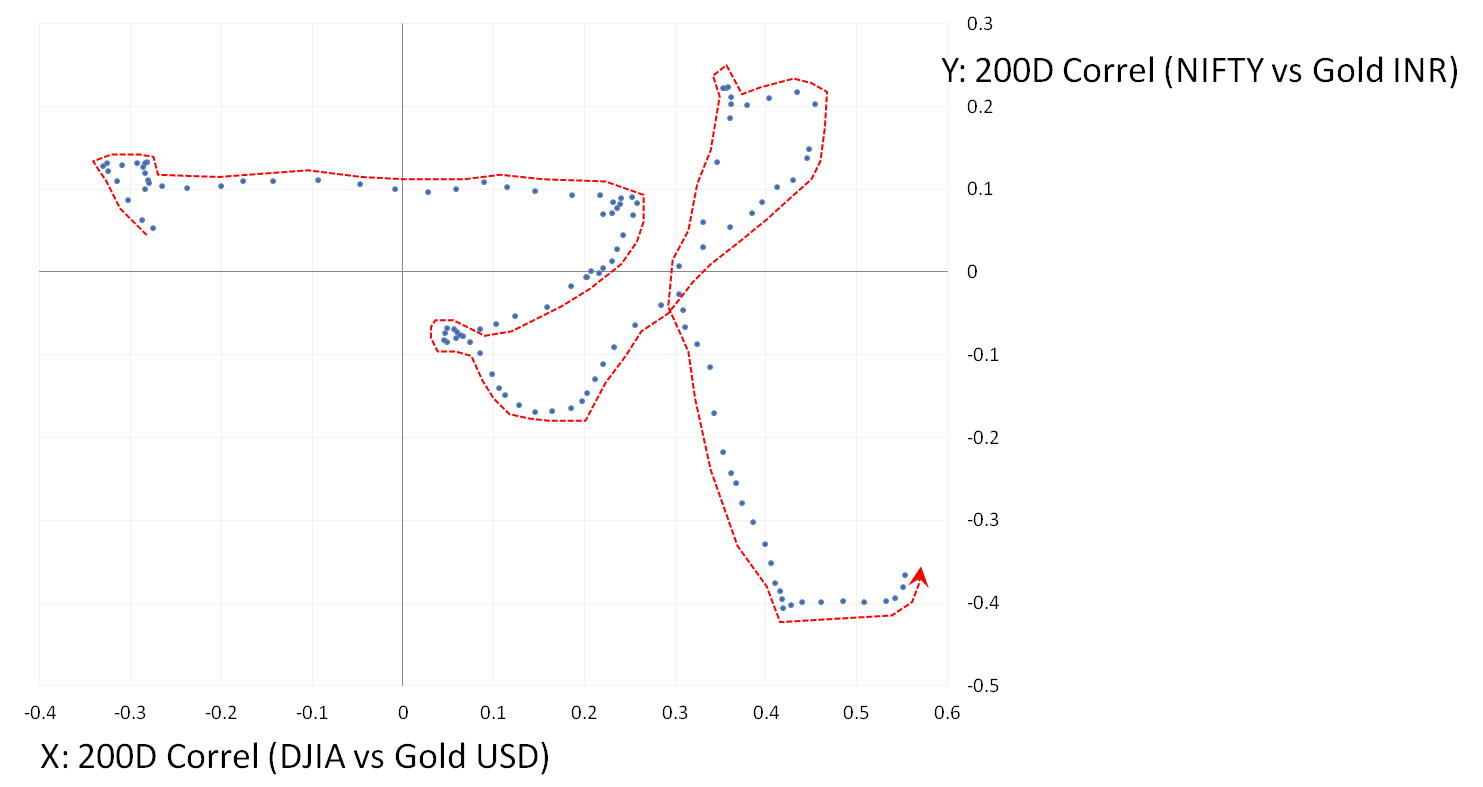
To investigate myself, I studied the correlation between the gold and equity prices (Gold in $ terms vs. the DJIA). The result (blue line) is shown below. The red line shows whats happening in India by comparision – the difference, of course is due to exchange rate fluctuation. It’s clear from the charts that both gold and US equities have been moving in step since July 2011 and going by the oscillatory nature of the plot, it looks likely that this positive correlation will continue for some more months to come.

The neat divergence between the gold/equity correlations between US and India is interesting. The charts below try to show the relationship between these two sets of correlations. The picture on the left below shows all correlation pairs over the past 10 years – it’s truly inconclusive. Perhaps an indicator of India’s closed economy status and the lack of full free float in the INR? On this messy chart, I have indicated where we are today – that position is clearly on the boundary of the plot. If the law of averages holds here, then there are three possibilities for this boundary position to go away: A) the correlation between US equities and gold starts to get positive; B) gold starts behaving like a risk asset in India as well and C) both A & B happen in tandem. The chart on the right covers a much recent period (since start of CY’12). This chart zooms in to the data points pertaining to the most recent 6 months and presents another look at the hypothesis that while gold is behaving like a risky asset in the US, it is very much a safe haven in India!


I think what is happening today is that everything is moving in tandem based on “news”: Fed/ECB announce more printing of their respective curriences – everything rallies; jobs report comes out in the US – everything falls, etc etc. Is it that the markets believe that no further QEs will get done? I guess gold better decide what it really wants to be and my hunch is that the day gold’s identity crisis will be resolved will be the day that’ll mark a clear trend for the markets. On the flip side though, I guess the weirdest story would be in the eventuality that gold does get classified as a tier 1 asset, rises in price and somehow equities rise further up as well – in which case would you still dub it riskless?

Rolling 200 Day Returns: NIFTY

I recently constructed this chart which shows the rolling 200 (calendar) day returns if one had just passively invested in the NIFTY over the last 10 years or so. As you can see this has been one heck of a ride. The unlucky ones were those who caught the first massive correction which happened post Jul’08 – this first red trough would have applied to investments done during the Jul’07 – Jul’08 period. similarly the second red trough pertains to investments done during the Sep’10 to Jul’11 period. There is a little flutter of green appearing towards the end. Hopefully, this will cause another sustained period of green for the next 12 months or so to come. Looking at the peak 200 day returns of >90% one wonders if we will ever see such kind of exuberance ever in the near future…

Rainfall Isochrones

An isochrone is a curve of equal travel time. The monsoon isochrone map shows isolines where each line depicts the arrival (i.e. the presence) of the refreshing and life sustaining S.W. Monsoon. Each point on the line depicting places where the monsoon arrived at the same time. This chart from the Indian Metereological Department says it all. It shows the rainfall isochrones as at June of this year. The dotted red line shows the normal advancement of monsoon while the dotted green line gives you the actual situation this year. Clearly Delhi is still waiting for the rains. Rains have played truant so far this year. It seems that the long summer vacation was not enough for little Johnny and that he wants to play a bit more. Its true – schools in Delhi have extended the summer vacations due to the heat conditions!

Compare this with what happened last year. The chart below is the rainfall isochrone map as at June 2011. Clearly we have an issue. Incidentally the attached press release (dated 22Jun’12) from the India Met office says that “Rainfall over the country as a whole for the 2012 southwest monsoon season (June to September) is most likely to be normal (96% – 104% of LPA).” The markets, meanwhile have been cantering up on news from the Eurozone and the Prime Minister cum Finance Minister’s comments. I think that sometime soon the market may turn its attention to the deficient monsoon. It seems that these days what Angela M says and does impact our markets more than the local economy’s supply side indicators. But if the rain gods remain unkind this year then somewhere the impact will definitely be felt – most probably on the inflation front. There are news of escalating corn and other downstream prices in the US due to the prevailing heat wave condition there which has played havoc with the corn sowing season there.

NSE – Falling Volumes

I fiddled around with the historical trading data on NSE and plotted the following graphs. The first chart (red line chart)shows the average daily turnover rising in recent months.

So while the turnover is increasing, this is accompanied by a very secular decrease in the average trade size. I am confused by the second chart really (brown line). According to this plot, the average trade size has been falling continuously since 2001 and is today around Rs 20,000. Does that mean more retail participation in the cash segment? But anecdotes point otherwise.

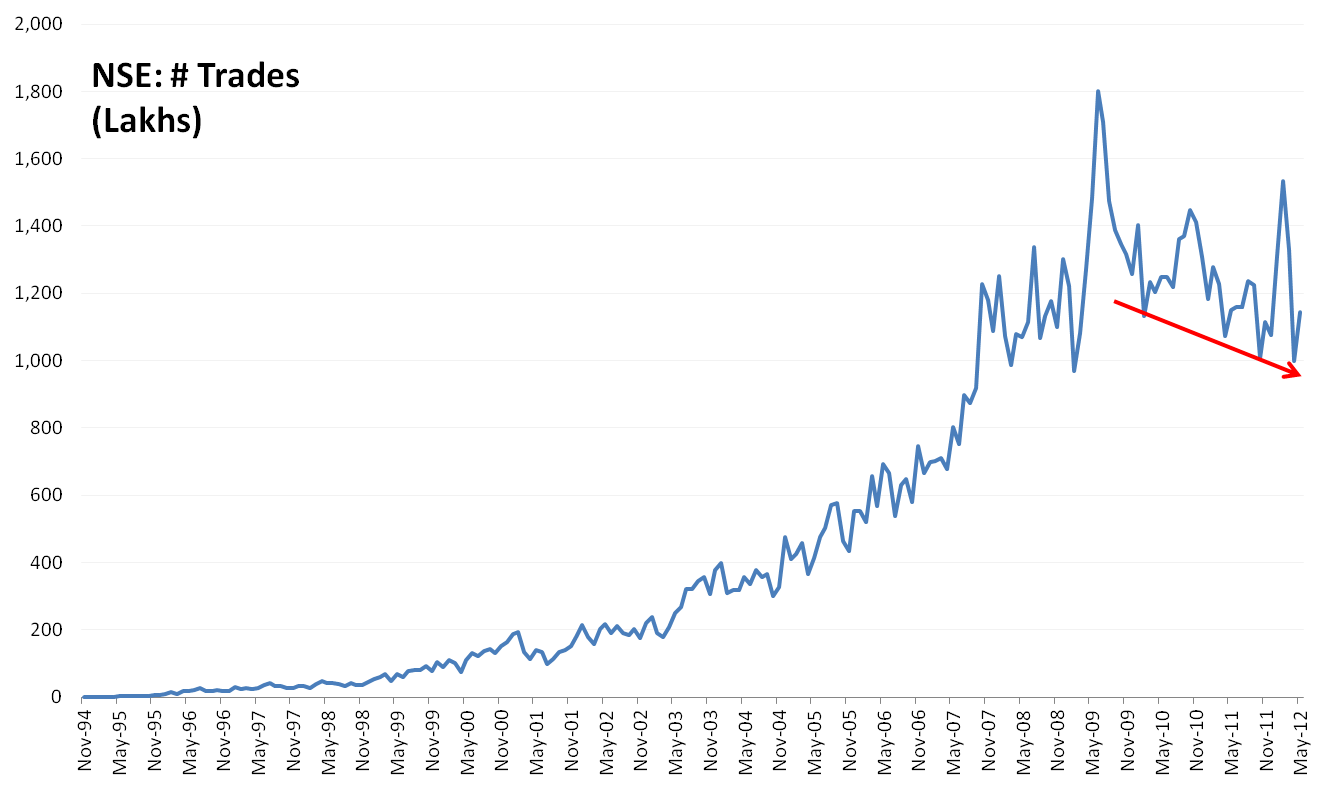
The 3rd chart I prepared shows the number of individual trades per month (blue line) and that finally shows a story which seems consistent with the times. The number of trades per month have definitely trended down in last 2 years.  In fact, in Indian stock markets, the daily number of transactions may be a better proxy of information than the total number of shares traded or the total value of shares traded. This also seems to be consistent with the view that is expressed in this research paper which concludes that in emerging markets, “the state of development of the market does not allow instantaneuous information dissemination”.

I am sure all that means lower revenues for institutions whose earnings are proportional to trading activity. Is that the reason why the BSE website shows ads via the google banner? To make up via “other income”, what they might not by transaction fees? I seriously doubt if any other noted stock exchange in the world shows banner ads. Also, how does one look at the fact that some of the products that may be getting peddled on the bse website billboard may actually belong to companies listed on the exchange itself! I am not a legal expert, but curious to know if that may be interpreted as a breach of impartiality?


Value of Employees

How macro economic business cycles influence how some companies regard their employees:

Is the Golden Age Over?

Finally Pranab Mukherjee said it. He is trying to discourage ‘educated middle class’ investors in India from buying this ‘dead asset’ considering that collectively, Indians now throw $60-62 bn worth of good money on the yellow metal!

While nothing has abated about the nervousness we read in financial journals the world over, I do think that the entry point in Gold for handsome returns has certainly passed us many years back. Yes, in the short term there might be volatility and the metal may climb up even more (as this article from The Economic Times points out) but a parabola is a parabola. To sustain Y = A .X^2 kind of a move, continuous energy needs to be supplied – it does snap one day or the other.

Return on Assets: Vizag Promenade

Have not been posting my thoughts at all as I have been travelling – this time to a new city: Vizag! I clicked this picture near the beach where I was staying and couldn’t but help connect this to the fact that Indian companies have one of the highest asset return ratios around. Squeezing the last milliliter of juice from already drained and hopeless lemons is a trick that comes naturally to a land that has many mouths but limited spigots to feed them and a ruling government thats unable to solve for the supply side of the inflation causality.

Design a site like this with WordPress.com
Get started