KSE 100 vs our Thrifty NIFTY

Two news topics on Pakistan – the air crash and accounts of the new found bonhomie between India and Pakistan gave me the thought to look up the stock market there. I was a bit lost trying to find out historical data on the KSE 100 (Karachi Stock Exchange – 100 stock Index). It’s certainly not available on the KSE website for people like me. The exchange, set up during Partition in 1947, actually sells that data! So I got it from the yahoo!finance website instead – but hold on a minute! Doesn’t this mean that…nevermind. 😉

As is my wont, I plotted NIFTY data for the period corresponding to the KSE 100 data that I could find on the internet. The result as you can see in the chart above is astonishing indeed. I mean – I don’t just get it. Neither does this paper that I scourged from the internet which inter alia says:

…the analysis of KSE 100 Index reveals serious structural flaws in true return of the companies in the Index and it is unable to represent the economy. These conclusions pose a serious threat to the use of KSE 100 Index as a benchmark for market return in Capital Asset Pricing Model (CAPM) in fair value calculation of Pakistani stocks. This also creates doubt about the forecasting ability of KSE 100 Index about the GDP growth rate of Pakistan.

Indeed, the paper does note that the correlation between GDP growth rate of Pakistan and what many consider to be its benchmark equity index is quite low. Who knows – maybe there is a flip side to what I learned today which may explain what meets the eye. The NIFTY on its part may also lend itself to some criticism for all you know.

However, I for one is quite happy for what the folks at Dalal Street have done recently to the Sensex – they caught up with the NIFTY in one aspect by including Dr. Reddy’s Labs into the Index!!!! Cool. 🙂

United Phosphorus

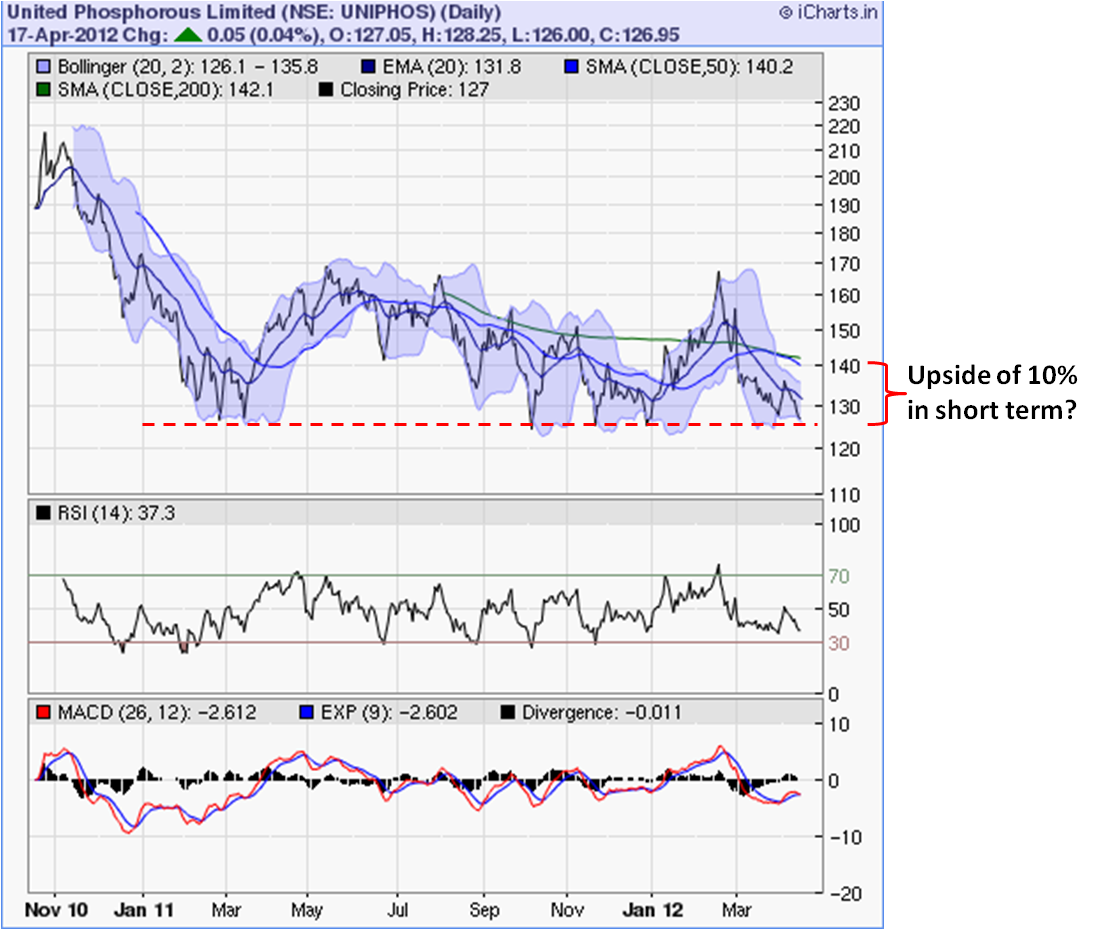
Sorry about the boring ‘stock forecast’ type of posts, but the United Phosphorus (UPL) chart set-up has caught my eye and I thought I should record this here today to come back and revisit the idea at a later date to check if the hunch was right. The chart clearly shows a very reliable support level of 125 – the stock has always bounced up a bit from that level giving returns in the range of 21% to 36% each time it has touched that level (see dotted red line on the chart). To me this looks like a good short term opportunity to pick up a 10% till the stock’s relationship with its 200 DMA becomes clearer. On their part various brokerage houses have come out with predictions for the stock ranging from 172 to 196 so there indeed looks like sustained buying interest.

UPL ranks 4th amongst the top global agrichemical generics companies with presence across the US, EU, Latin America and India. The market is divided into innovators who sell patented molecules and the generics. Given that a lot of patent expires are due in the next couple of years, this should serve as a good pipeline of opportunities for the generics companies. UPL gets 80% of its revenues from international markets and 20% from domestic sales. So buying this company again means that we are effectively shorting the INR. And important factor in this case since forex benefit due to favourable exchange rate movement contributed to ~19% of UPL’s 3Q12 revenue growth when compared to its 3Q11 revenues. The company is selling for a price of ~INR 127 per share today and given an expectation of a FY12 EPS of INR 14, this implies a P/E of 9 (looks attractive on this front). Equity research reports point out that its other Indian competitor, Rallis India Limited is ~50% – 60% higher on the 1 yr forward P/E front.

What is not clear to me is the company’s ability to hike prices in case it experiences margin pressures. I doubt it would have too much of pricing power – which means that if the exchange rate turns unfavourable (RBI cuts repo rates even more) or if their working capital requirements continue to zoom up, then UPL may have to take a hit on its margins. Since most brokerages are targetting a price range of 172 – 196, this target range could scale down to the 165-168 range in case these risks materialize. Incidentally, 165-168 may also be the resistance level for the stock. Regardless, the prospect of a 10% short term and a 35% medium term gain isn’t bad.

Hum Aapke Hain Kaun: 5 Degrees of Separation

It is nearly a century since the first film was made in India (Raja Harishchandra in 1913). Last weekend, I watched the Marathi film, Raja Harishchandranchi Factory (2009) and read up a bit on the moolah trends associated with Indian filmmaking. The website boxofficeindia gives collection figures for films since 1940 and while the data is not uniform across the entire period, one can deduce the earnings trend of the top grossing film per year since 1940. I plotted net revenue collections of the number 1 film per year since 1940 and came up with the following chart (click to enlarge)

Initially, the success of a film was determined by longevity as opposed to revenue. Have you ever tuned in to those lazy Sunday radio programs where they interview some senior film artiste (director, cinematographer, musician, playback singer, actor, etc) where the favourite songs of the person being interviewed are played. The guest on the show almost invariably mentions something that sounds like “woh picture ki to golden jubilee huyi thi“… Nowadays there is total front loading of revenue around the initial days following the film’s release. Front loading of revenue also reduces the bleed which a long running film may suffer due to piracy.

A couple of points stand out from the chart: the lost decade of the 80’s and the phenomenon that was Hum Aapke Hain Kaun. HAHK, in short, transformed the whole process of making money from films in India. While it may not be as dramatically causal as a single film being responsible for moving the industry into a higher orbit but the film certainly gave enough reasons for uncles and aunties, grannies and veiled bahus to venture out into the dingy, single screen, paan stained cinema houses across the country. HAHK and Jurassic Park (both released in 1994) gave reasons for movie watching to become a family experience in India. Jurassic Park was timed very well as it got in just as the Government (in 1992) ended the National Film Development Center’s monopoly over film import into India. Jurassic Park’s technical sophistry, which was never before seen (or heard) in Indian movie theatres, forced theatre owners to upgrade their demonstration equipment. HAHK’s pull ensured that the hygiene and comfort levels of movie theatres in India improved dramatically – going to movies was no longer taboo. I was in my late school years in Ranchi during this time and I do remember that no one – absolutely no one among my parents’ milieu used to visit theatres. Or even in modest Jalgaon. Imagine what a social phenomenon it must have been for a product to come along which got four generations of a family into a lice and bed-bug infested theatre to watch HAHK! We had reaffirmed our resolve not to watch any movies in theatres but just this one exception. That promise got quickly broken as the theatres (in Jalgaon) plowed back some of their profits and improved their property. Maine Pyaar Kiya, Qayamat Se Qayamat Tak and Titanic were testaments of those broken promises. While that is what happened with my extended family, it may very well be the case across most Indian families. Such feel good, family oriented movies expanded the market – big banner production houses started releasing a large number of prints. A 2nd tier city used to get the prints in the 3rd of 4th week but now even a remote village gets to see Bodyguard on day 1. And now that the entire family is walking in to a cineplex on weekends, ticket prices are also very high on the weekends. That is how we entered the 21st century.

Now we see films rapidly busting the Rs. 100 crore mark with regular precision – while it does sound very prosaic and formula driven, there are two external factors which may be at the root of this ‘leg up’ which the industry is enjoying at the box office. The rapid urbanization of India would certainly be the first – with the share of services income continuously rising, more and more people are coming to towns. Spending nuclear money on weekends in malls is becoming quite a habit. The other reason for the recent increase in film earnings is also the gradually increasing size of the Indian NRI diaspora. Overseas earnings are a very high (and growing) proportion of a film’s revenues these days – the INR:USD and INR:GBP exchange rate translates into high takings even if the number of viewers abroad are much lesser than that in India. While India gets trounced on most parameters when compared to China, there is one comparator where the Chinese should see red: Indians overseas remain far more loyal and patronize Indian cinema far more than the degree of adoption by overseas Chinese to flicks orginating from Hong Kong.

Finally, I have a prediction to make. Taking clue from the other mass obsession of Indians – cricket – and noting the declining length of popular formats of the game (test matches to one-dayers to T20), it may very well be possible that Indian films (musicals as they are sometimes categorized by foreign audiences) may shrink their run times from the current 150 – 180 minutes. Makes immense commercial sense as well since more shows can be packed into a weekend.

Personally, I feel that the product quality (as judged by the strength of the storyline) has, on an average, waned considerably during the last 70 years, but since the purpose of cinema is to entertain first and enlighten later, who cares about the content of films beyond a point? If someone talks of enlightening entertainment or entertaining enlightenment then all I can say is that the film – The Three Idiots is a true black swan of our times.

AWOL

Been travelling…couldn’t p0st. Key thought playing in my mind as I did this property chores re trip. The thoughts playing around in my mind during this trip: hopelessness of real estate prices in Pune and the realization that the RBI may not cut interest rates anytime soon. 😦

Kelly Formula (Part 1)

Most of my smart winners have been small capital bets while the losers have seen larger bets of capital. One of the reasons for this could be that catching a high beta asset at its low point (about to breakout; Lower Bollinger  touch; RSI < 20%, whatever) has given a higher alpha to me since the price move (due to high beta) has been swift and definitive. The low beta stocks, giving the illusion of secure staidness, have killed often by bleeding a part of my portfolio to death. Since these are the blue chip, low beta shares, I have been tempted to invest a larger proportion of my capital as compared to the mid/small cap sprightly upstarts being lured by the illusion of safety. As I look into my trading log, it is the multiple smaller bets that have really been multi baggers for me. So, I spent a good part of the long weekend reading on optimal bet sizes!

It is a common belief that a high amount of beginning traders do better with paper trading than once actually live. The reason being the realization of losing ‘real’ money. Knowing how to deal with profits doesn’t make one a successful trader insomuch as being able to handle losses. Every trade can have five potential outcomes – big profits, small profits, par, small losses and big losses. Taking the big losses out of the picture will logically give any trader less chances of frowning. Big losses can come due to decision paralysis (and waiting in the hope that the price will recover) or large capital outlay. The topic of this post is to ponder on understanding what should be the right size of trades. While its natural to think that the size of trades depends on a) your personal strengths and weaknesses, b) amount of capital, b) trust in an investment thesis, c) degree of diversification etc but like all good things there is a formula for this too! Namely, the Kelly Formula. This was designed by John Kelly who worked for AT&T and devised this for use in long distance communication – signal loss; signal to noise ratio and all those nice things. Since there are two basic components to the formula: win probability and win/loss ratio, this found application in the world of trading as well. The Kelly Formula states that for any given stock, you should invest the probability of winning times the payoff minus the probability of losing divided by the payoff. It is represented by the equation:

 where, P = payoff (i.e. odds offered by the betting syndicate); W = probability of winning and L = probability of losing


So while the debate on chance vs. skill in investing continues, here are some of my investigations and thoughts on whatever I have read and managed to understand so far. At the core of all this line of enquiry is a desire to figure out a personal method to ensure that I statistically end up putting more money on my winning ideas as compared to my duds. If I get to do that I am pretty sure, I would  be all :)s.

So back to the ruminations on the Kelly Formula: If you are worth 1 crore (say) then it’s clearly stupid to be risk averse for small amounts like INR 5,000 (say). You should regard “gaining 5,000” and “losing 5,000” as equal-but-opposite faces of the same coin. But it’s very rational to be risk averse for 50 lakhs. Whatever I have seen and heard from people with modest wealth around me suggests that people in fact behave in a predictably irrational manner when faced with these little choices of chance that their investment process throws at them. Penny wise and pound foolish…

But what if we step out of the frame a bit and focus on the really long term? Personally, if my health (mental as well as physical) stays with me, I very well have a further three decades of investing ahead of me. However, let’s take a hypothetical case – say you inherit a sum of money at a young age and to invest it for a really long time. [if wishes were true…] You always have a choice between a safe investment (treasuries) and a myriad of risky bets whose probabilities of outcomes is also known to you. [this is possible in a casino, but never on Dalal Street, but please lets go ahead with the logic]. Also, lets visualize that you are breaking up your investment time horizon into finite smaller periods (could be years, months or even weeks or days) at the end of which you take stock (i.e. P&L) and start again with whatever you’ve got at that time (i.e. rebalance your portfolio at periodic rests). The Kelly Formula gives you an explicit rule regarding how to divide your investments to maximize long-term growth rate.

There is this book called Fortune’s Formula by William Poundstone which I need to read to understand this better. Part two of this post will come after I have read that book and some more.

Read less, Trade Less

Among the many misconceptions/myths prevalent, one is that you should be an active trader if you want to make money from equity markets. Well, ‘active’ does not mean actively buying or selling – but active in being knowledgeable about the economy/markets etc. Not every ball should be hit – good batsmen realize that some balls outside the off-stump should be left alone.

Traditional finance theory have always recommended that individual investors simply buy and hold the market portfolio, or at least a well diversified portfolio of stocks. The typical retail investor doesn’t hold a well diversified portfolio nor does he desist from churning his portfolio every now and then. The attached paper delves into the subject and concludes that younger and male investors trade more aggressively than older and female investors.

In addition to overconfidence and gender, the more frequently individuals invest in information, the more they trade. To stretch the point further, investor psychology research has also pointed out that trading behaviour is also sensitive to the sources of information used by investors. Overconfident investors trade more frequently when they collect information directly using specialized sources. Investors getting stock related information from banks and/or brokers tend to trade more frequently than those who interact socially and are informed via friends and family or those who use non-specialized media like newspapers, financial magazines etc.

News, ‘hot tips’, brokerage reports et al are like deadly vortexes that can suck in an average investor and sink his portfolio hard. When you play information (budget announcements, RBI will come out with a rate cut, employment figures, economic survey etc) you are playing a game which is dominated by the big boys. Big players use news events to trade. In fact, some of them may even not be above ‘creating’ news if there is no ‘real’ news available. I recollect myself buying a share nearly concomitant to the release of a nice upbeat equity research report on the stock only to realise that it was all downhill from there on. May not happen always and maybe i was just plain unlucky and that things are not so murky in the world of equity research, but it pays to be very, very paranoid if you a small chap. In any case, smart money gets to see the research report first before mainline media catches it and sends it out for the universe to consume. Furthermore, when the big players trade, they trade such large holdings that when they initiate trades, they typically move markets. If you are the sucker who’s caught the other end of the rope, chances are very high that you’re the small fry who has come in attracted by the recent news blurb on the stock and are entering the room just as the party’s ending and the biggies are leaving. Best bet for the little ones – do not rush into acting on every thing that you hear or read.

Worst off are the ones caught in the middle – i.e. ones between the retail rats and the fat cats; the higher net worth individuals who do not consider themselves to be small and ergo turn over their capital to professional wealth managers or bank/broker dealers. Sometimes, unbeknownst to them, their money managers may resort to excessive churning of the portfolio in the lure of commissions. In this regard, the stock turnover ratio has been commonly used to measure and keep tabs on such fleet footedness, but really it is another ratio – the commission to equity ratio which is a better way of measuring the impact of excessive trading in a very direct way, i.e. the cost impact.

The chart above shows how often I have traded over the past 10 years.

NIFTY Total Return Index

Dividends now represent 27% of the total return index of the NIFTY since the start of 2000. What this means is that assumming that the changes in index constituents are pari passu, if the dividends issued by the component companies of NIFTYwere reinvested/reconsidered back into the NIFTYcalculations then the value of the index would roughly be around 6,728 (27% more than the current NIFTY value of 5295, as at 1Apr’12). The Total Return Index (TRI) tracks the capital gains of the NIFTY stocks and assumes that any cash distributions, such as dividends are reinvested back into the index. The German stock market DAX is an example of a TRI while NSE distributes historical values of its TRI here.

I downloaded NIFTY TRI and played around with the data trying to find some patterns and inferences. The first chart is a simple compare of the NIFTY TRI (dark green line) against the NIFTY (dark brown line) with the difference between them shaded in light green. The gap between the two indices is also shown in the second chart. I am unable to make any meaningful conclusion from this chart.

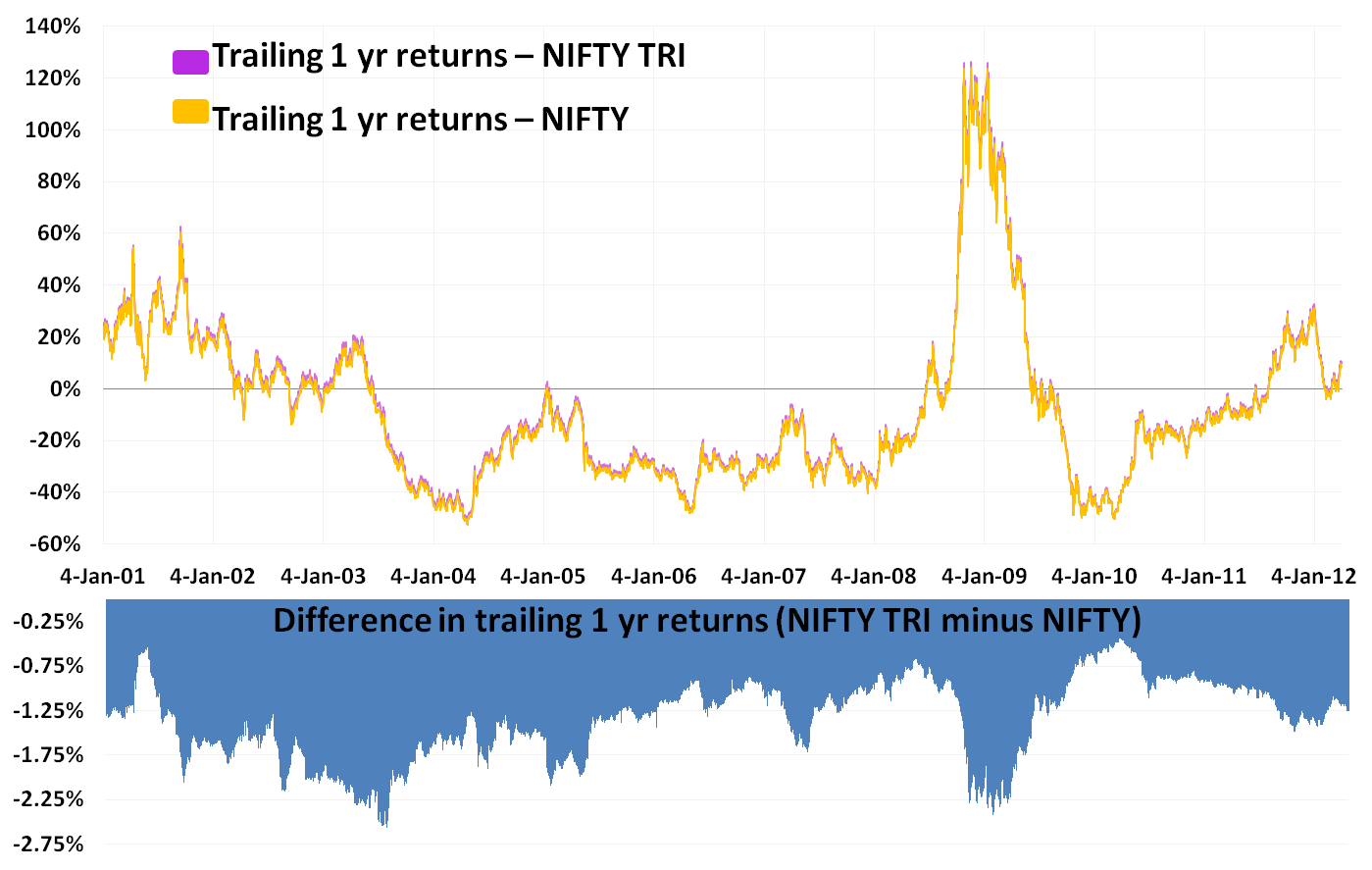
The third chart is interesting. This shows a comparision of the continuously trailing 1 yr returns of the NIFTY TRI compared with the trailing 1 yr returns of the NIFTY since 4Jan2001. Given that the NIFTY continuous 1 yr returns have swung widely over a +120%  to -50% range during this period, the difference between the two lines is not noticeable at all. The small footer chart shows the difference between the two series of 1 yr returns. What came out was that the trailing 1 yr returns of the NIFTY are always greater than the trailing 1 yr returns of the NIFTY TRI. Duh. This did not make any sense to me. I guess the major insight, though unrelated to the topic of the post, is the amazing wild swings in the trailing 365 day returns of the NIFTY. Can anyone spell V  O  L  A  T  I  L  I  T  Y for me? 🙂 

NIFTY Volatility Index (Part 2)

 In my previous post I had talked about the high negative correlation between the VIX and its underlying, the NIFTY. The chart on the right shows the actual movements of the NIFTY compared with the corresponding VIX moves. The period covering Mar’09 to Sep’10 marked a very rapid increase in the market (NIFTY rose from 3000 levels to 5,500). Since the VIX indicates volatility, the period at the start of this phase saw the most rapid increase in the NIFTY (in percentage terms) and that is why the VIX readings were above 40% during this time. The period from Sep’10 till date however have seen the market mostly move in a sideways direction. It started off around 5,500 in Sep’10 and is now at the 5,300 levels. Accordingly, if you look at the VIX, it has also remained mostly flat. Now, the big thought in my mind is this: we hear mostly bullish noises these days. Golden Cross; correction within an overall bullish trajectory etc. So, if the negative correlation were to hold and the NIFTY were to move up from now, it is logical to expect the fear (i.e. VIX) to come down from its current levels (~24%) t0 something like a 15% (?) or so. Since the start of this chart (chosen since that is the date range for which NSE publishes its VIX values) marked the markets coming out of a rather exceptional period in its history (global banking sector meltdown), VIX values > 40% may be really rare to come by again in the near future.  I have nevertheless plotted a dotted red line on the VIX portion of the chart which shows the median level of the VIX range. In the event that the VIX ‘reversion to the mean’ becomes a reality in the months to come then I guess we should brace ourselves for another secular fall in the NIFTY. If you take the economic events near the starting period  of this chart to be exceptional, and ignore the corresponding VIX values as outliers, then the new median will be quite close to where the VIX is today (22% – 24%) in which case there is definitely a case for it to fall down to late teens/earlier twenties. As you can guess I am rooting for a rise in the NIFTY and trying to twist my data interpretation to fit that notion!! 🙂

 The correlation factor in the above chart comes in at a high -0.83. Why such a high number? The reason could be because increased volatility (i.e. high VIX) signifies more risk. To keep their portfolios in line with their risk preferences, market participants must deleverage. Since long positions outweight short positions in the market as a whole, deleveraging entails a lot of selling and less buying (since the longs have to be shortened). The relative increase in selling causes downward pressure on stocks. The volume rise in the NIFTY puts really drives the VIX up. The NIFTY VIX is a weighted sum of puts (strikes < forward) and calls (strikes > forward) on the NIFTY. The weights are proportional to 1 / [(strike)^2]. As the NIFTY goes down, all the out of money puts become more valuable and those start having the highest weights (since the weights are the reciprocals of the strikes).

The unit of measurement of the VIX is in percentage terms. Its value essentially signifies the % expected movement of the NIFTY over the next 30 calendar days. So, for example, since the value of NIFTY VIX was 24.33% (on 29Mar’12), what the market is essentially saying is that it expects the NIFTY to move (either up or down) at a 24.33% annualized rate over the next 30 days. This implies that the market is pricing in a 24.33% /SQRT(12) = 7.02% movement at current levels over the next 30 calendar days. Which btw, is huge! In terms of confidence level, this means that the near term options on the NIFTY are being quoted with the assumption of a 68% likelihood (1 sigma) that the magnitude of NIFTY’s 30 calendar day return will be less than 7.02% (either up or down)

Taleb here points out how even seasoned market participants wrongly derive mean deviation (the 7.02% deviation as at yesterday’s close) from measures of standard deviation. My uninformed take on this is that if all are consistently making this error then that becomes the norm. Consider for instance, that a standard market data provider like Reuters or Bloomberg inadvertently distributes erroneous reference data – since both sides of the trade are using that same value, it becomes the de-facto standard and no one is out of balance.

VIX as a trading indicator: Since the VIX is a measure of dispersion and has a reversal to the mean property, all the standard technical indicators like RSI, Bollinger Bands etc can be used as identifiers for trade entry points. Since we do not have derivatives on the VIX in India yet, these technicals can give entry points into the underlying (i.e. NIFTY) by inverting the logic (buy for VIX would be a sell for NIFTY) due to the high -ive correlation between NIFTY and VIX. There have been studies which point out that the 2 period RSI on the VIX gives a very good trading signal. If the RSI (2) of the VIX >90, then buy the underlying and if RSI (2) < 30, then sell the underlying. Underlying = NIFTY in our case. I do not have any ready charting software at hand, so I will have to painstakingly generate the RSI values in a spreadsheet if I have to test and see how this really could have played out on historical data. Maybe fodder for a future post… 

NIFTY Volatility Index (Part 1)

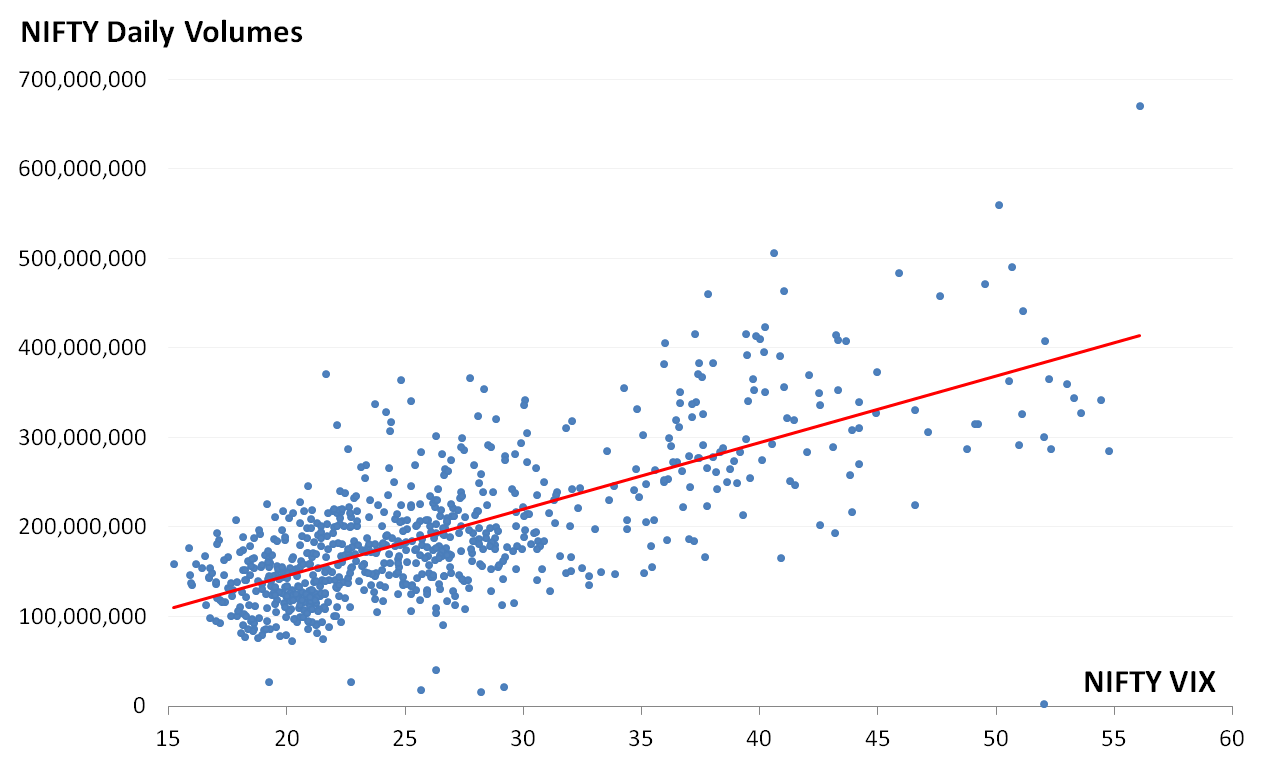
The volatility index measures the market’s expectation of near term volatility. A low value of VIX accordingly implies that the market believes that prices will fluctuate very less from its current levels. This would typically be associated with low volumes – see chart on right, it shows a correlation of +0.72 between NIFTY volumes and VIX. Now, correlation is obviously not causality, and accordingly a lack of trading volumes does not by itself cause depressed VIX values. On the other hand, VIX is negatively correlated to the market, a high value (of the VIX) indicating loads of nervousness (option writers demanding high premiums due to the uncertainty in prevailing underlying prices) while a low VIX value signifying low levels of nervousness and higher confidence in the sustenance of the market levels (options writers will not find takers if they charge more for the options they write, so the premiums will be lower in a market with low volatility). A similar conjecture can be made by looking at the put/call ratio as well – low indicating range-bound or slowly rising market in the near term.

One point is important to note re the inverse correlation with the market. The table on the right shows average correlations for different time periods of observation. I downloaded VIX values from 2Mar09 till date and correlated them with corresponding NIFTY values in windows of 5, 20, 40, 60, 90… trading sessions. The table on the right shows the average correlations I got. Assumming 5 x 52 ~ 250 trading sessions in a year, this points to an average correlation of -0.63 to -0.64 over a year. In the second part of my post on VIX, I’ll try to study the actual movements of VIX over the past years and any trading opportunities that may have come about in the past.

Click here to get a white paper explaining the calculation methodology. A summary is here. Since herd behaviour like greed and fear can be deduced from VIX values, it is logical to assume that greed will chase fear and vice versa. VIX therefore has a mean reversal property making it a very useful tool for short term traders. Given the high volatility in Indian stock markets, VIX was long overdue. The CBOE (Chicago Board Options Exchange) had launched its VIX as far back as 1993. It finally came to us in April 2008 when NSE launched it, expectedly basing it on the option prices of the stocks that make up the NIFTY. There is not much noise about the VIX in mainstream financial media in India yet. Is it because it is relatively new on the scene? Or maybe it might be a bit too nerdy for most people to understand. But so are options. How many of the people who trade options really understand the math behind option prices?

NIFTY EPS vs Price (update)

This is a continuation of the chart I had prepared and posted on 04May’11 here with newer data points pertaining to the intervening period in between. The trailing NIFTY P/E has indeed fallen from a level of 20.58 (04May’11) to 18.65(23Mar’12). Here’s the updated chart:

The smaller image on the right is the earlier version of this chart. There, I had done a straight line extrapolation of the most recent behaviour of the chart and predicted that the line will fall down and gradually approach an index value of 5,200 and a trailing P/E level of 18. What happened in reality (the bigger chart above) was more severe. The line moved down quite sharply (NIFTY dropped to 4,750 at one point) and rightward as well (expansion in EPS). Not that I profited too much from all of this. I am always long, so loss aversion by staying in cash/gold is my equivalent of profiting from a long/medium term, secular drop in markets. Ergo, I  havent lost much money in the interim and have ridden the dotted red line. Now, I had mentioned something called ‘cycloidal’ in my earlier post when looking at the chart – strangely enough, the line did indeed fall and is now even curling inwards, just like those cycloidal mathematical curves and/or their variants would. I don’t understand the pulse of the markets enough to figure out why this is the case but yes, we can at least look at the chart here and form our own conclusions.

Design a site like this with WordPress.com
Get started