Country Stock Market YTD Rankings

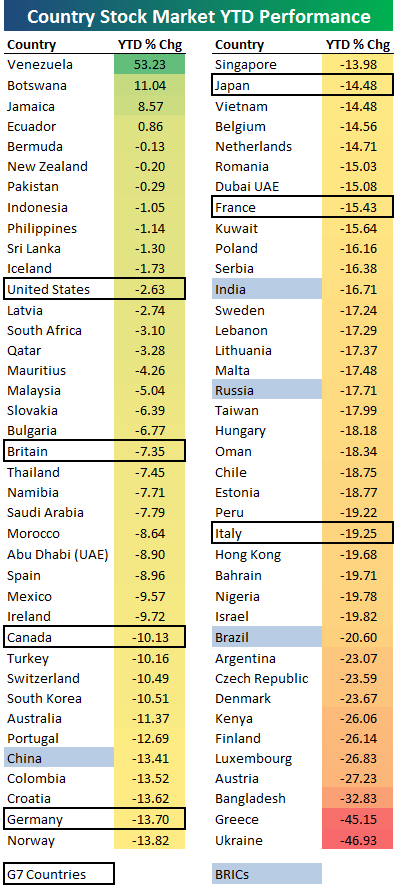
Following chart comes via the Bespoke Investment Group. There’s always a bull market somewhere! News of Venezuelan President’s battle with cancer made many investors scramble to pick up assets there as people hope to pick up great companies at bargain prices hoping that there will be a regime change! Venezuela in 2007 was really a candidate for the worst performing market as Hugo Chavez went about nationalising local companies. Companies like Cantv (20% of weightage in local stock market index!). He is concerned that the US may attack Venezuela after Libya and Syria and has taken massive loans from China and Russia. Some of these will be repaid in oil barrels (I like the Chinese!). Also, if you take out the inflation (running at ~25%, the returns in real terms come down sharply. But even then the returns are handsome. Until you remember the ~50% currency devaluation that was done by Chavez at the start of 2010. So, in $ terms, the returns would be even lower.

Good to see Pakistan at no 7. Not for long though, is my guess.

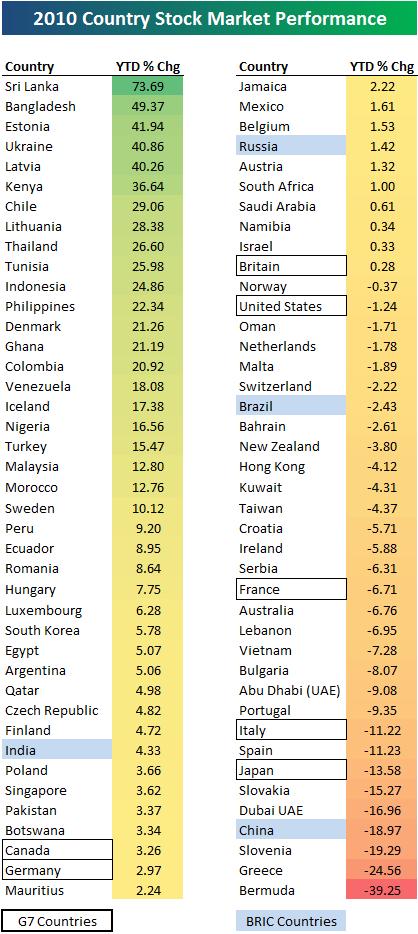
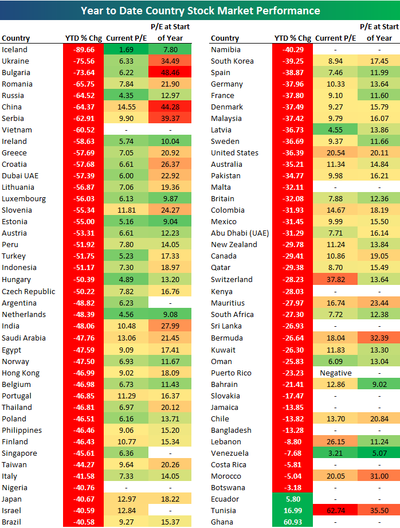
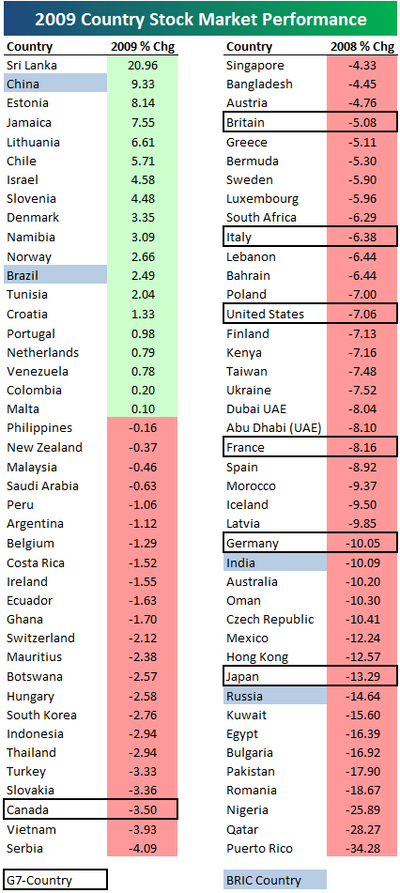
2008 – 2010 country performance pics below. Lets see if Venezuela and Pakistan feature in these…

Gold Platinum Ratio

The gold – platinum breached unity recently for the first time in the past 30 months. I have plotted the prices of gold, platinum and the gold/platinum ratio for the past 10 years. It does look like the 70s rally in gold may just get repeated this time as well.  Last time we saw this convergence, the ratio quickly fell down and it was more a case of platinum retracing its sharp fall of 2008 and tearing away from gold. Gold rose as well but platinum rose faster. This time around, what will happen? Many folks are of the opinion that the ratio will shoot up as a result of gold continuing its upward march vis-a-vis platinum.

It seems that platinum is a cyclical asset while gold is more seen as a heat sink, attracting the risk averse wielder of capital. Since industrial demand is down and many catalytic convertors seems to be idling around, platinum appears to have lost its sheen. Platinum has indeed been a 5 bagger during the first 8 years of the past decade, so a reversal to the mean (given its cyclicality) is expected. But the question to goldbugs is – will 1.0 the new near term median level for the gold-platinum ratio? Or will this p/g ratio retrace its recent climb and get down in the region of 0.5 which seems to be its last decade’s resting level. If the latter, then gold surely has ample room to rise.

HDFC Bank – Intraday as well as Long Term Opportunity

HDFC Bank is sitting nearly on its 200 SMA (see chart at bottom of this post) and also roughly at its horizontal support. Tomorrow (10Aug) there will surely be a bounce back and this share, among others, should perk up a bit. Though it is very much possible that the market may slide back again after a few sessions as the medium term bias does look -ive. But HDFC Bank is a good thing to buy around these days if you have sticky money and can wait on it for a few years.

Hell, even if you have 5k, 10k, anything at hand and have a good 10+ years of working life ahead of you – please do buy. You don’t need expert advise in times like these. Another tip is that you are the kind that uses Equity Linked Savings Scheme (ELSS) for their tax saving purposes, please buy now for the current FY. Unless you believe that the market has started a nice, long downward slide, there is no point in doing a SIP if you can catch plunges like these. Lets wait for the bounce tomorrow/day-after and then if the market droops down a bit more, that could be a good time to buy. While some people are feeling relieved that the 5,000 level was held, some others are of the opinion that some more depression is left in the market and that it could fall down to 4700 – 4800 territory.

One silver lining: stock of Allcargo Global Logistics Ltd. It bounced up 4% today!! Pretty sure it will go up tomorrow as well – lets see. I own the stock 😉

Borrow US, Borrow

No glass ceiling for the US, it seems. We will know on 02nd Aug, if the lawmakers in the US raise their debt ceiling so that they can continue to borrow more to pay off their servicing due pertaining to their extant debt obligations! The credit card issued to the US is massively revolving its credit with exporting countries providing angular momentum for these revolutions by lapping up US paper. The exporting countries (most of them on this side of the Prime Meridian) obviously want to hold down their currencies from appreciating, but considering inflation and its political impact, they may not be able to go the full way. Maybe the US will be able to cleave the rating agencies and have at least one of them desist from swinging the axe of ratings downgrade.

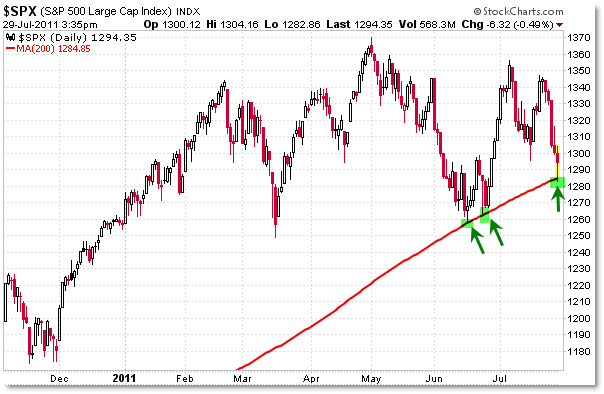
So the coming week is going to get very exciting. The S&P 500 is sitting on its 200DMA. Whatever you believe, or whether you believe in nothing at all – you have to brace yourself for some tight action around this point. People look at such chart positions and either line up for a bounce (from the 200 day DMA line) or short-sell and expect a cut through the line. Since a majority do it, it becomes a very important psychological level.

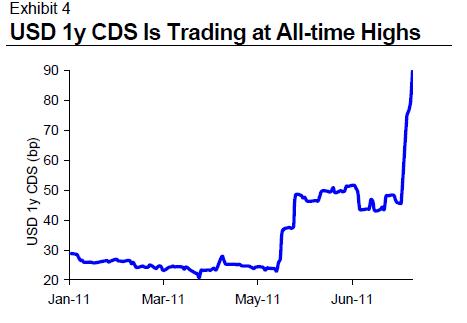
Meanwhile, the credit default swaps markets are certainly pricing for a US default. Actually, may not be for a default as much as for a marked decrease in the credit worthiness of the nation. Now who holds US debt in what proportion? These guys must sure be a worried lot. And so are we all since the whole thing is one giant messy spider’s web. In our desi markets there are quite a few companies whose stocks are either rising up to touch their 200 DMAs or  have dropped down to kiss that emotional line. With interest rates going up in India, and loads of shareholdings of promoters being pledged to banks for favourable short-term loan rates, I’d rather bet on the market drowsiness to continue. Let’s see. Like Jaspal Bhatti, who once in a television serial, made a comedy that won an award for being the best tragedy (or vice versa), I hope that my logic and thoughts continue to be contrarian indicators! 😉

No disclaimer here.

Misery at an All Time High

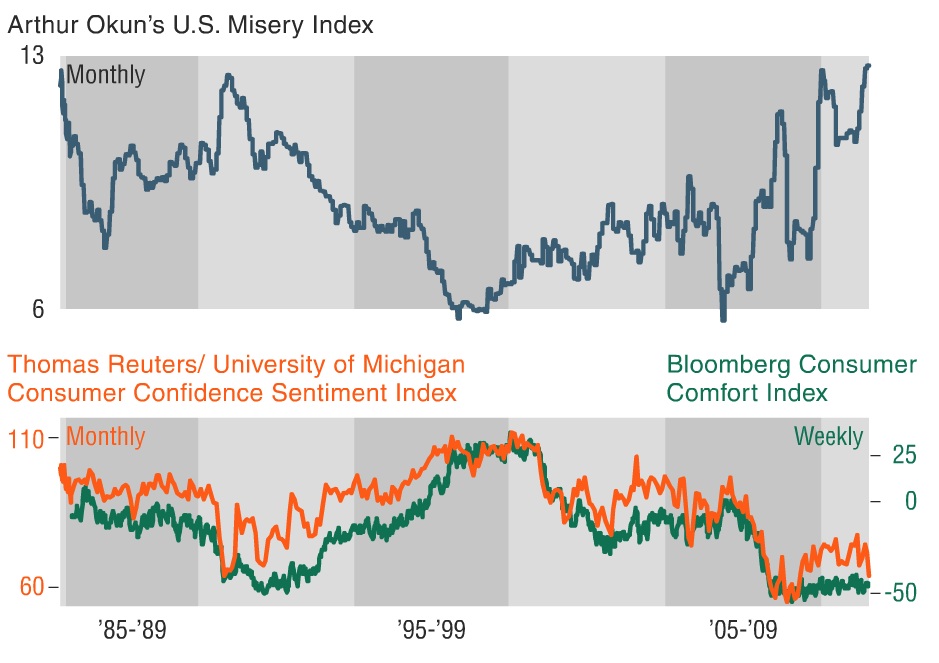
The Misery Index was conceived by Arthur Okun, an economist at Yale University and the Brookings Institution who served as an adviser to Presidents John F. Kennedy and Lyndon Johnson. Currently, it stands at 12.8, the highest in 28 years. The chart below (idea for post borrowed from Financial Armageddon) depicts the relationship between consumer confidence indices & the Misery Index.

Well, Americans haven’t felt this bad in three decades! The moot question then is that if this is the peak and if some reversal to the mean is expected, does it mean that things are going to get better from here on? Is there any “Scepticism Index” of equity investing as well? That people loathe and shun the stock markets like the plague. If miserable people are also paranoid about equity, then yes, behaviourally at least, we may well be on the verge of a recovery. Who knows!

Abortive Gold Trade

Of late, the NIFTY has been climbing up while Gold has been dropping. When I looked at the short term technical charts of NIFTY and Benchmark Gold Bees Index (I am long this index on a long term basis), I had an idea – to short the NIFTY and go long on Gold. So I chewed upon this trade set-up idea this weekend and finally perished the thought. Interestingly, my gut-feel (aka intuition or 6th sense) is a biased coin. When I have relied on my inner voice and followed the thought or idea that has sprung to my mind first, I have generally found myself to have chosen wisely. But this is generally related to work related and other decisions. Now, investing is certainly not about which-turn-to-take-from-Masab Tank type of inner voice invocation. So, it is not surprising that for me, when it comes to investing gut-feel, usually my initial gut-feel reaction has always tended to be dead wrong!!! Quite a personal contrarian indicator.
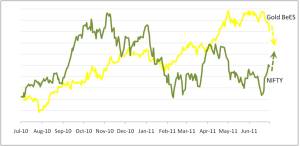
The chart alongside shows the 7.45% return of the NIFTY over the trailing 12 months against the very significant 16.25% returned by the Benchmark BeES index. The first half of the trailing calendar year has generally seen gold prices moving in lock-step with equity prices. From February this year onwards, the correlation has turned mildly negative which is what seems intuitive. So, commodity prices being the primary fuel of the stock indices has ceased to be the case for now as metals and of course, oil contracts. As I read up more on the internet, I figured out logic and reasons for why my initial gut-feel spawned trade idea was bad. On Gold, with Greece passing austerity measures, there is less of a motivation to look at gold as a safe haven in the very short term. So, it is likely that the coming week will be bearish or directionless for the yellow metal. Moreover, the US markets are going to be closed on Monday (4th July) and therefore gold could continue going the “buy the rumour, sell the fact” way down. On Thursday, the ECB and the BoE will have interest rate decisions announced and Friday will see the release of non-farm payroll data in the US. Therefore, it is unlikely that traders will take a strong view before these data points are clear.

So, if you look at the above chart, my hunch is that during the coming week, the gap between the yellow line (proxy for Gold) and the NIFTY will narrow down. Even if it doesn’t, no big deal for I have done the best thing that practise has taught me re investing: ignore my otherwise extremely reliable inner voice when it comes to pulling the trigger on investment decision making. Even if my intuition is proved right, at maximum I would just be guilty of an opportunity loss. Trade idea postponed, if not entirely killed, to next week now!

Industrial Disease

The Indian manufacturing sector output growth has slowed down for the second successive month in June to its weakest level since Sep ’10. Markit compiles this index in association with HSBC.

The commentary accompanying the press release says:


 The momentum in the manufacturing sector slowed in June as sequential growth in output and new orders decelerated further. Even with growth easing, tight capacity is still showing up in rising backlogs of work and a lengthening in supplier delivery times. On the inflation front, input costs accelerated, while output prices rose less fast. These numbers confirm that tight capacity and monetary tightening is constraining growth. However, inflation pressures are still firmly in place, calling for further policy rate hikes to anchor inflation expectations.

In other words: brace up for more rate hikes in the near future?

US Default?

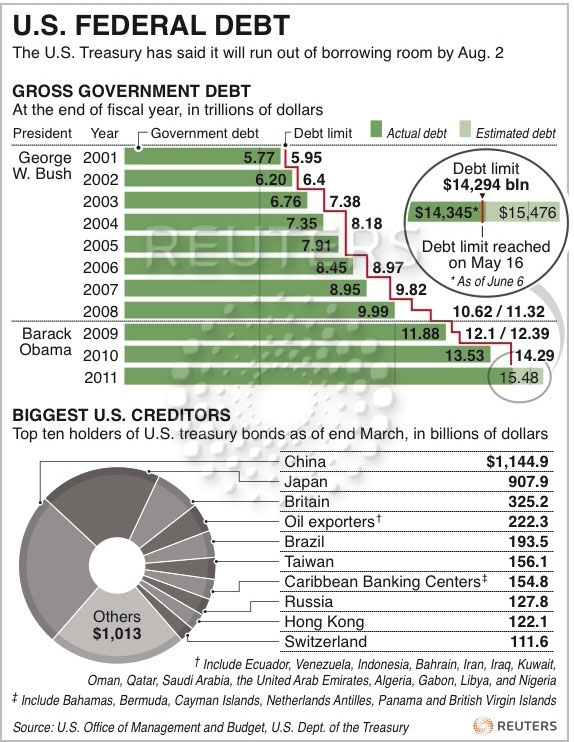
China notes that the United States is “playing with fire” if it agrees to default on its debt. Quite unwittingly and a bit reluctantly this will most definitely force countries like China to try to prop up the USD by purchasing more and more of the defaulted treasuries as they get dumped (mostly by US domestic holders of such treasuries). What a debt trap! China seems to have invested as much as 70% of its $3 trillion foreign currency reserves in US Treasuries! The posture taken by the Chinese is all about their concern that the money that they have invested in US Treasuries is safe, the reality is that the US wouldn’t care as much even if a “technical default” causes a fall in the USD. But countries exporting to USA would get killed – therefore in order to protect their exports, countries such as China, Brazil, even India, might be prompted to buy more to help hold down their currencies from appreciating.

The picture on the right shows the distribution of the lenders to the US Government. The main worry of the US would be that such a technical default would likely cause a ratings downgrade which would in-turn increase funding costs; raise interest rates; depress house prices and slide the economy back into a recession. And of course crash stock markets and shoot up gold. US benchmark 10 year Treasury yields are already hovering near their historic lows of 3%. Now, just what trigger would these notes need to start yielding higher again? A massive sell-off?

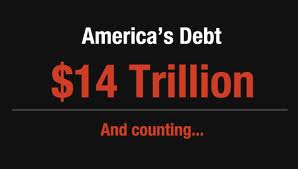
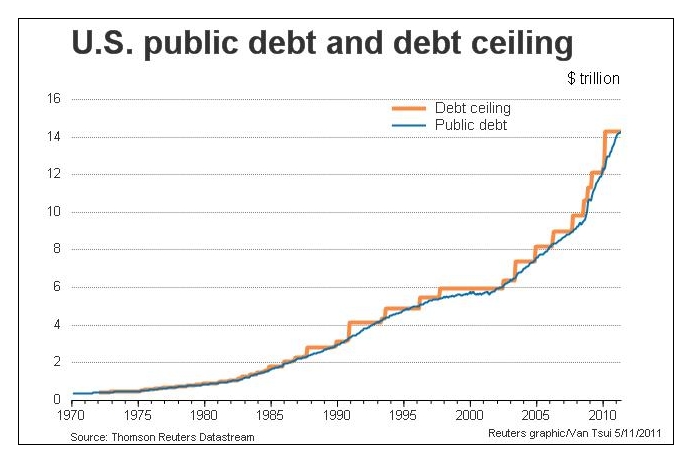
Assorted articles on the internet (I’ve pulled most of the ideas for this post from Reuters) seem to be placing the chances of a US default at near zero and many people are obviously dismissing the idea as ludicrous – but stop and think about what would happen if this really plays out like this. We’d know by mid August when some chunk of treasuries are up for redemption and payments. The chart on the top (click to enlarge) shows the US debt levels and the corresponding increasing in its debt ceiling levels. Now, the US Government cannot borrow more than its debt ceiling level and since it breached that level in May 2011, the Senate needs to vote in an increase of the debt ceiling. The reason why people are calling for a “technical default” is that a delay in voting for raising the debt ceiling may give time for economic forces to play themselves out and things to settle and solutions to emerge. Like a cooling off period. Before upping the ceiling. Most certainly it sounds like the political opponents of President Obama trying to generate real bad press and image for him by making the US Government “default technically” and then coming in to the rescue by voting to support the resolution to up the ceiling. That may be why the Treasury Secretary and the Fed people are saying that the results to the world economy will be disastrous if the US defaults.

While the idea of the US defaulting does indeed appear crazy, nitpickers are therefore qualifying a “technical default” as being a different situation as compared to a real “failure to pay” kind of an event. The latter is catastrophic. The former is more like a pause that people do when enjoying a lavish luncheon buffet. They pause for breath, beam at their table-mates and reach out for their wine or water to catch their breath. Continuous eating, while supplying loads of calories, can be quite tiring. It also makes you a glutton. Take a look at this chart that I’ve sourced from Reuters (US online edition). How long can someone keep eating and eating and eating?

Rising Prices and Risk

If you agree to the idea shown in the below graphic, would you not agree that as Gold rises and rises, it is getting to be more risky?

SKS Microfinance

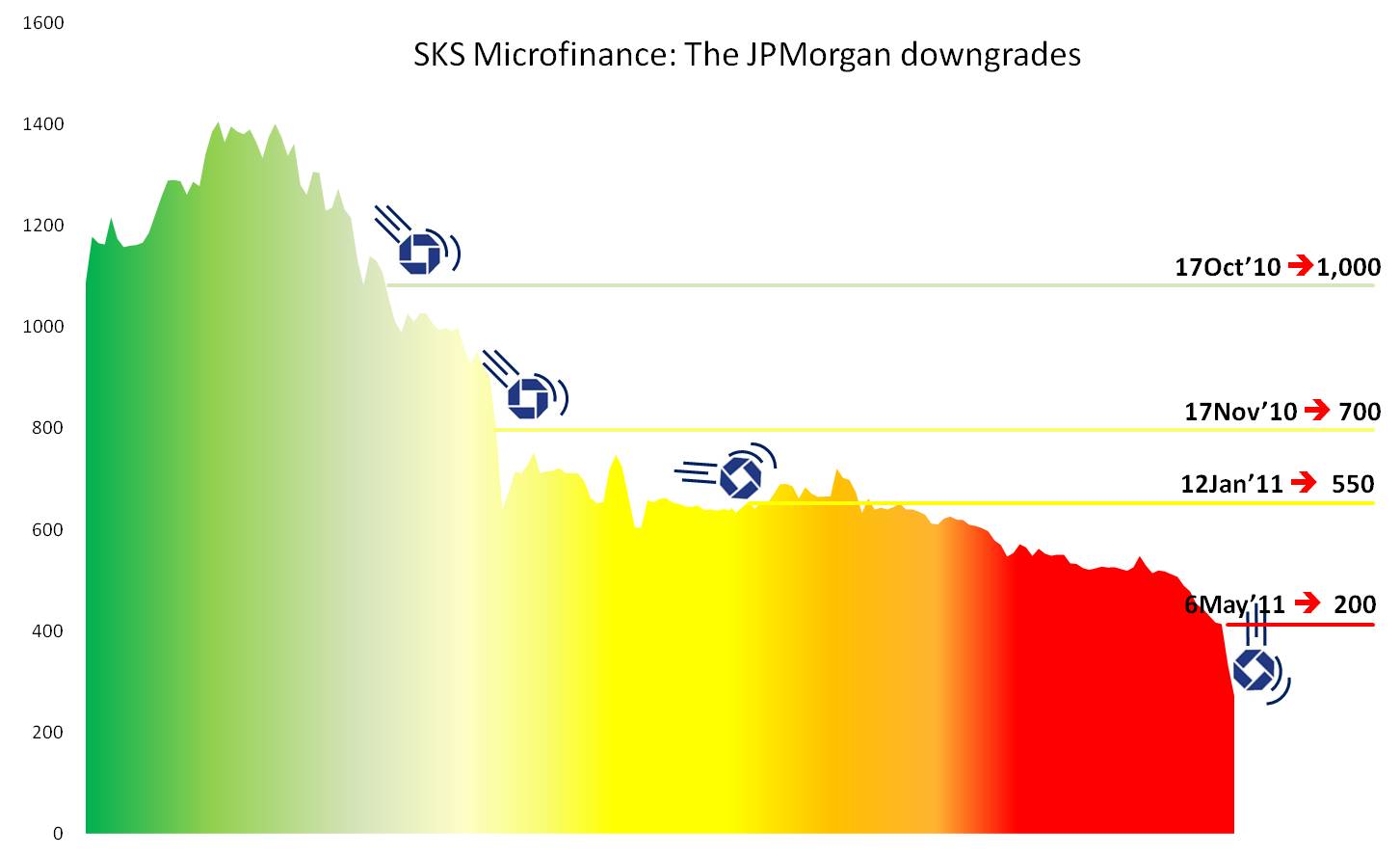
A bit of a light hearted take on data I pieced together from the web. We know that JPMorgan did not get the mandate for the SKS IPO, but there are indeed some dark stories that have come out re SKS – upward bias of interest rates, insider trading allegations and all that. Some of these successive downgrades may have been dipping the toe in the water kind of cautious missives – but the latest one that drops the ball right down to 200 is a nice, clean cut. 


Design a site like this with WordPress.com
Get started