Platform and Purpose

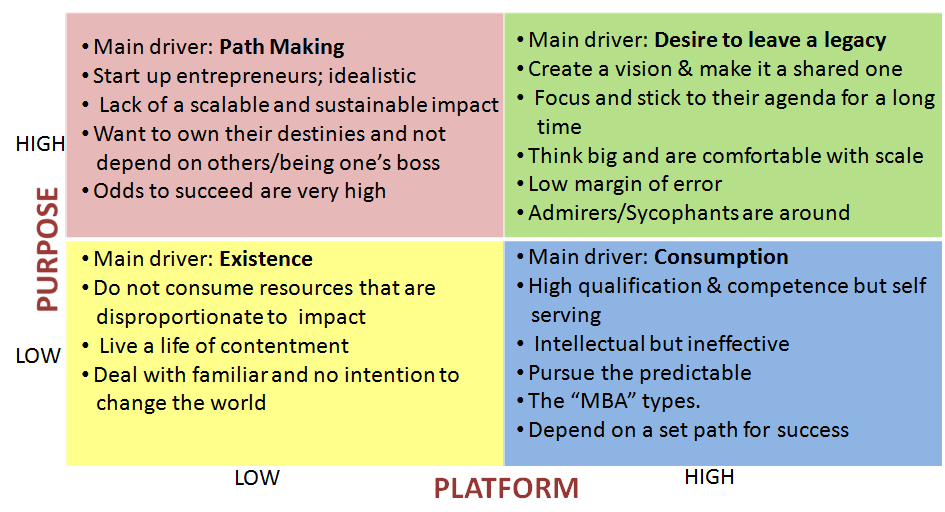
Finished reading Subroto Bagchi’s “The Professional: Defining the New Standard of Excellence at Work“. Simple anecdotes bring out very powerful messages. Messages which all of us intuitively know as being right but somehow which don’t sink in. This is not a book review or a synopsis but just a diagrammatic representation of one of the summary chapters towards the end of the book. Basically, active workers have been clubbed into quadrants, each of which is defined by a unique combination of platform and purpose. “Platform” here refers to the silver spoons you get in life, the ‘leg up’ your education and social status provides you etc. “Purpose” refers to the methods you follow to act out your professional destiny on the platform given to you.

Something like that. So I depicted the sense I got through the chart below. I think I am in the blue quadrant as a “Pretentiously intellectual but pathetically ineffective” specimen!!!

I guess a good station in life is rare and many of us are in the high platform but low purpose realm. It appears from the book that the probability of moving over to the high purpose | high platform quadrant from the low purpose | high platform is higher than the probability of getting there from the high purpose | low platform quadrant. Ergo, the bases have to be high/low for the transition probabilities to be low/high and therefore both logically and emperically, it appears that the volume distribution of workers among each of these looks like the below. Very few people in the high purpose and high platform quadrant really.

Wikipedia Shuts Down…

…thankfully, only for a day. This is as a mark of protest against some proposed legislation – Stop Online Piracy Act (SOPA) in the US House of Representatives and the Protect IP Act (PIPA) in the US Senate. Must have been taken a good deal of thought to announce the 24 hours blackout, obviously aimed at mobilising public opinion against the proposed legislation and making the general public aware of the threat to freedom of information flows in the internet. I agree and so does the Obama establishment saying that “we will not support legislation that reduces freedom of expression…”. It does seem a very retrograde step and suited to serve the commercial interests of those who profit by limiting access to information. While the White House statement veers off into cyber security issues, the moot point is the thin line that seperates responsible information dissemination and cyber sanctimoniousness.

Various culture, education, IT and Information and moral ministries and politicians appear to be the most sanctimonious of the lot. It was learnt recently that a Minister of the Government had summoned execs from Facebook, Google and Twitter and asked them to remove content that maligned the current Congress President. Wow! That was some time back. Personally, I have absolutely no interest to search and read about the Congress President – regardless of the antecendents or authenticity of such information but I do care about such social media websites running fine and being allowed to flourish. A statement by an Indian judge however seeks to thwart that desire – he told Google and Facebook that their websites can be blocked “like China” if they fail to come up with a way to remove religiously offensive content. Some obscene pictures and derogatory articles pertaining to various Hindu gods, Prophet Muhammad and Jesus Christ have been found on the internet it seems. Quite predictably, todays Times of India carried a short comment from these companies pointing out to the fact that India is not China – in that it is a democracy where freedom of speech and expression is a right.

Which finally brings me to these fantastic infographics by http://open.youyuxi.com/ on the who, what, how and why of internet censorship around the world. The site has a counter for visitors to vote for an internet that is more open and uncensored. 2.27 million people have said a yes to that, including me. I use wikipedia extensively – very extensively in fact and I hope that they don’t touch it too much.

Update [18Jan’12, 4:53pm IST]:

And this is how wordpress looked like some time back today. Brilliant stuff!!

Eastern vs. Western Averages

Here’s a chart from The Economist worth a second look. While it does appear that slowly and steadily we seem to be in an era of transfer of wealth from the west to the east, the problem of India and China is that of distribution. Is this growing wealth helping lift people out of poverty. The question to be asked is that if this increase in GDP be distributed across all citizens of India and China equally, what % of their respective population would get lifted out from poverty?

 And here’s an interesting addendum to this chart:

S&P Sovereign (FCY) Ratings:

Britian: AAA                    United States: AA+                      France: AA+                                Germany: AAA

Russia: BBB                       Brazil: BBB                                        India: BBB-                                   China: AA-

Managed Floats

Jeffrey “King of Bonds” Gundlach was the former head of the $12 bn TCW Total Return Bond Fund. His presentations on the state of whats happening around the economic world are eagerly awaited and discussed. You can find his latest message here. I am showing two screens that caught my eye. These are the lines of movement of the Chinese Renminbi (RMB) and the Indian Rupee (INR).

The INR is on a “managed float” path. Successive administrations at the Reserve Bank of India (RBI) have managed to maintain and further this strategy of not pegging the INR to a particular foreign currency at a particular exchange rate. Earlier, the RBI used to intervene in the currency markets (it still tried its hand very recently), but the growth in recent trading volumes on the INR means that RBI’s intervention will lack any meaningful punch going forward. The INR has therefore moved a little bit closer to full float status. 

The RMB, on the other hand is undergoing a lot of makeovers. It was earlier pegged to the USD at a fixed rate and then in 2005 when the peg was lifted, all the pent up pressure got released and an immediate revaluation took place. However, the peg was unofficially brought back due to the onset of the financial crisis. Then, in Jun’10, China’s central bank said that it will increase RMB’s flexibility. Now it is moving to managed float status. HSBC had earlier predicted the RMB to become the 3rd major world reserve currency in 15 years. That’s a lot of time for a few more makeovers.

Happy New Year

Here’s wishing all a very happy and prosperous 2012!

Risk Management and Inter Bank Dealings

This will be big news in today’s papers (posting around midnight AM) – RBI’s promulgation of capital controls to reign in the currency movement. There is a meeeting there in the RBI today for a review of its monetary, so some more interesting sound bytes should come out. What if they cut the CRR?

And Ajay Shah provides a contra view to RBI’s action. Boy! If I have to pick between the short term bounce up generated by a possible CRR cut and the medium term lower levels of NIFTY as mentioned in Ajay Shah’s post, I’d pick the latter.

BTW, at one point in time yesterday RBI’s legal tender was quoting at 54.29 times a USD! Can’t believe it. Sort term relief for exporters? Only if they prevent losing their margins to local inflation.

Emerging Markets Myths

Chart from The Wall Street Journal. The parent article talks about some reality checks regarding investing in emerging markets. And why the developing nations road to stock market earned wealth will be bumpy.

Repo Rate and Inflation

The Reserve Bank of India (RBI) has designated the weighted average overnight call money rate as the operating target of its monetary policy and the repo rate as the only independently varying policy rate in order to more accurately signal the monetary policy stance. So while cash reserve ratio (CRR), statutory liquidity ratio (SLR), market stabilization scheme (MSS) etc. are all important tools, the policy lever of RBI that is always in the spotlight is the repo rate. This is the rate at which banks borrow from the central bank blah blah…

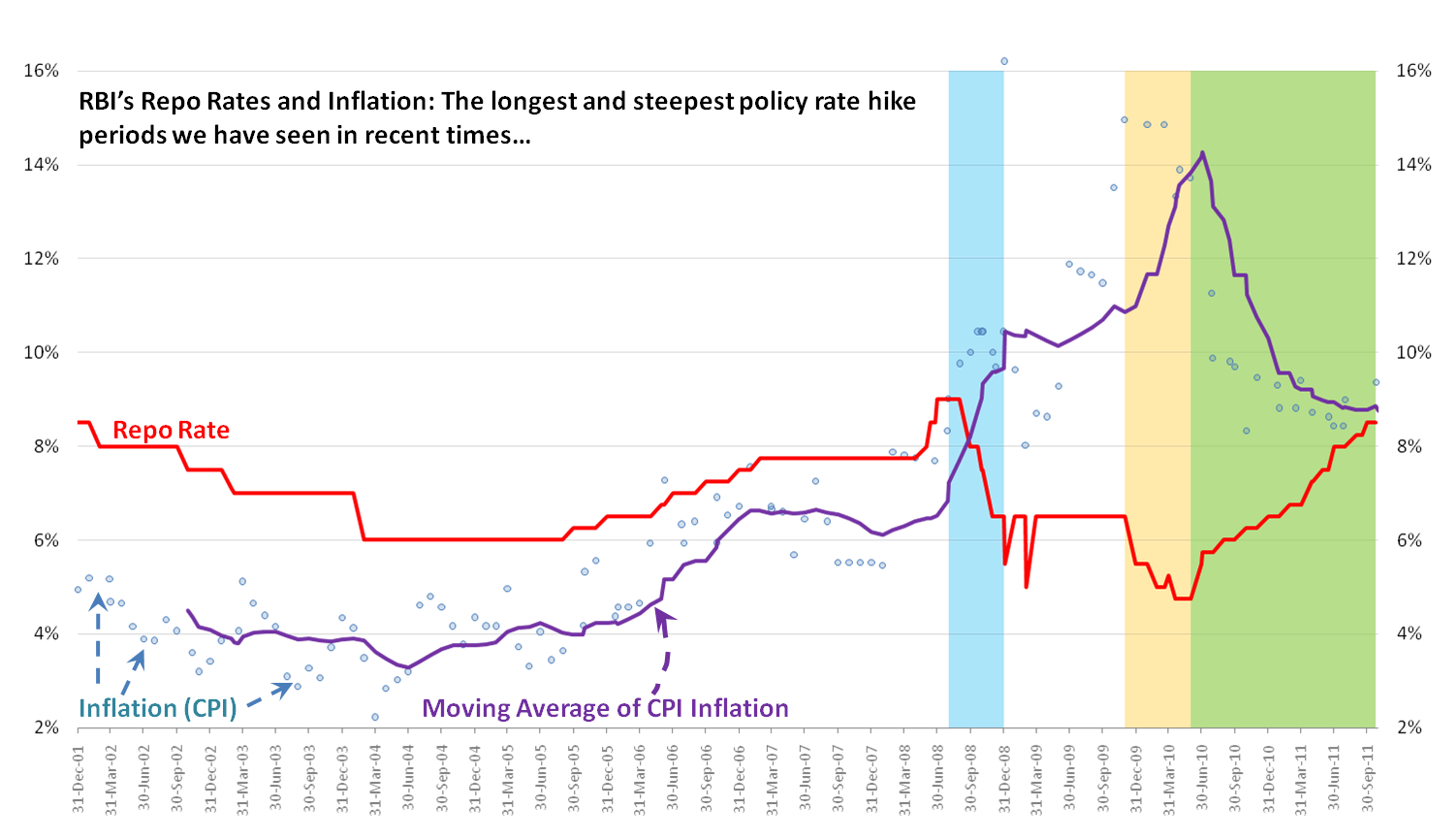
A lot has been said about RBI’s role and its effectiveness in fighting inflation. Rate hikes are common knowledge to all in the country by now concerning that they affect people with loans in their lives. Interest rates have been rising in India (and all the emerging economies) and I had an investment thesis of catching banking stocks when the interest rate cycle turned. Interest rate senstive sectors like automobiles, real estate, banking etc. will get a breather if the rates turn. The sovereign debt crisis in Europe has however ensured that the hawks continue to circle above the Indian economic landscape. Fat chance that we may see a rate reversal. Indeed, the banking sector is badly mauled and it certainly does not look to be in a hurry to recover. I need to figure out what to do with my investment positions in Axis Bank and HDFC Bank – and towards that end I tried to read up and form an opinion on inflation, rates and their cycles. The below chart came out.

If you look at the period after mid-2008, there is a very perceptible negative correlation betweeen inflation measures and the repo rates set by RBI. I am saying correlation here. As you know, correlation does not automatically imply causality. I have shaded the three time periods of recent times where we can discern some sort of a clear monetary stand taken by the RBI. The light blue band is a period of declining repo rates. I have added a 12 period moving average of the monthly inflation rates (taken from ycharts) to show trending inflation information. As you can see, during this period, the inflation rate increased as the rate fell. Then the light yellow period (Nov’09 – May’10) shows the continuation of the trend started in the previous phase. The RBI further reduced the repo rate down to 4.75% towards the end of this phase – with inflation continuously rising while all this was taking place. Then finally, the green band, which we seem to be in today as well. Here, we all know the sequential repo rate increases affected by the RBI. The inflation rate did appear to have fallen from a high of 14%. But it is still high at 9.5% – 10.0%. So many experts (and some vested interests) have argued that the RBI should stop fiddling with the policy rates since these measures have not been successful in taming the beast. My point here is that inflation is whatever it is, but can you confidently say that the situation could not have been any worse than what it is today?
I guess, my view is that till this point successive repo rate increases have helped in “controlling” inflation. They may not have brought inflation back to the comfort zone of 5% – 6%, but they have definitely put some brakes on the juggernaut. Beyond this point, any further increases in the policy rates may actually be detrimental to the economy (from the inflation point of view)! Beyond a point, if rates continue to rise, they will do their bit to strangulate the supply side by making it uneconomical to produce. While you may smile when you read about farmers in Andhra Pradesh striking work, the fact of the matter is that very high rates do push out payback times, reduce rates of return on economic activity and shut down the cogs of industry. I would not be surprised if the increasing levels of cash balances with Indian companies is linked to them not finding any profitable incentive to produce/invent and invest. So, my hunch is that RBI will/should stop raising rates now. However, my holding in Axis Bank and HDFC Bank is still a millstone around my neck since a pause in raising rates does not mean that the central bank will start reducing them! It could be a good 6 months (if not more) before we start seeing a reversal of the current policy regime.

So what about inflation? Maybe we hope that foreign policymakers and governments are more adept than ours. FIIs run our stock markets by proxy anyways. If the cost of fuel starts falling and INR goes up (read as: USD depreciates since Americans would want Germans to continue buying American exports) then perhaps inflation will take care of itself. This will happen inspite of our Government which has done absolutely nothing to control the supply side pressure to inflation. In fact, people posture and talk as if the RBI is responsible for the supply side as well! We are in a hot air balloon now. Lets enjoy the expansive expensive view from the top. 🙂

2008/09 vs. 2010/11

The charting fun continues…

Here, I have highlighted the two massive cuts in recent times in the NIFTY chart since 1Jan’01. The US sub-prime/Lehman correction is in red while the current recessionary times are in dark aqua. Well, there is hardly much of a time span between the end of the red phase (6Mar’09) and the start of the second drop (5Nov’10) which obviously leads one to believe that the red and the aqua phases are part of the same pain that started once the sub-prime mess started. 20 months can hardly be called a recovery.

What I also did (ref chart below) was to phase shift the second bearish drop and superimpose it on the first drop to see how they compare. I know past patterns may or may not portend the future, but then all I said was that I wanted to have some charting fun! So, here is what is looks like. Please draw your own conclusions, for I know of none. Caveat Emptor, as always.

 But tell you what, reading all the stuff that is being talked about Europe, who knows what will happen. It’s like this:

HEADS: Merkel and Sarkozy do the impossible and let the European Commercial Bank’s (ECB’s) priniting presses run and run and run. I am happy since I do not have to update my chart. It happens just I thought it to.

TAILS: Politicians are for the polity, by the polity, of the polity. Crazy things happen and I have to redo the comparative chart all over again! 😦

This week the dice is expected to roll. Let’s see. While I don’t mind the extra effort involved in updating my wayward chart predictions, the way I sway depends very much on the way the dice rolls. I have a lot of hard earned money whose trail somewhere leads up to the presently idle printing presses of the ECB. But not all’s gloomy: there is one positive lesson to take from the above chart. Just look at the comparative chart and reflect on the 2008/’09 time period. You lived through it. Correct? Some of your positions would have been abandoned at a loss but if at all you initiated any fresh positions towards the end of the red phase, you’d have made up a good part of the drop, correct? The most important part is that you are alive (if you are reading this) and are still sane (if you are reading this!).

And here is the best and most audacious part. Chartbusting stuff really! How many years did the Pension Commissioner say I have till retirement? (By retirement I mean growing old and easing out of the active labour force). 20 more years? Ok. So I took the first chart, which shows the NIFTY’s march since 1Jan’01 and increased the scale by a 20 more years. Values of the index are blanks since who knows what tomorrow may bring…but do look at the resulting chart (shown on the right) and stare at it for a loooooong time. Do you see what I see? Ok, you know that I have played around with the axes of the chart but then that’s what I said at the start I would do right? i.e. having some charting fun.


NIFTY Monthly Closes

Here’s a hastily drawn chart which shows NIFTY monthly closing prices ever since Aug 2002. I have drawn the purple support (?) line rather arbitrarily, but via that it does look like the knife has some more height to fall. Lets not catch it and bloody our hands anymore than they already are!

Design a site like this with WordPress.com
Get started