HDFC Bank – Intraday as well as Long Term Opportunity

HDFC Bank is sitting nearly on its 200 SMA (see chart at bottom of this post) and also roughly at its horizontal support. Tomorrow (10Aug) there will surely be a bounce back and this share, among others, should perk up a bit. Though it is very much possible that the market may slide back again after a few sessions as the medium term bias does look -ive. But HDFC Bank is a good thing to buy around these days if you have sticky money and can wait on it for a few years.

Hell, even if you have 5k, 10k, anything at hand and have a good 10+ years of working life ahead of you – please do buy. You don’t need expert advise in times like these. Another tip is that you are the kind that uses Equity Linked Savings Scheme (ELSS) for their tax saving purposes, please buy now for the current FY. Unless you believe that the market has started a nice, long downward slide, there is no point in doing a SIP if you can catch plunges like these. Lets wait for the bounce tomorrow/day-after and then if the market droops down a bit more, that could be a good time to buy. While some people are feeling relieved that the 5,000 level was held, some others are of the opinion that some more depression is left in the market and that it could fall down to 4700 – 4800 territory.

One silver lining: stock of Allcargo Global Logistics Ltd. It bounced up 4% today!! Pretty sure it will go up tomorrow as well – lets see. I own the stock 😉

Yet Another Lap

OK. So I was a bit late in posting about my 36th lap around the Sun, but better late than never. Well, the 36th lap and the moment aross the chequered flag has been well, very chequered indeed! A very different 5th of the 8th for me this time around. 😐 I think I just grew up.

Let me first recount and take stock of my previous year’s resolutions (click 5Aug’10) and see how I fared.


GOAL WHAT HAPPENED?
Gift myself more time Achieved!
Trimmer and fitter Failed!!
Giving Gave (but as expected, only to myself 😉 )
Know when to sell Failed!! (am sitting on a pile of crap)
Pay more attn to sonny boy Well. Umm. Lets just say that the traffic lights project failed to take off. Sorry.
Read > 12 books this year Achieved.
Do not read Atlas Shrugged Achieved!! Tried to get someone to read it, but failed there!!
Stop idolizing Jessie Livermore Achieved! I held back and stayed mostly in cash this year
Increase monthly views to The Third I by 30% Failed miserably!!!
Stop paying people money to visit my website Achieved. This was easy considering that the stock market had wiped out all my money at hand anyways!!

So net net, I managed a 6/10 score last year. Good,eh!! 🙂 Remember, I am the judge and the jury here.

And whats it for this year:

  1. Complete the traffic lights project (typed extremely sheepishly)
  2. Read yet another 12 books this year
  3. Lose weight by at least 8%. I am horrified at what I have become compared to what I was. 🙂
  4. Practise CAS: Control anger; Accomodate and be Sensitive.
  5. be more spiritual
  6. increase ticket size of investments. Dont be afraid to trade big. Its all about %s anyways.
  7. be regular on The Third I

That’s it. Trying to be a tad modest this year.

Godrej Industries Limited – 1Q12

My core holding, Godrej Industries Ltd. (GIL) continues to inch up amidst all this talk about desi rate hikes, debt ceiling, Greco-Roman excesses and Obama’s insomnia. Over the last one year, the stock is up 15.7% compared to the NIFTY. The company announced its 1Q12 results on 30Jul11 covering the following points:

  • The agri business has grown 40% yoy while the other core business of Chemicals is up 28% yoy. Both in revenue terms.
  • A 46.34% growth in consolidated net profit at INR 71.33 crores. The consolidated net sales increased 35.85% at INR 1,307.42 crores for 1Q12.
  • Godrej Properties witnessed revenue growth of 83 per cent despite a difficult quarter for the real estate sector

So to me, the results look very good indeed. In my previous post on GIL (dated 31Oct’10), I’d written about the integration challenges that GIL will face as it goes about acquiring companies. Well, the recent Godrej – Hershey breakup just adds to the fears. I guess global majors may be seeing low barriers to entry in the yummy Indian food sector and therefore itch to go solo. I’m thinking – how expensive would it really be to set up a sales & distribution & marketing infrastructure when denominated in GBP or USD? I don’t know but it may not be a large sum for a global foods major who has decided about getting serious in India. I know I may be trying to justify but typically I do not fall in love with the stocks I own!!

Another update I wanted to share was about the general notion that holding companies are duds because they trade at a massive discount to the market value of the assets that they own. Last month there was a lot of buzz about these holding companies – thankfully the general downward bias of the markets stopped spikes of manic proportions. As of now, I don’t give a rats ass about holding companies other than GIL obviously. Speaking of which I did start wondering about who moved my cheese when I came across this video clip of an interview of Basant Maheshwari on CNBC-TV18!! This is what he had to say about the Godrej gang of shares.

Godrej Industries did very well for 4 – 5 years because investors who wanted to buy Godrej Properties, couldn’t buy Godrej Properties. The only option was to buy Godrej Industries, but now if Godrej Properties is listed and I am bullish on Godrej Properties, I’ll go and buy Godrej Properties. Why will I buy Godrej Industries?

And these are the nuggets of wisdom I picked up from this interview:

  • Embedded values in holding companies always remain valuable!!
  • Investors make money in a cheap stock only when the cheap stock becomes expensive. So it has to bloody well move. There is no point in holding up your capital on a sloth.
  • If you are playing for the valuation gap i.e. the discount factor of the holding company to aggregate market value of its assets, then that’s wrong since the discount will always continue to exist.
  • Key play should be in holding companies which A) consolidate the earnings of their subsidiaries; B) the subsidiaries pay dividend and C) the holding company has a majority holding. C being the cause of point A  really.
  • Buy those kind of holding companies whose subsidiaries are not listed such that the act of taking them public monetises  the discount factor and unlocks value.
  • A holding company that receives discount from its subsidiaries usually does not go into too steep a discount. That is because if the dividend yield of the subsidiary is X% and the holding company is at a Y% discount then the dividend/income yield on the holding company’s portion of investion would be X%/(1 – Y%). The market will flatten this discrepancy by reducing the discount.
  • The reason why discount is justified is because if a holding company decides to monetize its assets and sell of all its holdings, it will still have to pay taxes on the income recieved. Therefore, the logic for discounting holding company’s asset values is correct.
  • Finally, if you are bullish on the holding company you have to be bullish on the underlying assets. If those assets are listed, it always makes sense to buy the underlying assets directly.

Now this has me thinking. Need to investigate and read up more to figure out what to do.

Finally, This is how some people are valuing the company: 9 times multiple for core businesses of GIL + 40% haircut to the market value of GIL’s stake in Godrej Properties and Godrej Consumer Products Limited. Adding all of this up gives a Sum Of The Parts valuation of ~240 – 250. Given CMP of 225 – 230, the company looks fairly priced. From the short term technicals perspective, 240 looks like a good resting place for the stock. From the longer term perspective, which is mine, the play is to ride the business growth and hope for a measured EPS expansion in the quarters to come.

Borrow US, Borrow

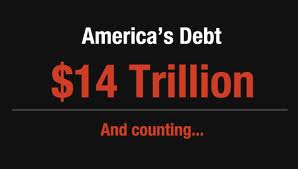
No glass ceiling for the US, it seems. We will know on 02nd Aug, if the lawmakers in the US raise their debt ceiling so that they can continue to borrow more to pay off their servicing due pertaining to their extant debt obligations! The credit card issued to the US is massively revolving its credit with exporting countries providing angular momentum for these revolutions by lapping up US paper. The exporting countries (most of them on this side of the Prime Meridian) obviously want to hold down their currencies from appreciating, but considering inflation and its political impact, they may not be able to go the full way. Maybe the US will be able to cleave the rating agencies and have at least one of them desist from swinging the axe of ratings downgrade.

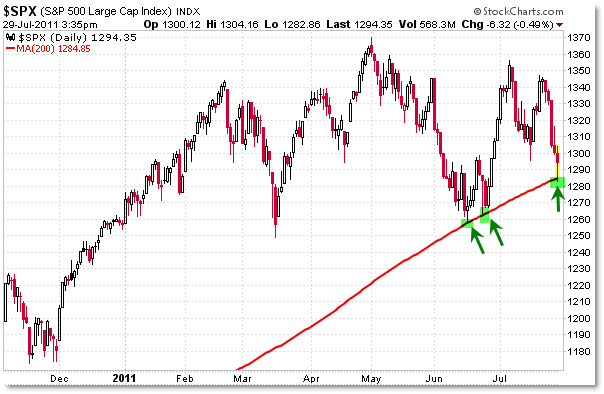
So the coming week is going to get very exciting. The S&P 500 is sitting on its 200DMA. Whatever you believe, or whether you believe in nothing at all – you have to brace yourself for some tight action around this point. People look at such chart positions and either line up for a bounce (from the 200 day DMA line) or short-sell and expect a cut through the line. Since a majority do it, it becomes a very important psychological level.

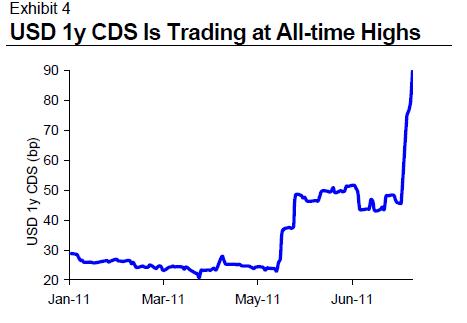
Meanwhile, the credit default swaps markets are certainly pricing for a US default. Actually, may not be for a default as much as for a marked decrease in the credit worthiness of the nation. Now who holds US debt in what proportion? These guys must sure be a worried lot. And so are we all since the whole thing is one giant messy spider’s web. In our desi markets there are quite a few companies whose stocks are either rising up to touch their 200 DMAs or  have dropped down to kiss that emotional line. With interest rates going up in India, and loads of shareholdings of promoters being pledged to banks for favourable short-term loan rates, I’d rather bet on the market drowsiness to continue. Let’s see. Like Jaspal Bhatti, who once in a television serial, made a comedy that won an award for being the best tragedy (or vice versa), I hope that my logic and thoughts continue to be contrarian indicators! 😉

No disclaimer here.

Misery at an All Time High

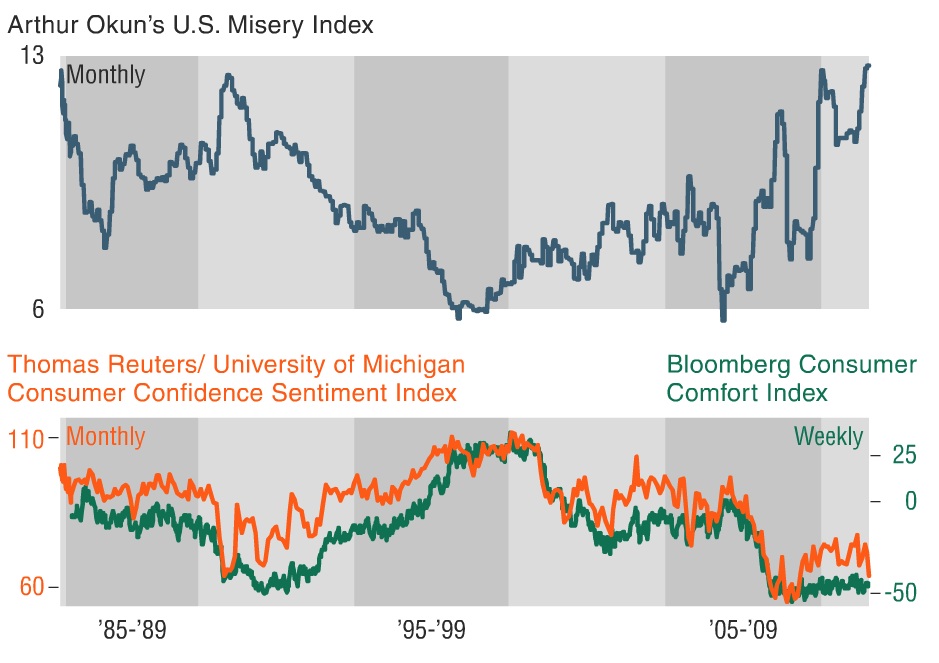
The Misery Index was conceived by Arthur Okun, an economist at Yale University and the Brookings Institution who served as an adviser to Presidents John F. Kennedy and Lyndon Johnson. Currently, it stands at 12.8, the highest in 28 years. The chart below (idea for post borrowed from Financial Armageddon) depicts the relationship between consumer confidence indices & the Misery Index.

Well, Americans haven’t felt this bad in three decades! The moot question then is that if this is the peak and if some reversal to the mean is expected, does it mean that things are going to get better from here on? Is there any “Scepticism Index” of equity investing as well? That people loathe and shun the stock markets like the plague. If miserable people are also paranoid about equity, then yes, behaviourally at least, we may well be on the verge of a recovery. Who knows!

Shree Renuka Sugars Ltd.

I had written about the sugar stocks here nearly a year back. Since then the bunch has steadily trailed the indices (SENSEX, NIFTY) not doing anything exciting. But now I am wondering if enough is enough and its time for the Indian sugar scene to pick up. I have plonked down a smallish packet on Shree Renuka Sugars (SRS) and the position is up 20% already. The real test will come in the near future where the scrip first tests its 50 SMA and then the 200 SMA in quick succession. If it cuts through, then maybe there is a case to load up on the sugar. So my hunch is that breaking 80-85 is going to be key for the stock. SRS’ FY ends in September, so that will also be a good time to take ‘stock’.

This Belgaum, Karnataka born company is the only sugar/ethanol producer in the world with a year-long cane crushing activity due its footprint in Brazil and of course, India. It’s production facilities are located on opposite sides of the planet really and therefore SRS can take advantage of complementary crushing seasons and ride out the seasonality which usually applies to the India only producers. There’s another benefit of this geographical spread. The Indian Government very actively intervenes in the markets to regulate the price of sugar. The Government stipulates export quotas on the sugar producers so that they do not end up dunking their stocks on the highly lucrative global sugar market. While international sugar prices have dropped hugely of late, the export market still commands a premium (and therefore higher realizations). Click here to see how international sugar prices have moved over the past 30 years. In the medium term, the investment logic seems to be solely centered around better numbers from their Brazilian units.

Over the last 4 – 5 years, the company has done well. It has upped the scales and managed to transform itself into a global giant throwing up an average Return on its Equity of 32% and a CAGR EPS growth of nearly 20%. SRS is amongst the top 10 sugar producers in the world. Also note that SRS is NOT a media, software, banking industry company. It operates in a very cyclical industry. So to have such figures in the CAGR leaderboard is very noteworthy and impressive and picking up the Brazilian units shows a lot of foresight and conviction on the part of the owners. I am ploughing trough the latest annual report as I type – reading some bits from it, watching YouTube videos of the founder and looking at some sundry opinion available on the net, it does appear that the management is quite level-headed (read small investor friendly/neutral).

I seem to be veering towards taking a long-term view on this company. In the short to medium term the company may not may not provide succor. International sugar prices rose sharply in June and are likely to remain flat for the remainder of the year. The Indian government is certainly doing its bit it in terms of keeping the international prices down by relaxing the export restrictions in place for domestic sugar millers. Check out this recent article in the Business Line which explains the impact of Government’s intervention in the domestic market and the changes anticipated. There is a word of caution though – this year the Government did relax the export restrictions on domestic sugar producers but I did read somewhere that SRS does not seem to have met its full export potential. Full decontrol and therefore letting market forces dictate prices means that the Indian sugar producers will have to become more nimble in production and mechanize/automate the way the Brazilian industry has done. Which would mean more capital investments.

The last point above brings me to one of my key concerns here: how will SRS handle its debt. While the Brazilian units that SRS acquired give a far better realization than its Indian factories, the acquired units had loads of debt on their books which came into SRS’ fold. The key is for the international sugar prices (and also oil prices) to hold high enough for a quick surge of cash flows into SRS’ Brazilian ops so that much of that debt can be retired quickly. The debt driven acquisition of Brazilian operations resulted in an increase in interest outgo by around seven times and also increased the depreciation charge five times over.

At a market price of INR 70, the stock representing a discounting of 7 – 8 times its trailing 12 month earnings. Other domestic India producers are currently trading at higher comparable discount factors. The reason why it has been hammered down considerably more as compared to the North Indian sugar companies is because its high-margin Brazilian ops did not contribute as much as they were expected to do. Net, net I think SRS could be a nice compounder and give a decent α above market returns over a 3 – 5 year period. But I am guessing that there will be a lot of swings on this counter. Hopefully 50 – 55 is a support level and therefore presents a good entry point.

Remembering Reliance

Ads that appeared on 6Jul2011 in Hindustan Times, Mumbai edition. Is there some message here that investors should pick up?

I’ve played around with the sizes, but the ADAG one was a half page ad while the RIL one was full page albeit a bit inside the paper. Don’t know what the ads were supposed to bolster, but they sure did not stop Morgan Stanley from (finally!) downgrading RIL stock’s target price to 956 from 1206. Just about around the same time that the ads came out.

Abortive Gold Trade

Of late, the NIFTY has been climbing up while Gold has been dropping. When I looked at the short term technical charts of NIFTY and Benchmark Gold Bees Index (I am long this index on a long term basis), I had an idea – to short the NIFTY and go long on Gold. So I chewed upon this trade set-up idea this weekend and finally perished the thought. Interestingly, my gut-feel (aka intuition or 6th sense) is a biased coin. When I have relied on my inner voice and followed the thought or idea that has sprung to my mind first, I have generally found myself to have chosen wisely. But this is generally related to work related and other decisions. Now, investing is certainly not about which-turn-to-take-from-Masab Tank type of inner voice invocation. So, it is not surprising that for me, when it comes to investing gut-feel, usually my initial gut-feel reaction has always tended to be dead wrong!!! Quite a personal contrarian indicator.

The chart alongside shows the 7.45% return of the NIFTY over the trailing 12 months against the very significant 16.25% returned by the Benchmark BeES index. The first half of the trailing calendar year has generally seen gold prices moving in lock-step with equity prices. From February this year onwards, the correlation has turned mildly negative which is what seems intuitive. So, commodity prices being the primary fuel of the stock indices has ceased to be the case for now as metals and of course, oil contracts. As I read up more on the internet, I figured out logic and reasons for why my initial gut-feel spawned trade idea was bad. On Gold, with Greece passing austerity measures, there is less of a motivation to look at gold as a safe haven in the very short term. So, it is likely that the coming week will be bearish or directionless for the yellow metal. Moreover, the US markets are going to be closed on Monday (4th July) and therefore gold could continue going the “buy the rumour, sell the fact” way down. On Thursday, the ECB and the BoE will have interest rate decisions announced and Friday will see the release of non-farm payroll data in the US. Therefore, it is unlikely that traders will take a strong view before these data points are clear.

So, if you look at the above chart, my hunch is that during the coming week, the gap between the yellow line (proxy for Gold) and the NIFTY will narrow down. Even if it doesn’t, no big deal for I have done the best thing that practise has taught me re investing: ignore my otherwise extremely reliable inner voice when it comes to pulling the trigger on investment decision making. Even if my intuition is proved right, at maximum I would just be guilty of an opportunity loss. Trade idea postponed, if not entirely killed, to next week now!

Industrial Disease

The Indian manufacturing sector output growth has slowed down for the second successive month in June to its weakest level since Sep ’10. Markit compiles this index in association with HSBC.

The commentary accompanying the press release says:


 The momentum in the manufacturing sector slowed in June as sequential growth in output and new orders decelerated further. Even with growth easing, tight capacity is still showing up in rising backlogs of work and a lengthening in supplier delivery times. On the inflation front, input costs accelerated, while output prices rose less fast. These numbers confirm that tight capacity and monetary tightening is constraining growth. However, inflation pressures are still firmly in place, calling for further policy rate hikes to anchor inflation expectations.

In other words: brace up for more rate hikes in the near future?

Tsunami of Cash

Source: https://pepperstone.com

Design a site like this with WordPress.com
Get started