NSE Advances vs Declines

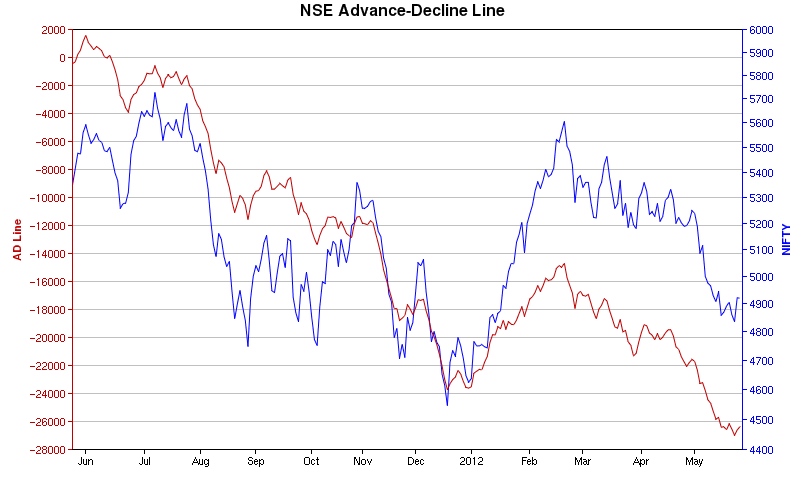
Here are two plots – the first is the daily breadth of the NSE listed stocks (the A/D ratio). The A/D line is at it near lowest since the past 12 months with the benchmark index also moving in the same lock and step with the A/D line. This chart is from http://icharts.in and I was too lazy to plot the broader market indices (other than NIFTY) but even then the NIFTY superimposition on the NSE A/D line does seem to point to some trend reversal in the days to come.
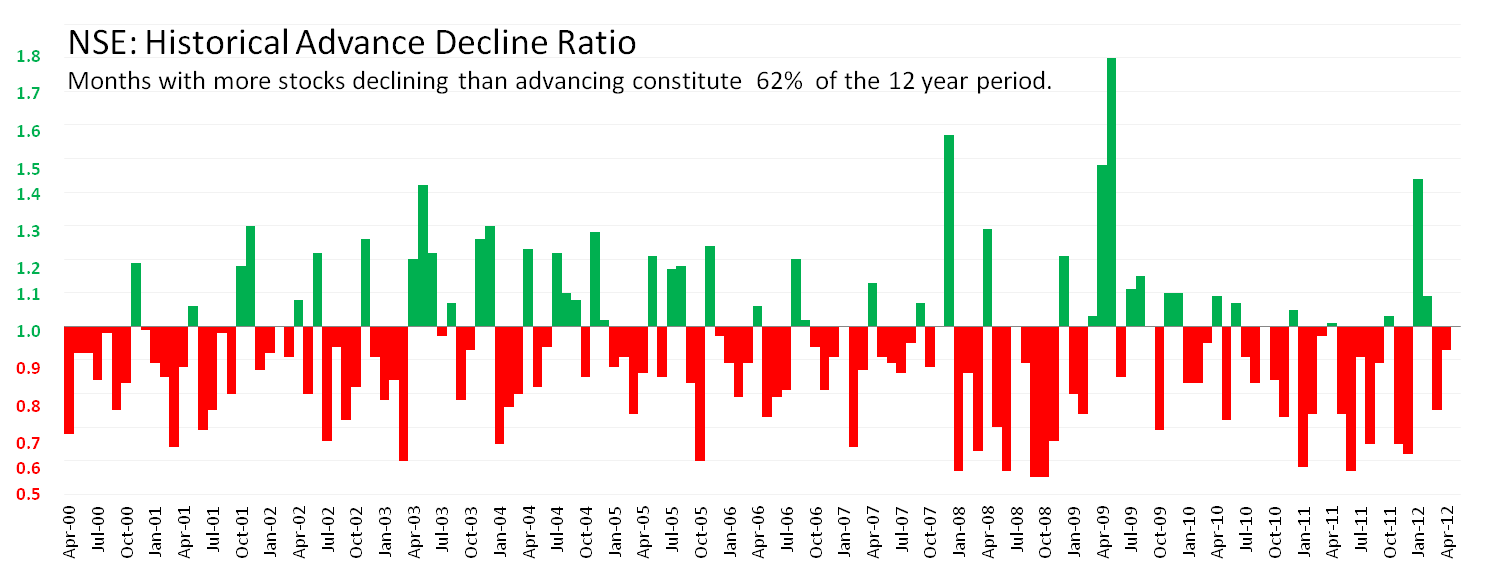
 

The second chart shows the monthly A/D ratio for all NSE stocks. The months which had more stocks falling are shown as red negative columns. The chart is more red than green despite the NIFTY having returned 236% during the same period which represents a gain of 10.9% compounded per annum. I guess this hints at the quality of listings on the NSE. The action is always in the frontline stocks – not that you needed a chart to reveal that! But maybe the visual might serve its purpose if it makes you pause and rethink any decision of yours that may be asking you to throw money on small, unloved, thinly traded and operator driven stocks.
Petrol on a Roll

Economic medicine that was previously meted out by the cupful has recently been dispensed by the barrel. These once unthinkable dosages will almost certainly bring on unwelcome after-effects. Their precise nature is anyone’s guess, though one likely consequence is an onslaught of inflation.
Warren Buffet

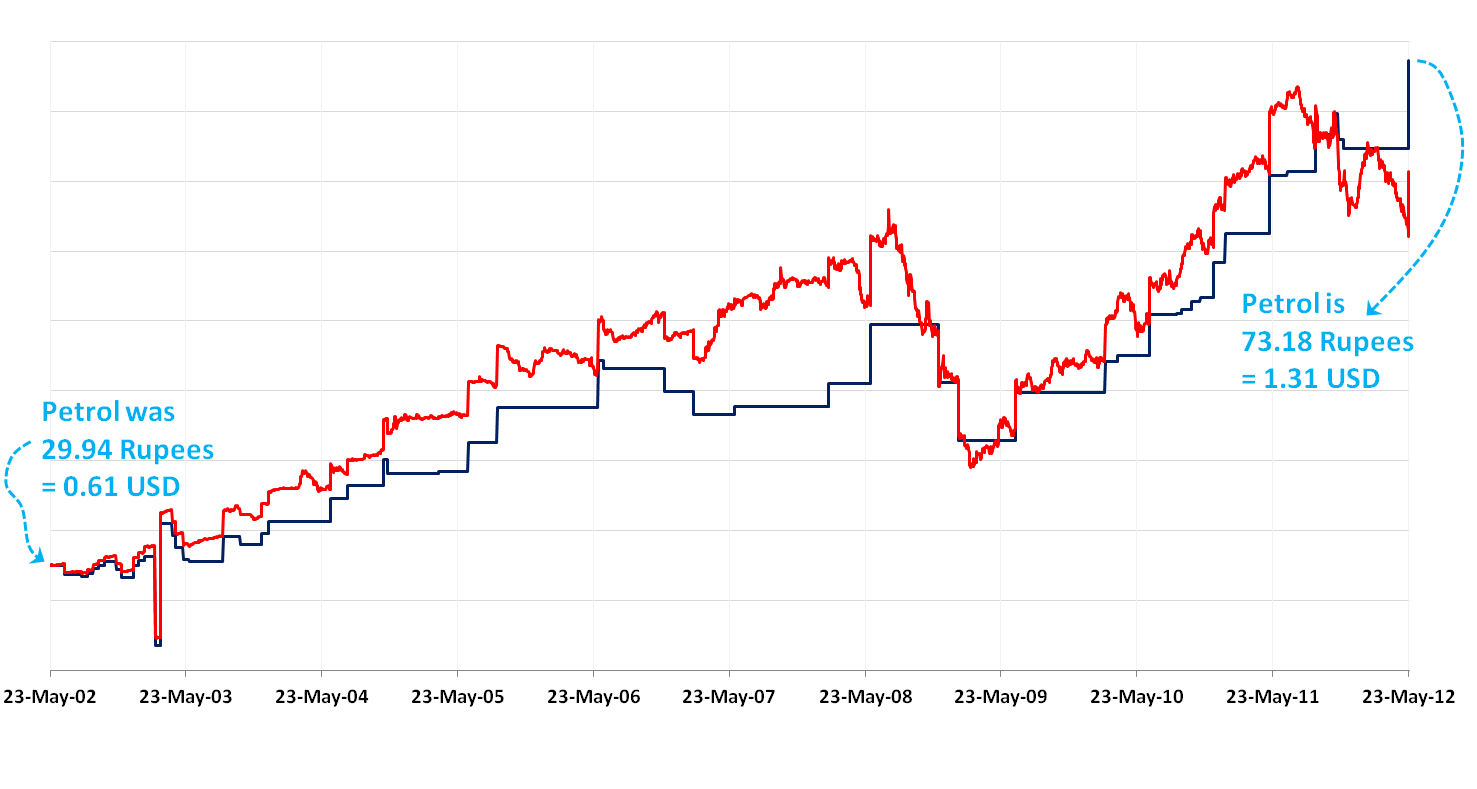
I did some number crunching and came up with the chart on the right. It shows the movement of the price of a liter of petrol in INR (stepped blue line) vs. it’s price in equivalent dollar terms (red line) over the past 10 years. The price of petrol in equivalent USD terms has always been  higher than the local retail price except during Jan – Feb ’09. Petrol pricing strategy seems to rely on ‘fixing’ the retail price of the fuel so as to minimise the tracking error against the red line. I constructed this chart to test this exact same hypothesis – point being that the red line is indicative of what the Indian refiners have to pay, in USD, for buying crude oil from the international markets. The blue line is obviously indicative of the revenue they get when they sell it to Amar, Akbar and Anthony. So the gap between the red line and blue line essentially indicates the subsidy burden that the Indian economy and therefore what AAA (the three gentlemen above) have to bear via taxes.

Also, between the INR:USD exchange rate and the petrol price, the latter is the dependent variable, i.e. exchange rate causes petrol price policy. This also comes out through the tracking movement of the blue line vis-a-vis the red line in the chart above. I doubt if all get this – many think that recent petrol price hike will help arrest the recent fall of the INR. Well, nothing like that happened today. Most people also think that the RBI can intervene to control the INR. The fact is that the INR fx market is too large for the RBI to control anymore. We are living in very different times from 10 years ago [ref: these excellent articles by Ajay Shah. click here and here].

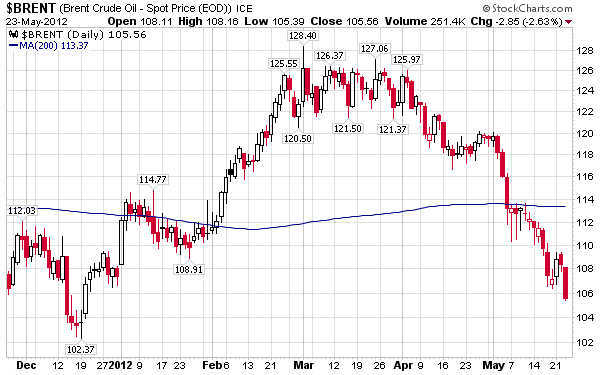
Now, what’s interesting with this recent hike is that it has happened at a time when the global price of Brent crude has been in a continuous fall since April this year! So India has increased its retail petrol prices despite a near 20% drop in the global price of oil! Reason being that while global crude oil prices fell by 20%, the INR dropped a similar amount in the same time thereby negating any benefits that could have accrued due to a lower oil import bill.

Also wanted to jot down the observation that the quantum of the recent blue line spike (i.e. price hike) is very high indeed. Maybe the Government had anticipated massive opposition to the move and hiked a lot so that they can roll back a partial amount to appease the insulted. Or it could be that Finance Ministry is seeing the INR go down to 60 soon and therefore have announced a one time whopper of an increase. I do not know what’s behind me but my chart certainly points to an anomaly – i.e. the blue line troucing the blue line by such a wide margin – perhaps for the first time in the past 10 years. Whatever be the explanation, the chart makes it quite clear that we live in exceptional times today and that all manner of caution and discretion is advised especially when allocation your capital to your ideas.

Incidentally, I am wondering if I should increase my ‘work from home’ days given that the price of petrol in Hyderabad has risen from 65.15 (16Jan’11) to 80.58 (24May’12) representing a 17% annualized increase. The only two major cities where petrol is more expensive than Hyderabad are Jallandhar (80.68) and Bangalore (81.01). Petrol remains lowest in Goa at 68.51, but even there, as in all Indian cities, beer is cheaper than petrol!! Cheers.

Greece

If this is Greece, what lies beneath? WYSINWYG. The one piece of ice that’s been drifting around very closely to this beast is Turkey. They should have included it in the Euro zone when things were good. Now, I doubt if the Turks will ever swim close to this thing. Cold Turkey, really. Incidentally, which is the country with the highest per capita holdings of gold? China? India? Greece? Its Turkey. China & India’s consumption may be high but Turkey’s growth in consumption is staggering – according to the World Gold Council, demand rose by 32.6% in 2011 compared to the previous year. Both their government as well as the people there are worried about the future. So while many emerging counties’ central banks are loading on gold as a hedge against inflation that the US Fed exports out to them, India seems to be a little bit too big to do that. Lots of money will be needed to buy more and more of the expensive gold and that would mean printing INR that’s getting cheaper in value (and therefore more costly to print) by the day. Considering that inflation will not be allowed to rise up any more than what it has in the past given we are soon going to be entering into the election year it looks like a catch 22 to me. Is my logic correct?

State Bank of India

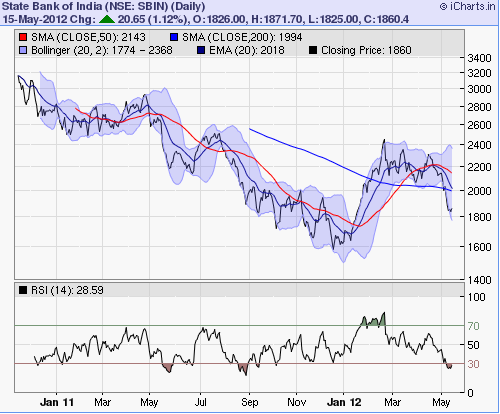
Look who’s come with a pile of cash at the State Bank of India’s ATM! Have they started selling/issuing shares through ATMs/

I am right behind this lucky guy lining up at the same ATM. But me, being more niggardly than this fellow will wait for a price level of 1600 to enter the ATM. Doesn’t look like we’ll see that price being offered, but again, there’s no harm in waiting and hoping. The least that can happen is that my wait will yield nothing. These days, I am ok with that. 🙂

Global Commodity Prices and the INR

The $CRB index gives global price levels of a basket of commodities and is an important indicator that is watched to get clues on whats happening. The index has been declining of late and this would certainly seem to benefit countries like India that have a whopping oil (and gold!) import bill. However, the INR seems to be playing spoilsport. Any gains from a drop in global commodity prices seems to be getting undone by a concomitant drop in the INR. I constructed the below chart to figure out the relative movement of the $CRB and the INR:USD exchange rate. The correlation comes to a high -0.75.

Skill vs Luck in Trading

Here’s my take on the eternal debate. Let’s indicate the unknown (i.e. what trading is?) by ‘x’. Now, luck and skill seem to be at 90 degrees to each other (i.e. only luck and no skill as well as only skill and no luck will both take you to the cleaners, I guess). Furthermore, since we are talking about successful traders here, it is unlikely that any would be found on the (all skill, no luck) or (no skill, all luck) lines. Which means that every successful trader has to have some modicum of both. Elementary, but I am sure how many of us are humble enough to recognize and appropriately fear the role that luck plays in our fortunes.

Anatomy of a Winner

Missed a flight yesterday – the first time it has ever happened to me. Had to take an alternate flight today morning at 5AM which made me wake up at 3:30AM. Lack of energy results in a very abridged post today. I hope you like the idea behind this quickie infographic I created based on some thoughts that came about via a newspaper article I recently read.

How Many Eggs In Your Basket?

“Don’t put all your eggs in one basket”. That’s what Cervantes made the  rotund Sancho Panza say in his book Don Quixote. The view expressed across the Atlantic, however, was quite different. Mark Twain told us to put all eggs in one basket and to watch that basket very carefully. Wise wits and financial advisors take Cervantes’ cue and tell us to scatter our assets and attention. The saying undoubtedly originated from the simple observation that if you put all your eggs in one basket and if you were to drop that basket, then you’d lose all your precious eggs. If I were a CFA or a wealth advisor I’d have egg on my face if I said that I believed that Mark Twain was right, but since I am not, I am going to exactly do that in this post! It’s important to understand the context in which it’s good to diversify and where it is not. This is the context I am referring to: make a pie chart of your wealth and ensure that you always have 3 – 4 wel diversified slices in it. Within the particular slice of the pie that indicates your equity exposure, you shouldn’t have too many further sub divisions. Many people interpret the eggs in one basket to mean that they need to own multiple stocks and multiple mutual funds!

According to me, it’s obviously important to have a little diversification and redundancy but generally small investors take this to the extreme. They play with woefully small stakes. So even if they bag multi-baggers it hardly grows their personal wealth. Even if you get a 3x return what’s the point if all that you have running on it is a measly 10,000/-? If I have to talk co-variances and correlations, the multi-basket approach only works if the baskets are independent. Which means that it is obviously a great idea to spread your wealth across (mostly non-correlated) asset classes like gold (not too much please!), real estate (uncorrelated really?), stocks, equity mutual funds, fixed income (PPF, bonds, debt MFs) etc. Fixed income may be interesting over a 2 – 3 year horizon if the local interest rates move down. If you noticed, I did not mention insurance since I do not consider that asset class as an investment, sorry.

But it’s a horrible idea to spread your investments across > 15 stocks (just to pick a number, my Kelly Formula post notwithstanding). Why? Because its impossible for a small investor with a daily job to digest all those bits and bytes of information that get generated in the financial marketplace everyday. You can’t monitor multiple baskets beyond a point. By spreading your capital across multiple stocks you are certainly setting yourself up for cleaning the mess that’s soon to appear on your floor. Be careful with those egg shells when you walk, you may bleed (in more ways than one).

If I have lost you or you remain skeptical, then let me try some other way. Let’s try to visualise as to why you may want to keep all your eggs in one basket:

  • You have only one egg [well. you shouldnt be in the markets. Line up to buy Super Lotto.]
  • You have only one arm [I do. I am not ambidextrous – juggling work and finances and home and hobbies is challenging on me. Quality suffers. So I have only one arm to give for monitoring my trades]
  • You need all your eggs [which means dropping one basket with all eggs will cause you similar grief as dropping some baskets]
  • It’s a trash basket [all your eggs are already broken or rotten – i.e. hopeless loss making holdings. I’d strongly urge you sell off all your shares (if they are really broken or rotten) and A) start fresh and B) start reading this post from the top!]
  • You eggactly know what you have [i.e. you’ve focused on a few ideas but really thought very deeply & are honest to admit to yourself what you don’t know]
  • Last time you spread your eggs across baskets you dropped a few of them [This is true in my case and the following paragraph talks about that]

A past colleague and good friend drilled this message into me. Since then (this was nearly 3 years ago) I have consciously tried to reduce the number of positions I have at any given point in time in a bid to improve my performance. I have been resonably able to limit my holdings to a few, and I can now stand up in front of the mirror and talk about the basis for each of my speculation – when bought, how many shares bought, why bought, when will I fold, maximum loss threshold etc. It was impossible to do this when I had > 15 stocks in my portfolio.

The challenge here? As your portfolio size increases having just 5 – 6 stock positions at any given point in time means your stakes go really high. If you cannot make the mental shift to think in % terms and remain rooted to absolute rupee amounts, then this focus will be impossible to achieve. You will either end up being under-invested in equity (since it’s too much work) or have loads of positions to monitor.

Finally, inspired as I am by Mark Twain, let me invent a quote: “Never own more stocks than there are colours in a rainbow!” Am I an egghead or what? 🙂

Why Long Term Financial Planning Sucks

Long term planning lulls one to believe that the future is under control. Many of us meet fast talking financial salesmen (women?) and feel smug when we buy some investment cum insurance policy or unit linked insurance plans etc. Even a house or the index for that matter bought for the purposes of holding on to 10+ years makes us feel confident that we have secured our future. A book that I really like doesn’t think so. Its called The Zurich Axioms (by Max Gunther) and I like picking it up and reading a small chapter or two on and off, repeatedly. The fable of the ant and the grasshopper is turned on its head in the book:

The dour and practical ant works all summer long in anticipation of the winter ahead,while the planless grasshopper just sits around singing in the sun. In the end, of course, the poor grasshopper has to come around, hat in hand, to beg for food, while the ant has the satisfaction of saying, “Ha, ha, I told you so.”

In real life, however, it is more often the ant who gets himself fumigated or has his nest torn up by a bulldozer. That’s what comes of having roots, and roots come partly from long-range plans. The grasshopper, lighter on his feet, just hops out of the way.

You may have visibility for probably a week ahead (unless black swans fly over your head). If you are really gifted, maybe you can portend the events to come a month ahead. What about six months? Or a year? The visibility dims considerably, but you’d still beable to reasonably predict where you will be in your personal and professional life a year or two ahead. I can bet that you can’t predict where the markets will be a year or two ahead with the same level of confidence. Even on personal/professional matters, a period of five years  itself starts getting quite blurred to predict into, especially if you are a relatively young person who has just started his career and family. If you older, then yes, maybe you can see five years ahead. But then long term financial planning is done by young ‘uns, right? And wait, we just got to five years! What about ten years? Twenty years?

You just can’t see through the fog of time. Remember that – you just can’t see through the fog of time.

The advise: don’t try to make really long range plans or let others make them for you. Instead, be light on your feet, like the grasshopper. React to events as they unfold around you, all in the present. When you see opportunities, go for them. If you see some danger coming your way, just hop away and come back when the trouble has rolled over.

The only long term plan you need, as far as your wealth and finances is concerned, is to have a sincere intention to get rich. The ‘how’ will differ from person to person – do try to discover it, but do so in the now and operation in today’s moment with a less of a “buy and forget it” kind of an attitude. It may work for Peter Lynch or Warren Buffet – that strategy may really suck in your case.

Moment of Truth?

There are these points in time which are like moments of truth in investing/trading/speculating that I hate the most. The point where you have to take a decision and use whatever intuition, experience, awareness and knowledge that you have accumulated in your investing career till date. Where is a crystal ball when you need one?

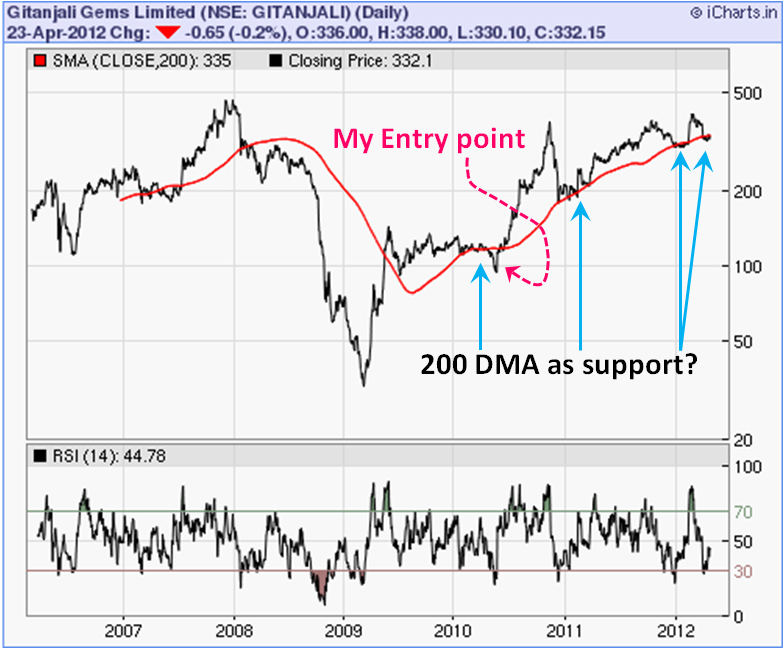
One such moment of truth that I am facing is what to do with my Gitanjali Gems holding. The chart below shows where the share price has come from historically. Looks like the 200 DMA line has been a good support in recent times and given that it is now poised on the 200 DMA makes me pensive.


What should I do?

  • Nothing
  • Buy more
  • Sell


 I asked this question to some people whose opinion I value. One of the response was:

If you think it is a long term play – book some partial profits and hold on to the rest. If you have made looks like 200% then if you sell 1/3 you have recovered your capital..

Sound advise perhaps – and there definitely is a good school of thought which believes in taking out the capital invested and letting the profits run. Only in my case if I were to do this, I’d add my hurdle rate (my long term expectated rate of return that I wish to earn) to 100% and take out that % of my capital – ensuring that not only do I get my capital back but also the time value of money component. But my big problem with this approach is that once I have done that I am really back to square one. The feeling of having secured my capital is illusionary since I intend to remain invested in the markets for a looooong time to come. Who knows, I could end up sqaundering this recovered captial on a dud investment which could erode it quickly, stop losses notwithstanding. The truth is that I’d have to find another ‘sparkling’ idea like this one – or at least one that fetches me my expected rate of annualized return. That’s tough in today’s times for someone like me who cannot devote much time to studying the market. Caught between the ‘rock’ and a hard place I guess. Ultimately I have decided to do nothing and see if its breaks the 200 DMA conclusively. If it does then I guess I would fold completely.

Design a site like this with WordPress.com
Get started