Emerging Markets: 2012-’18

Foreign Institutional Investors (FIIs) had mostly stayed away from Indian equities during 2011. While around 20,000 crores were brought into the debt markets some 3,000 crore worth of net equity positions were withdrawn from India. I guess it took the softening of  inflation and the subsequent cessation of the interest rate hikes that got this hot money back to India. Its FII money that mostly contributes to the volatility of Indian stocks. So, the more one studies whats happening across the globe – what the top fund houses, hedgies etc are saying, the better prepared you are to take a stance wrt to the Indian scene.

This calendar year, we have seen the return of this fickle capital to India and other emerging market stock exchanges. They are saying that FII flows into Indian stocks have already reached $4 bn in 2012! Mind you, we have seen 56 days in 2012 till now – a good 300+ days are yet to pass us by. Will this deluge of foreign capital continue to build up? Most certainly not. But before the tap runs dry and the vacuum switches on, I think it looks likely for the NIFTY to at least climb right all the way up to 5900? While that’s a good 8.7% points away from current levels of the NIFTY, I think it’s certainly achievable given the very bullish set-up and the decent correction/pause in the rise of the Index given the option expiry/rollovers for the Feb series. So with all that covering up and rolling over completed, I am hopeful of another 7% – 8% rise of the NIFTY. It will then be a good time to unwind the non-core positions.

There is however an interesting view put out by Jeffrey Frankel (Professor of Capital Formation & Growth at Harvard University) who points out to the cyclicality in the occurrences of troughs or crises in emerging markets asset class. He serves on the “Business Cycle Dating Committee” in the United States – whose job it is to declare the official start and end dates of recessions. So, he has a view on past emerging markets’ economic cycles and where the emerging markets are in the current cycle. Frankel draws attention to the earliest references to economic cycles perhaps came from the Old Testament, where the Pharoah orders Joseph (the chief architect) to build stockpiles of food grains as the Nile flowed in plenty for 7 years and then it relatively dried up for the next 7 years. So there were 14 year cycles then. While I am not sure if Egypt of biblical times could be called an emerging market, but closer to our times, Frankel notes that during 1975-81 (7 years) we had a phase which marked plentiful capital flows to emerging markets [recycling of petrodollars in the form of loans to developing countries]. Then the period from 1982 – 89 saw the international debt crisis which spread out from Mexico with these 7 years being referred to as the ‘lost decade’ in Latin America. 1989 saw the issue of the Brady Bonds [where the Latin American countries dunked their currencies and issued bonds denominated in US Dollars] which helped the Latin American nations move over from the capital drought. The period from 1990 -96 was obviously marked by crazy capital flows to emerging market countries. Then came the East Asia crisis of 1997 and another 7 years of capital drought. So that took us to 2003/04. Now, the period from 2003/04 to 2010/11 has seen the third cycle of net capital inflows into emerging markets – will the period from 2011 – 2018 be the next drought period? We can answer these questions only in hindsight. A lone swallow does not a summer make – i.e. the eagerness which the $4bn of today has shown in coming over to the Indian stock market can easily turn into a nervous stampede out of the country. Then this would be a mere blip in the 14 year cycle charts. If you look at the chart at the start of this post, the period of rapid rise of the MSCI Emerging Markets Index during the period 2003 – ’08 was really the time when capital flowed in so freely into emerging party spots. Now, the preceding 7 year period was from 1997 – ’03 during which time the index lost ~50% of its value. Scary? So if this logic holds good then is it appropriate to surmise that A) we are headed down and B) the top of 2008 will not be taken out till 2018 at least.

There are ends of beginnings of ends and then there are beginnings of ends of beginning. It’s difficult for simple people like me to say what is beginning and what is ending, but there is a neat little tidal wave of money coming in on the bourses where my hard-earned money rests and I am going to ride the wave for now. Amen.

2008/09 vs. 2010/11

The charting fun continues…

Here, I have highlighted the two massive cuts in recent times in the NIFTY chart since 1Jan’01. The US sub-prime/Lehman correction is in red while the current recessionary times are in dark aqua. Well, there is hardly much of a time span between the end of the red phase (6Mar’09) and the start of the second drop (5Nov’10) which obviously leads one to believe that the red and the aqua phases are part of the same pain that started once the sub-prime mess started. 20 months can hardly be called a recovery.

What I also did (ref chart below) was to phase shift the second bearish drop and superimpose it on the first drop to see how they compare. I know past patterns may or may not portend the future, but then all I said was that I wanted to have some charting fun! So, here is what is looks like. Please draw your own conclusions, for I know of none. Caveat Emptor, as always.

 But tell you what, reading all the stuff that is being talked about Europe, who knows what will happen. It’s like this:

HEADS: Merkel and Sarkozy do the impossible and let the European Commercial Bank’s (ECB’s) priniting presses run and run and run. I am happy since I do not have to update my chart. It happens just I thought it to.

TAILS: Politicians are for the polity, by the polity, of the polity. Crazy things happen and I have to redo the comparative chart all over again! 😦

This week the dice is expected to roll. Let’s see. While I don’t mind the extra effort involved in updating my wayward chart predictions, the way I sway depends very much on the way the dice rolls. I have a lot of hard earned money whose trail somewhere leads up to the presently idle printing presses of the ECB. But not all’s gloomy: there is one positive lesson to take from the above chart. Just look at the comparative chart and reflect on the 2008/’09 time period. You lived through it. Correct? Some of your positions would have been abandoned at a loss but if at all you initiated any fresh positions towards the end of the red phase, you’d have made up a good part of the drop, correct? The most important part is that you are alive (if you are reading this) and are still sane (if you are reading this!).

And here is the best and most audacious part. Chartbusting stuff really! How many years did the Pension Commissioner say I have till retirement? (By retirement I mean growing old and easing out of the active labour force). 20 more years? Ok. So I took the first chart, which shows the NIFTY’s march since 1Jan’01 and increased the scale by a 20 more years. Values of the index are blanks since who knows what tomorrow may bring…but do look at the resulting chart (shown on the right) and stare at it for a loooooong time. Do you see what I see? Ok, you know that I have played around with the axes of the chart but then that’s what I said at the start I would do right? i.e. having some charting fun.


NIFTY Monthly Closes

Here’s a hastily drawn chart which shows NIFTY monthly closing prices ever since Aug 2002. I have drawn the purple support (?) line rather arbitrarily, but via that it does look like the knife has some more height to fall. Lets not catch it and bloody our hands anymore than they already are!

The 200 DMA Pivot

During a bull market, breaks below the 200-DMA tend to represent good buying opportunities. During a bear market, breaks above the 200-DMA tend to represent good selling opportunities. The challenge, of course, is to be able to weigh all the evidence and arrive at a high-confidence conclusion as to whether the previous major trend is still in force because every break of the 200-DMA will be a false signal…until the last one.

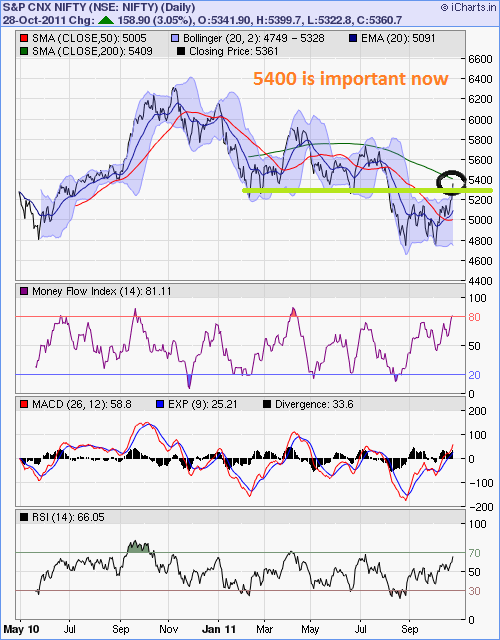
Market makers track the percentage of stocks above/below their respective 200DMA. If this number is greater than 85% or 90% then many traders look for a reversal in the market. On the other side, when this indicator plunges below 20%, people hope for an upswing. Ergo, most traders may end up avoiding stocks that are trading below their 200DMA. Whether the line is the cause of trend reversal or not is not my point – i haven’t read enough to make that point. All I am saying is that if enough people behave in step, it can cause a stampede. Who cares who cast the first stone in the pond and caused the ripple? As long as enough subsequent ripples/waves follow that first in synchronous phases, you can have the makings of a great wave. Then there is the “golden cross” which is the point at which the 50DMA and the 200DMA cross each other. A close (and sustenance) of the 50DMA above the 200DMA is supposed to indicate the commencement of a bull journey (and vice-versa). When used in conjunction with the 50DMA, the 200DMA line provides some trending views: if a stock that has price trading above its 50DMA and if the 50DMA is above its 200DMA then the stock movement is bullish and the trend should continue. A natural logical extension of the above rule is to consider the 200DMA as support and resistance levels. This is what appears to be the case with the NIFTY currently. Will the 5400 level get taken out? If the index closes and stays conclusively above 5400 then maybe this will become the new support line. The index could hover around that level, being range-bound and wait for the 50DMA to catch up and cross-over the 200DMA giving a clear signal of an intermediate up-move. Alternatively, with Trichet (President, European Central Bank) warning all that the Europe’s sovereign debt woes are far from over, it could well be possible that the 200DMA level does not get breached by the NIFTY and the index falls down. I have no hunch and in moments of apparent inflection points such as what i am thinking next week to be, it’s best for retail rats like us to sit the action out and see what happens.

Here’s a trading strategy:

Monitor your portfolio. On stocks that you pick (whatever be the method), get out of them if their price falls below their respective 200DMAs. Stay in cash and re-enter when the price goes above the 200DMA.

I have a feeling that, if this tactic be consistently applied over a long time period, it would yield superior returns to a “random walk” style of investing even after taking transaction costs and taxes into account. This scheme may not work in markets like Europe, US or Japan, but this would be very applicable to economies that are in the middle of their S-curve of economic growth (China, Thailand, India…)

Deepak Shenoy has given some direction here on how to live under the 200DMA line.

And finally, a very important trading lesson picked up from State of the Market:

One should never buy stocks on HOPE when they trade below 200 dma and one should never sell stock on fear when they trade above 200 dma because no HIGH is too High and no Low is too Low.

Markets: What Next?

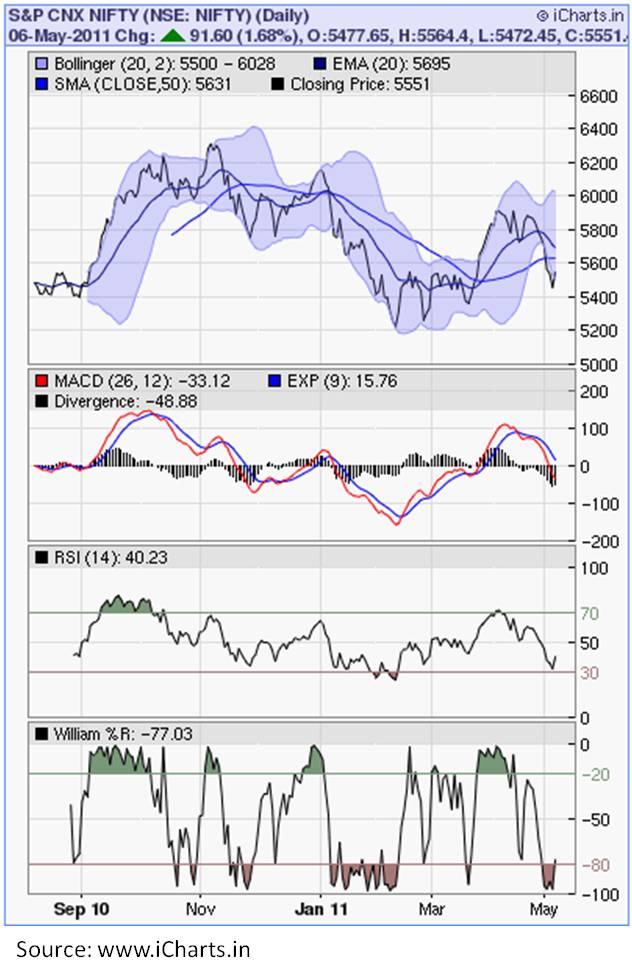
The market fell for 8 straight trading sessions before twitching up its tail a bit on Friday. Probably helped by the falling global oil prices and/or the short covering purchases and/or some other reason. Whatever be the case, the picture does not look pretty for the near time. In fact the markets have badly misbehaved since the start of the year. Most of the mutual funds are reporting negative ytds and so are many stock prices. NIFTY took out its 50 and the 200 moving averages in one swift fell swoop. As always, the reason on the surface is the rapid vacuuming of money by the FIIs even as the DIIs try to pick up the pieces a little. So what next? Will the NIFTY fall down further to perhaps 5375 thereabouts before finding support? Rahul commented here the following words:

I think commodity prices will start coming down now, also a lot of froth in these markets is due to risk premium of Middle East crisis and speculative positions. We have seen how silver has almost fallen 20% after the contract margins were raised in China and India. Therefore I think commodities like Crude, Copper and base metals are next in line with Silver which has fallen nearly 20% from the peak in a week. This should bring inflation down and should trigger a big rally in Indian and emerging markets. This should begin somewhere in the middle to end of May.
My broad view is if commodity prices comes down by the end of this month which I think will happen, Indian markets could break all time High’s by Diwali i.e. October end. :)

But then today’s www.economictimes.com mentions that Angel Broking’s MD does not expect the Sensex crossing 20,000 (~ 6,000 for the NIFTY) over the next 6 months. Fine. I don’t know about all time highs (~ 21,000), but my gut says that 20k for the Sensex is possible. Lets see.

Silver has certainly fallen given that the poster face of uncertainty was slain recently. Seemed like the fall of Osama was a cue for silver to retract heavily. For once my tweets found their intended mark 😉

Of course, the other big event has been yet other round of belt tightening by the RBI when it announced its latest monetary policy approach. Forget exchange rates they seem to say, inflation is obviously a much more sensitive number to control. Which is all fine, but spare a thought for the poor real estate developers. Nothing is going right for them – or at least their equity prices! I remain committed to my play on Godrej Properties via an investment in Godrej Industries Ltd. though. The other big bunch that logically should be affected would be the banks, but the short term charts of banks show a mixed picture. One good bank that has corrected nicely of late is Axis Bank and I’m keep an eye open if that’s a possible entry point. Bank stocks surely get over this rate hike headache much more quicker than other more rate sensitive stocks.

Infosys, though not leveraged, continues to bleed. What can the new guard do? Well, they’ve certainly thrown in a corporate action in the mix by shortening the company’s name. The trouble about over-owned stocks is that when they start getting out, they go out in droves. Some wildebeests, these FIIs are!!

The other idea that is forming is about Provogue. I know its another slice in the real estate commotion and it does have a good packet of debt, but maybe, just maybe there is something to the notion. I am digging and reading up and trying to follow this trail and hopefully Mr. Market will oblige by falling a bit more?

The fact of the matter though is that the juice, the “spring” in the step is gone – every purchase idea that germinates in the head is now getting knocked around with doubts. “What if the markets fall further”, “Is the worst over? Maybe not” – this uncertainty is so unnerving. When can we start trading volatility in India please?

NIFTY EPS vs P/E

Played around some more with the market data. The chart below plots the locus of the NIFTY (solid, curvy red line) across the various EPS’ that it has had on the first day of each quarter since 1Apr2008 superimposed between a band of P/Es ranging from 12 to 26. The NIFTY has flirted with both these P/E envelopes at least once since 1Apr2008. Cycloidal? We are around 260 now. If it is cycloidal then it must droop. Which means the markets must fall. Am I crazy or are the markets crazier? 🙂

NIFTY ex RIL ex INFY

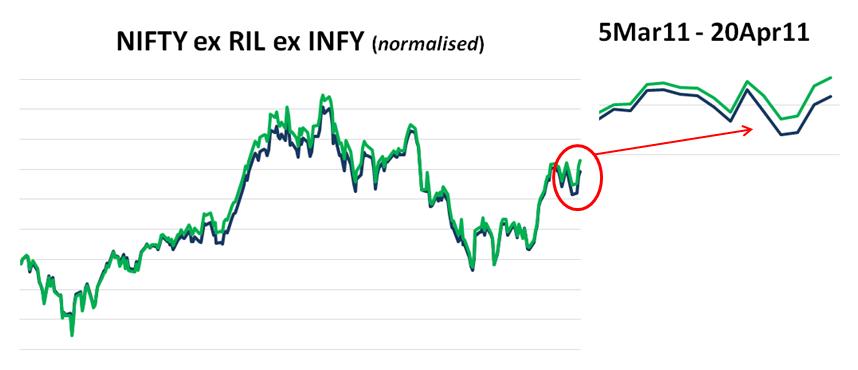
Did a crazy amount of number crunching on spreadsheets recently – trying to test the impact that INFY and RIL have on the NIFTY. I had earlier written about RIL being a sloth and I guess that was not enough to wake it up ;). And now that INFY has enthused no one with its results people might slowly start offloading this much over-owned stock. HCL Tech seems to be written about a lot these days and yes, TCS continues to deliver. Anyways, I tried to strip out the two bellwethers (really?) out of the NIFTY and see how things have panned out over the last one year period (20Apr2010 to 20Apr2011) . The results did not surprise me much – these two collectively have behaved quite much like the NIFTY with some dispersion coming out between the two data sets in recent times (bottom chart). The process itself has been quite a pain. The capital structure of companies mentioned on the NSE website is definitely incorrect. And I am not talking of some small cap, Ramprasad Chatak Mills kind of scrip, these are the largest listed companies by value in the Indian market! So having realised that error, I went to other places (BSE!!) to pick up the number of issued shares data and came up with the following charts after a lot of blah blah spread (under the) sheets. Corporate actions like splits and bonuses have also been accounted for. The green line is the NIFTY sans INFY and RIL while the blue line is the true blue blooded NIFTY as we track it. And yes, I don’t have time to write to the NSE and point out bugs/errors on their website.

The heartening thing is that the share (by m.cap) of the two loud-in-the-media companies has dropped from ~13.2% (on 20Apr2010) to ~12.1% (on 20Apr2011). Good!

When to Sell – Part One

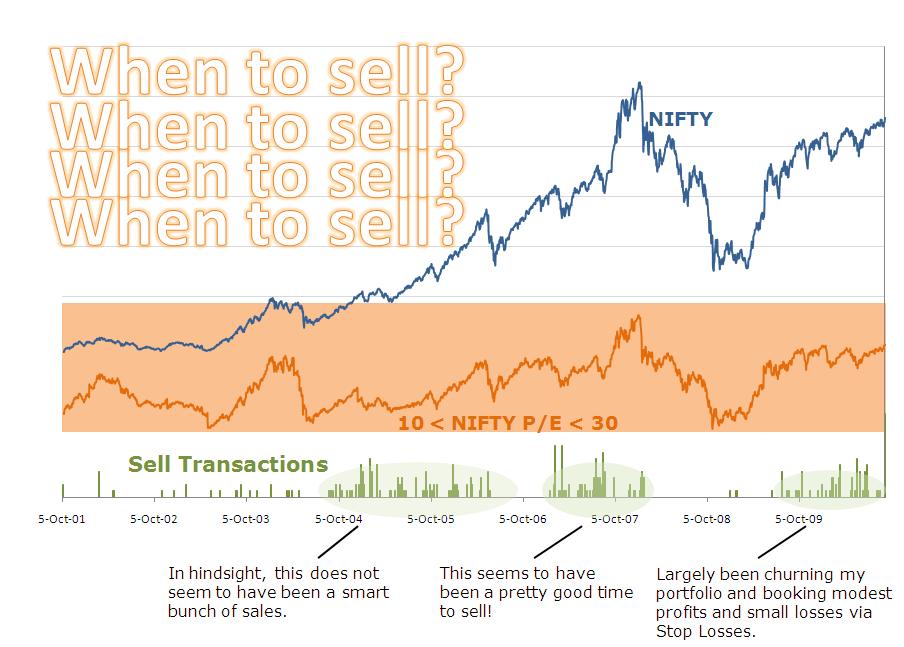
I’ve been spending some time digging around in my trade journal and trying to understand this. Getting a handle of this very important aspect of investing is one of my birthday resolutions. This study and therefore these series of posts are a set of steps in that direction. I’ve entered into 337 sell transactions till date. The first time I ever booked a profit on a secondary market trade was way back in 05Oct’01 and the latest one was as near as 06Sep’10. To understand more about the when of my selling behaviour I looked at these 337 in conjunction with the market and it’s valuation. I also tried to plot my sales in along time to see if there were clusters of sales happening during particular time periods. I will bother (and write) about the other questions of why, how and what regarding my selling behaviour at a later stage.

For now, I constructed this chart which shows my selling activity during the period spanning Oct’01 to Sep’10. The small green histograms at the bottom show the distribution of my sell trades. Three clusters seem to emerge: Aug’04 to May’05; Jan’07 to Apr’07 and Aug’09 till date. I have started my investing career with a handicap – which might seem like a paradox given the upward ascent of the NIFTY since 2001. What I mean is that my investing thought process has been spawned during a whopper of a bull run. Nearly anything anyone touched during 2001-03 turned to gold. Midases were everywhere, hemlines were getting higher by the minute. Then after that 2008 and the early part of 2009 was such a humbling moment. And a great learning experience. I lost money on a few trades and the flurry of sales that you see during more recent times are my unwinding of those doomed trades as they recouped some of their lost ground. The wicked blue line represents the market – NIFTY in this case. The oscillating orange band represents the value of the market – trailing 12 month NIFTY P/E ratios. If one uses this lens to view the art of getting off the train, then it’s good to be a net seller when the NIFTY’s P/E is above 25. It pays to be a net buyer if the NIFTY P/E is below the first quartile (under or at 15). Currently the NIFTY P/E is around 24 so we are entering hilly terrain – best to tighten up our seat belts. I use the terms “net seller” and “net buyer” since even at exalted heights of market valuation one can find a few lonely bulls rampaging around and likewise the depths of market penury still throw up some bears lying in wait to maul you.

The idea is that statistics and data tell a story about your trading pattern. It is useful to step out of the frame once in a while and see things from a wider time perspective. I guess successful traders need to necessarily have oodles of experience behind them. The best minds in the business have lived through at least a couple of downturns and figured out their behavioural patterns and emotional compass. Also, when you see the picture in cinemascope, a few down months don’t seem all that frightening.

The wise ‘old’ men of investing mysteriously say – buy when you see value and sell when your asset gets expensive. but how the heck does one go about ‘seeing value’? We seem to know/have heard about things like fundamental analysis, discounted cash flows, industry compares, etc. Most of us however, do not have the time to do detailed down-to-the bone analysis of company financials. Some of us don’t even know how to go about doing it. I don’t think that such people should not participate in the markets or run scared of balance sheets and mathematics. I guess what is required for this set (I may fall in this realm) is to develop and consistently use common sensical heuristics with modest return expectations. One such rule is getting in and out depending on the movement of NIFTY P/E as compared to the two control limits as depicted in the chart. You may have a better method – gazing at tea leaves perhaps – whatever it is, I think the key is to stick to it. Economies and therfore the stock markets have a slight inbuilt bias towards expansion and growth. Therefore, the dice is loaded – but only if you stick to the same dice.

I don’t drink tea, BTW.

The Glitter of Gold

Does Bappi Lahiri have a golden voice? Well! Thats subjective, but to me he is the golden stud, many times over. He had once walked past me in the Oberoi Mall (Mumbai) during the promos of the film, Chandni Chowk to China and even then the Au aura that emanated from him, piercing the reverential envelope of fans that surrounded him was striking. Bappi da (as he is known to Bollywood) has a penchant for gold. And boy, has be been spot on. I am sure he must be having kilos of the metal and what a climb his portfolio must’ve made during the past 10 years. I can’t wait for the film, Bappida Tusi Great Ho to get released. It’s said that the secret of his attraction for gold will finally get revealed through the film! I don’t care whether his golden sheen works on the silver screen but I think he has delivered a fitting reply to the numerous mocking references that people have made for his affinity for gold. And an awesome investing lesson for many of us. And I have a confession to make: I like listening to Bappi music in my car- esp. the variety from my younger days. But I wonder why did he say,

Yaar bina chain kahaan re. Yaar bina chain kahaan re. Sona nahi, chandi nahi, yaar to mila. Arre pyaar kar le.
[trans: Where’s peace of mind if you are loveless? x2. No gold, no silver, but at least I found love. Let’s love.]

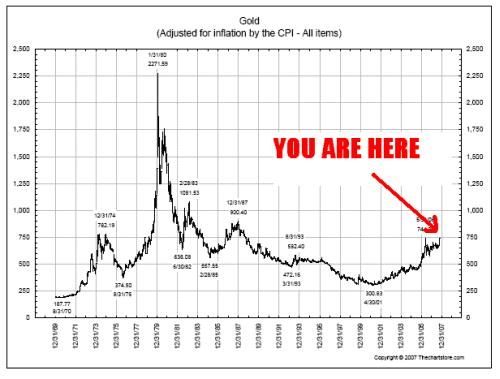
Bappi da has enjoyed a much steeper climb than someone who would’ve been long the NIFTY during the past 10 years. The graph alongside shows the relative performance of Gold vs. the NIFTY over the past 10 years or so. The price of 10 grams of Gold was around 4,000 rupees at the start of the millennium and it is close to 19,000 rupees now. In contrast, 4,000 ‘gold currenncy units’ invested in the representative sample of the Indian economy that is the NIFTY would have fetched you just 6,000 gcus today. I don’t mean XAU when I say gcu – the latter is just a hypothetical contruct to indicate what would happen if metal became our currency and not some signed bill of paper. At one point in time (7Jan’08) it looked as if equities would cross over and start performing better than Gold. That was not to be and the NIFTY turned south from that point in time with the relative performance gap widening from that point till today. I had purchased some Gold (coins) some 4 years back (partly by design since my equity holding had risen quite a bit) and thankfully I have not unwound that trade. Actually I have the tax laws to thank since long term capital gains set in for direct Gold investments only after a holding period of 3 years.

I also took out the index data for the Dow & the NIFTY and restated the two data sets in equivalent gold weight in local currency terms. While the chart above puts out quite a glum picture for the NIFTY if seen through a golden lens, the Dow droop is even more depressing. What the chart alonside tells us is that if one would have done a 10 year swap between the index and gold, he would receive 79% less of gold (by weight) in the US as compared to a drop of 29% in India. The inflection point for the NIFTY stated in gold occurred during the second half of 2003. Differential economic growths and currency movements took the lime green line far away only to come crashing down at the start of 2008.

Indians are known to be voracious consumers of gold. Global gold analyts make it a point to understand a bit about the Indian marriage season and track it expectedly. I did spend a fleeting moment of sympathy on parents of girls of marriageable age. These guys must be getting squeezed tight unless of course, they had the foresight of Bappi da. While the assorted gaggle of relatives and opinion makers that mill around the circuses that are Indian marriages might have knowingly shifted their discussions to the value of the gold lining our marriages (as opposed to the weight), I have a suspicion that Indian mothers-in-law still regard their daughters-in-law by the weight of the gold that the latter brings into the coop. Any suggestions, on how I can get our mothers-in-law-in-waiting to read my site?

Since it’s highly unlikely that you are a prospective mother-in-law, the question that may be on your mind would be: Wither gold? Well, I dont know! But I think that it will continue to climb for some more years to come. People have started looking at gold as an investment option now. The front covers of investment magazines have started displaying the golden glow quite frequently these days. I am sure you must have noticed an increase in the number of ads selling gold backed loans, etc. Since Indians have historically stuffed a lot of gold in bank lockers, under their mattresses, on their noses, etc, it’s a good opportunity for Indians to monetise it for income producing opportunities. I personally cannot relate to gold as an investment theme. While I have added some more gold (in ETF form now) after that past investment of mine, it is largely as a hedge. If you look at the first chart above, the metal (yellow line) has climbed almost on a linear basis. But the chart spans 10 years which is less than the time that I’ve been around investing in the markets. So my sense of patience is not adequate here. In any case, gold does not produce any income – there are no dividends to be had from gold. The utility and power of equity dividends itself is not understood by many, though I do feel that the attention to dividends would be more in the developed economies as compared to India since the yields are low. Perhaps an investigation into this might be a theme of a future post but here what I can say is that the moment the price of gold departs from it’s linear trend and starts to climb at a rate depending on the square of time, then it will be the best time to get out. Parabolas cannot sustain their weight. They need continuous energy to feed it and since equities cannot keep grovelling forever to droop below their book values, there will come a day when gold will sink down. I don’t have the data set, but there are quite a few charts on the internet that depict the 200 year movement of gold (see above). And that will be the day when our statistically challenged mothers-in-law will be happier welcoming more heavily laden daughters-in-law into their fold. Till such time, enjoy the ride.

Are we done yet?

We are now at a 31 month high for the NIFTY (@ 5590 therabouts)!

And my mood is getting to be optimistically cautious. It surfaces immediately in my latest tweet which in turn was inspired by the recent tweet from Clifford Alvares, an Outlook Money correspondent.

Clifford Alvares Tell-tale signs of the next downturn: Slow-down in daily FII figures; market PE of 24+; unjustified run in small-caps — and free lunches. 5:50 PM Sep 6th via web Retweeted by you

Most of the people tracking and working the markets will be cautiously optimistic now, but I’m a worm. And worms have no spine. It’s getting to be a cacophony of dire predictions and upbeat prophecies. The more one reads and listens and watches, the more confusing it gets. But if you dont read or listen or watch, you might as well invest using your keen sense of smell or touch, maybe. Thats puts a weird thought in the wormy head. I am thinking of taking a leaf out of Curtis Faith‘s “Way of the Turtle“, where two stock market professionals recruited a couple of dozen bright men and women with no prior experience of trading and transformed them into star traders in two weeks flat (or maybe more). The basic premise being that trading is a skill that can be learnt just like any other academic/vocational course and that traders are made not born. So, what I’m going to do is recruit a dozen sharp blind men and women. Then as study material I’m going to give them thousands of historical stock charts converted into 3d, beveling up the stock price movement lines and make them trace their fingers on the line. The charts would run only upto certain arbitrarily chosen past points in time but I would urge my blind charges to carry on the “momentum” of their fingers….the future path which  the fingers take will be compared against actual historical movements and feedback will be provided….. if this experiment of mine ever gets done, then my hypothesis that blind people can make the best technical investors can be tested. Maybe this personal blind worm method of forecasting will work for me. I’ll write a book, become hugely famous and after a hundred years, people will falsely believe that the phrase “momentum investing” was coined off the tips of blind star traders.

The reason for this lunatic ambling within moving average envelopes is that expert opinions are certainly not helping:

The New York Times carries a story telling us all that the cloud of a double dip recession seems to have passed us by while Nouriel Roubini chastises the US economy planners that we are now defenceless against the looming threat of a double dip. A year or so back, if you’d have mentioned double dip to me, I’d have visions of Taj Mahal tea bags and “dip dip dip, and it’s ready to sip. Do you want it stronger, then dip a little longer. Dip, dip, dip..and it’s ready to sip”. But that’s a triple dip – maybe a new challenge worthy for Roubini. But for now, everyone and her pet poodle is talking of double dips:

Double Dip: the pet food of your pet bears. “Dip, dip and it’s ready to slip. For teddy to be stronger, dip a little longer. Dip, dip…and it’s ready to slip”.

I felt that this interview of the equity analyst, Sangeeta Purushottam dispensed some sane advice. It seems to say that there could be money waiting on the sidelines and it could come pouring in taking our local markets to euphoric heights. But the premise operating here is that there is indeed money waiting on the sidelines. Is there? A browse through global investing sites does not indicate a clamour to invest in the much discovered Asian bourses. Indeed, for all that noise about the NIFTY reaching it’s 31 month high, this country performance table by The Bespoke Investment Group is quite educative and humbling. But then the presses in the USA are printing and printing and printing. Strange things can happen.

So I crawled the SEBI website to ferret out FII net flows into Indian equity over time.  I left out derivative data and picked data representing the FIIs’ stock exchange investments and primary market data only. I think the chart speaks for itself. The main question however remains unanswered: is there is more cash coming India’s way via the FII route for the remainder of the year (net inflows)? Since Jan’10, c 60,000 crores of rupees have come into Indian markets via the FII direct participation in equity. Logic dictates that we should definitely get in more for the remainder of the 115 calendar days left in 2010. However, I noticed that typically there are 3 months (modal frequency) that see net FII withdrawals from the equity markets. We have seen two down months this year (January and May) – is a third one coming? So money will definitely be made, euphoria or not, but it calls for nimble trading and investing. That to me is a big problem since I am a worm after all. Any advise will be greatly appreciated.

Design a site like this with WordPress.com
Get started